

498
P. Joshi et al.
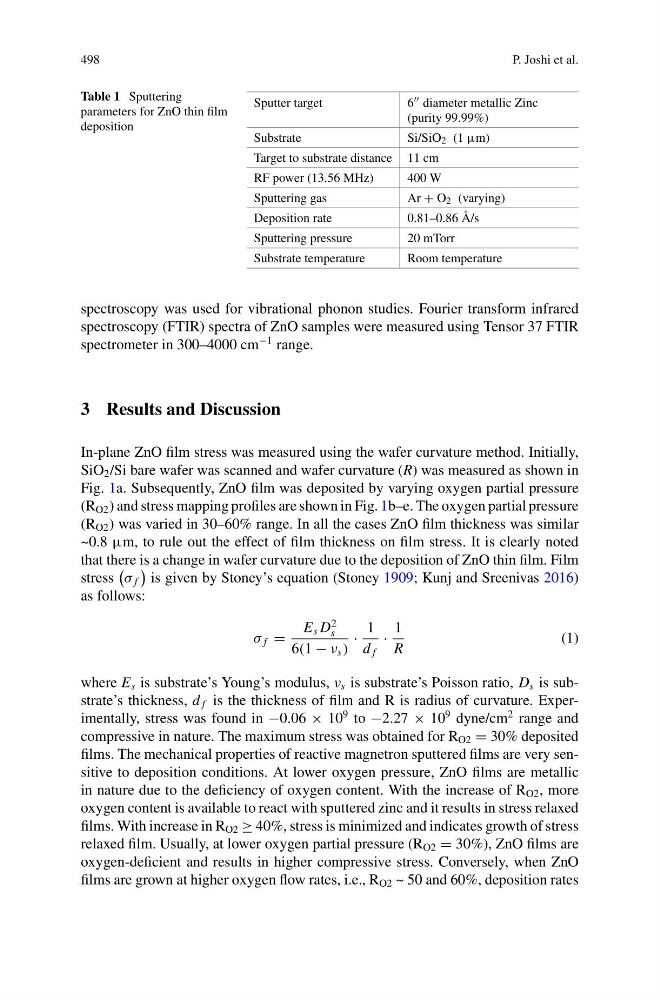
Table 1 Sputtering
parameters for ZnO thin film
deposition
Sputter target
6 diameter metallic Zinc
(purity 99.99%)
Substrate
Si/SiO 2 (1 μm)
Target to substrate distance 11 cm
RF power (13.56 MHz)
400 W
Sputtering gas
Ar + O 2 (varying)
Deposition rate
0.81–0.86 Å/s
Sputtering pressure
20 mTorr
Substrate temperature
Room temperature
spectroscopy was used for vibrational phonon studies. Fourier transform infrared
spectroscopy (FTIR) spectra of ZnO samples were measured using Tensor 37 FTIR
spectrometer in 300–4000 cm
−1 range.
3 Results and Discussion
In-plane ZnO film stress was measured using the wafer curvature method. Initially,
SiO 2 /Si bare wafer was scanned and wafer curvature (R) was measured as shown in
Fig. 1a. Subsequently, ZnO film was deposited by varying oxygen partial pressure
(R O2 ) and stress mapping profiles are shown in Fig. 1b–e. The oxygen partial pressure
(R O2 ) was varied in 30–60% range. In all the cases ZnO film thickness was similar
~0.8 μm, to rule out the effect of film thickness on film stress. It is clearly noted
that there is a change in wafer curvature due to the deposition of ZnO thin film. Film
stress
σ f
is given by Stoney’s equation (Stoney 1909; Kunj and Sreenivas 2016)
as follows:
σ f =
E s D
2
s
6(1 − ν s )
·
1
d f
·
1
R
(1)
where E s is substrate’s Young’s modulus, ν s is substrate’s Poisson ratio, D s is substrate’s thickness, d f is the thickness of film and R is radius of curvature. Experimentally, stress was found in −0.06 × 10
9 to −2.27 × 10
9 dyne/cm
2 range and
compressive in nature. The maximum stress was obtained for R O2 = 30% deposited
films. The mechanical properties of reactive magnetron sputtered films are very sensitive to deposition conditions. At lower oxygen pressure, ZnO films are metallic
in nature due to the deficiency of oxygen content. With the increase of R O2 , more
oxygen content is available to react with sputtered zinc and it results in stress relaxed
films. With increase in R O2 ≥ 40%, stress is minimized and indicates growth of stress
relaxed film. Usually, at lower oxygen partial pressure (R O2 = 30%), ZnO films are
oxygen-deficient and results in higher compressive stress. Conversely, when ZnO
films are grown at higher oxygen flow rates, i.e., R O2 ~ 50 and 60%, deposition rates
P. Joshi et al.
Table 1 Sputtering
parameters for ZnO thin film
deposition
Sputter target
6 diameter metallic Zinc
(purity 99.99%)
Substrate
Si/SiO 2 (1 μm)
Target to substrate distance 11 cm
RF power (13.56 MHz)
400 W
Sputtering gas
Ar + O 2 (varying)
Deposition rate
0.81–0.86 Å/s
Sputtering pressure
20 mTorr
Substrate temperature
Room temperature
spectroscopy was used for vibrational phonon studies. Fourier transform infrared
spectroscopy (FTIR) spectra of ZnO samples were measured using Tensor 37 FTIR
spectrometer in 300–4000 cm
−1 range.
3 Results and Discussion
In-plane ZnO film stress was measured using the wafer curvature method. Initially,
SiO 2 /Si bare wafer was scanned and wafer curvature (R) was measured as shown in
Fig. 1a. Subsequently, ZnO film was deposited by varying oxygen partial pressure
(R O2 ) and stress mapping profiles are shown in Fig. 1b–e. The oxygen partial pressure
(R O2 ) was varied in 30–60% range. In all the cases ZnO film thickness was similar
~0.8 μm, to rule out the effect of film thickness on film stress. It is clearly noted
that there is a change in wafer curvature due to the deposition of ZnO thin film. Film
stress
σ f
is given by Stoney’s equation (Stoney 1909; Kunj and Sreenivas 2016)
as follows:
σ f =
E s D
2
s
6(1 − ν s )
·
1
d f
·
1
R
(1)
where E s is substrate’s Young’s modulus, ν s is substrate’s Poisson ratio, D s is substrate’s thickness, d f is the thickness of film and R is radius of curvature. Experimentally, stress was found in −0.06 × 10
9 to −2.27 × 10
9 dyne/cm
2 range and
compressive in nature. The maximum stress was obtained for R O2 = 30% deposited
films. The mechanical properties of reactive magnetron sputtered films are very sensitive to deposition conditions. At lower oxygen pressure, ZnO films are metallic
in nature due to the deficiency of oxygen content. With the increase of R O2 , more
oxygen content is available to react with sputtered zinc and it results in stress relaxed
films. With increase in R O2 ≥ 40%, stress is minimized and indicates growth of stress
relaxed film. Usually, at lower oxygen partial pressure (R O2 = 30%), ZnO films are
oxygen-deficient and results in higher compressive stress. Conversely, when ZnO
films are grown at higher oxygen flow rates, i.e., R O2 ~ 50 and 60%, deposition rates