

478
S. Swami and R. Shrivastava
catalyst which is generally associated with conventional filtrations and centrifugation
methods (Swami et al. 2016).
During the past decade, the application of magnetic nanoparticles (MNPs) in
organic transformation like synthesis of amino nitriles (Kassaee et al. 2011), dibenzo
xanthene derivative (Amoozadeh et al. 2018), friedlander quinoline reaction (Rezayati 2016), oxidations of sulfides and oxidative coupling of thiols (Mahyari and
Shaabani 2014), suzuki coupling reactions (Taher 2009), regioselective azidolysis of
epoxides (Sajjadifar 2014), knovengel reaction (Zhang and Xia 2009), hydrogenation of alkynes (Abu-Reziq 2007), bignelli synthesis (Safari and Zarnegar 2014),
epoxidation of alkenes (Kooti and Afshari 2012), etc., rapidly evolved to further
simplify the recovery and reusability of the catalyst with advantages of high product
yield, lesser reaction time, and mild reaction conditions. MNps were classified in
various classes according to nature of the magnetic core utilized for the same purpose. Among oxides, iron oxides (Fe 2 O 3 and Fe 3 O 4 ) has found wide application in
organic transformations. The use of metal ferrites (MFe 2 O 4 , M = Cu, Co, Zn, Mn)
generated by partial substitution of iron by a second metal inside the crystal lattice of
Fe 3 O 4 , allow the extension of their catalytic scope, while the iron component continues to enable magnetic recovery (Hudson 2013). For example CoFe 2 O 4 a magnetic
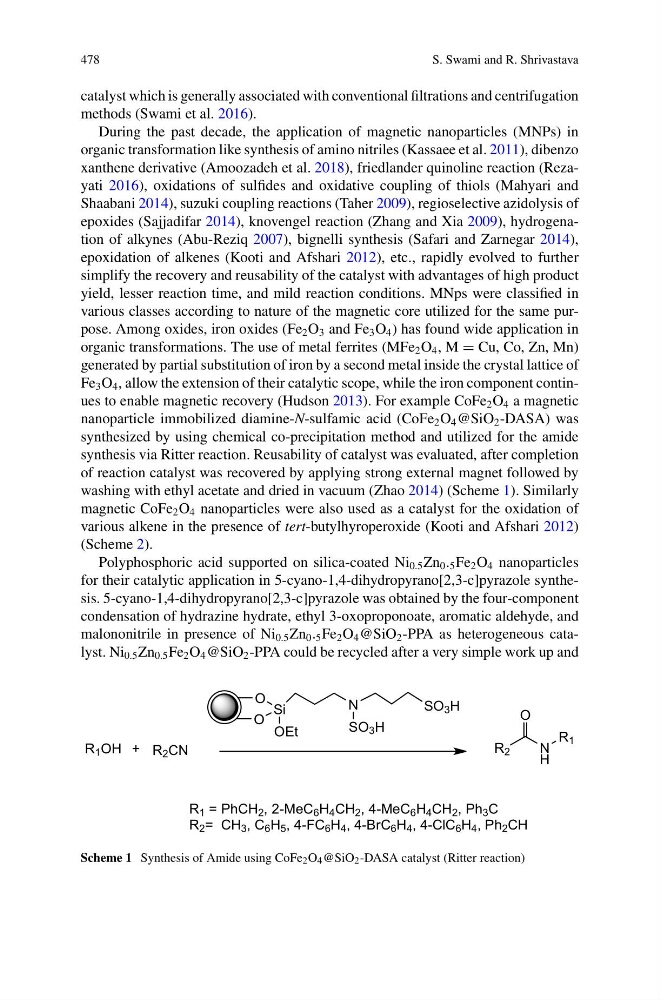
nanoparticle immobilized diamine-N-sulfamic acid (CoFe 2 O 4 @SiO 2 -DASA) was
synthesized by using chemical co-precipitation method and utilized for the amide
synthesis via Ritter reaction. Reusability of catalyst was evaluated, after completion
of reaction catalyst was recovered by applying strong external magnet followed by
washing with ethyl acetate and dried in vacuum (Zhao 2014) (Scheme 1). Similarly
magnetic CoFe 2 O 4 nanoparticles were also used as a catalyst for the oxidation of
various alkene in the presence of tert-butylhyroperoxide (Kooti and Afshari 2012)
(Scheme 2).
Polyphosphoric acid supported on silica-coated Ni 0.5 Zn 0 . 5 Fe 2 O 4 nanoparticles
for their catalytic application in 5-cyano-1,4-dihydropyrano[2,3-c]pyrazole synthesis. 5-cyano-1,4-dihydropyrano[2,3-c]pyrazole was obtained by the four-component
condensation of hydrazine hydrate, ethyl 3-oxoproponoate, aromatic aldehyde, and
malononitrile in presence of Ni 0.5 Zn 0 . 5 Fe 2 O 4 @SiO 2 -PPA as heterogeneous catalyst. Ni 0.5 Zn 0.5 Fe 2 O 4 @SiO 2 -PPA could be recycled after a very simple work up and
R 1 OH + R 2 CN
O
O
Si
OEt
N
SO 3 H
SO 3 H
O
R 2
N
H
R 1
R 1 = PhCH 2 , 2-MeC 6 H 4 CH 2 , 4-MeC 6 H 4 CH 2 , Ph 3 C
R 2 = CH 3 , C 6 H 5 , 4-FC 6 H 4 , 4-BrC 6 H 4 , 4-ClC 6 H 4 , Ph 2 CH
Scheme 1 Synthesis of Amide using CoFe 2 O 4 @SiO 2 -DASA catalyst (Ritter reaction)
S. Swami and R. Shrivastava
catalyst which is generally associated with conventional filtrations and centrifugation
methods (Swami et al. 2016).
During the past decade, the application of magnetic nanoparticles (MNPs) in
organic transformation like synthesis of amino nitriles (Kassaee et al. 2011), dibenzo
xanthene derivative (Amoozadeh et al. 2018), friedlander quinoline reaction (Rezayati 2016), oxidations of sulfides and oxidative coupling of thiols (Mahyari and
Shaabani 2014), suzuki coupling reactions (Taher 2009), regioselective azidolysis of
epoxides (Sajjadifar 2014), knovengel reaction (Zhang and Xia 2009), hydrogenation of alkynes (Abu-Reziq 2007), bignelli synthesis (Safari and Zarnegar 2014),
epoxidation of alkenes (Kooti and Afshari 2012), etc., rapidly evolved to further
simplify the recovery and reusability of the catalyst with advantages of high product
yield, lesser reaction time, and mild reaction conditions. MNps were classified in
various classes according to nature of the magnetic core utilized for the same purpose. Among oxides, iron oxides (Fe 2 O 3 and Fe 3 O 4 ) has found wide application in
organic transformations. The use of metal ferrites (MFe 2 O 4 , M = Cu, Co, Zn, Mn)
generated by partial substitution of iron by a second metal inside the crystal lattice of
Fe 3 O 4 , allow the extension of their catalytic scope, while the iron component continues to enable magnetic recovery (Hudson 2013). For example CoFe 2 O 4 a magnetic
nanoparticle immobilized diamine-N-sulfamic acid (CoFe 2 O 4 @SiO 2 -DASA) was
synthesized by using chemical co-precipitation method and utilized for the amide
synthesis via Ritter reaction. Reusability of catalyst was evaluated, after completion
of reaction catalyst was recovered by applying strong external magnet followed by
washing with ethyl acetate and dried in vacuum (Zhao 2014) (Scheme 1). Similarly
magnetic CoFe 2 O 4 nanoparticles were also used as a catalyst for the oxidation of
various alkene in the presence of tert-butylhyroperoxide (Kooti and Afshari 2012)
(Scheme 2).
Polyphosphoric acid supported on silica-coated Ni 0.5 Zn 0 . 5 Fe 2 O 4 nanoparticles
for their catalytic application in 5-cyano-1,4-dihydropyrano[2,3-c]pyrazole synthesis. 5-cyano-1,4-dihydropyrano[2,3-c]pyrazole was obtained by the four-component
condensation of hydrazine hydrate, ethyl 3-oxoproponoate, aromatic aldehyde, and
malononitrile in presence of Ni 0.5 Zn 0 . 5 Fe 2 O 4 @SiO 2 -PPA as heterogeneous catalyst. Ni 0.5 Zn 0.5 Fe 2 O 4 @SiO 2 -PPA could be recycled after a very simple work up and
R 1 OH + R 2 CN
O
O
Si
OEt
N
SO 3 H
SO 3 H
O
R 2
N
H
R 1
R 1 = PhCH 2 , 2-MeC 6 H 4 CH 2 , 4-MeC 6 H 4 CH 2 , Ph 3 C
R 2 = CH 3 , C 6 H 5 , 4-FC 6 H 4 , 4-BrC 6 H 4 , 4-ClC 6 H 4 , Ph 2 CH
Scheme 1 Synthesis of Amide using CoFe 2 O 4 @SiO 2 -DASA catalyst (Ritter reaction)