

456
S. Das et al.
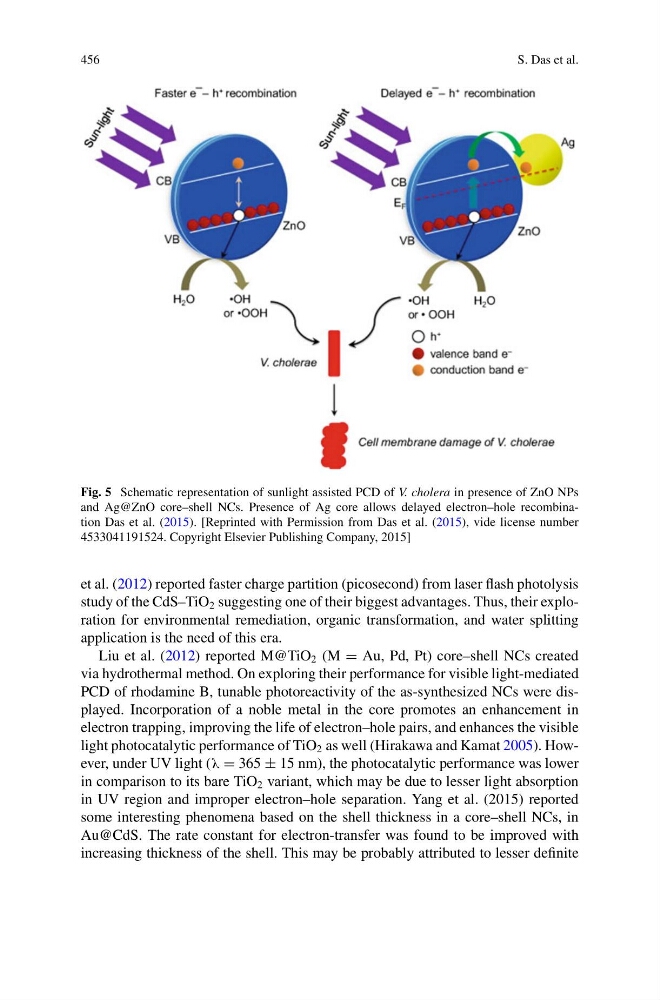
Fig. 5 Schematic representation of sunlight assisted PCD of V. cholera in presence of ZnO NPs
and Ag@ZnO core–shell NCs. Presence of Ag core allows delayed electron–hole recombination Das et al. (2015). [Reprinted with Permission from Das et al. (2015), vide license number
4533041191524. Copyright Elsevier Publishing Company, 2015]
et al. (2012) reported faster charge partition (picosecond) from laser flash photolysis
study of the CdS–TiO 2 suggesting one of their biggest advantages. Thus, their exploration for environmental remediation, organic transformation, and water splitting
application is the need of this era.
Liu et al. (2012) reported M@TiO 2 (M = Au, Pd, Pt) core–shell NCs created
via hydrothermal method. On exploring their performance for visible light-mediated
PCD of rhodamine B, tunable photoreactivity of the as-synthesized NCs were displayed. Incorporation of a noble metal in the core promotes an enhancement in
electron trapping, improving the life of electron–hole pairs, and enhances the visible
light photocatalytic performance of TiO 2 as well (Hirakawa and Kamat 2005). However, under UV light (λ = 365 ± 15 nm), the photocatalytic performance was lower
in comparison to its bare TiO 2 variant, which may be due to lesser light absorption
in UV region and improper electron–hole separation. Yang et al. (2015) reported
some interesting phenomena based on the shell thickness in a core–shell NCs, in
Au@CdS. The rate constant for electron-transfer was found to be improved with
increasing thickness of the shell. This may be probably attributed to lesser definite
S. Das et al.
Fig. 5 Schematic representation of sunlight assisted PCD of V. cholera in presence of ZnO NPs
and Ag@ZnO core–shell NCs. Presence of Ag core allows delayed electron–hole recombination Das et al. (2015). [Reprinted with Permission from Das et al. (2015), vide license number
4533041191524. Copyright Elsevier Publishing Company, 2015]
et al. (2012) reported faster charge partition (picosecond) from laser flash photolysis
study of the CdS–TiO 2 suggesting one of their biggest advantages. Thus, their exploration for environmental remediation, organic transformation, and water splitting
application is the need of this era.
Liu et al. (2012) reported M@TiO 2 (M = Au, Pd, Pt) core–shell NCs created
via hydrothermal method. On exploring their performance for visible light-mediated
PCD of rhodamine B, tunable photoreactivity of the as-synthesized NCs were displayed. Incorporation of a noble metal in the core promotes an enhancement in
electron trapping, improving the life of electron–hole pairs, and enhances the visible
light photocatalytic performance of TiO 2 as well (Hirakawa and Kamat 2005). However, under UV light (λ = 365 ± 15 nm), the photocatalytic performance was lower
in comparison to its bare TiO 2 variant, which may be due to lesser light absorption
in UV region and improper electron–hole separation. Yang et al. (2015) reported
some interesting phenomena based on the shell thickness in a core–shell NCs, in
Au@CdS. The rate constant for electron-transfer was found to be improved with
increasing thickness of the shell. This may be probably attributed to lesser definite