

454
S. Das et al.
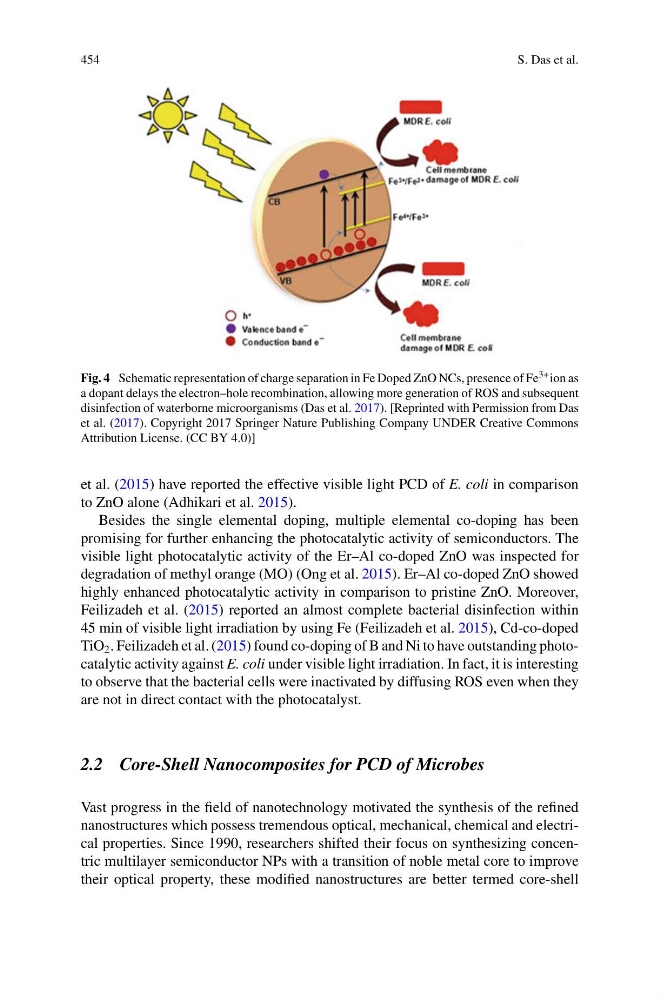
Fig. 4 Schematic representation of charge separation in Fe Doped ZnO NCs, presence of Fe 3+ ion as
a dopant delays the electron–hole recombination, allowing more generation of ROS and subsequent
disinfection of waterborne microorganisms (Das et al. 2017). [Reprinted with Permission from Das
et al. (2017). Copyright 2017 Springer Nature Publishing Company UNDER Creative Commons
Attribution License. (CC BY 4.0)]
et al. (2015) have reported the effective visible light PCD of E. coli in comparison
to ZnO alone (Adhikari et al. 2015).
Besides the single elemental doping, multiple elemental co-doping has been
promising for further enhancing the photocatalytic activity of semiconductors. The
visible light photocatalytic activity of the Er–Al co-doped ZnO was inspected for
degradation of methyl orange (MO) (Ong et al. 2015). Er–Al co-doped ZnO showed
highly enhanced photocatalytic activity in comparison to pristine ZnO. Moreover,
Feilizadeh et al. (2015) reported an almost complete bacterial disinfection within
45 min of visible light irradiation by using Fe (Feilizadeh et al. 2015), Cd-co-doped
TiO 2 . Feilizadeh et al. (2015) found co-doping of B and Ni to have outstanding photocatalytic activity against E. coli under visible light irradiation. In fact, it is interesting
to observe that the bacterial cells were inactivated by diffusing ROS even when they
are not in direct contact with the photocatalyst.
2.2 Core-Shell Nanocomposites for PCD of Microbes
Vast progress in the field of nanotechnology motivated the synthesis of the refined
nanostructures which possess tremendous optical, mechanical, chemical and electrical properties. Since 1990, researchers shifted their focus on synthesizing concentric multilayer semiconductor NPs with a transition of noble metal core to improve
their optical property, these modified nanostructures are better termed core-shell
S. Das et al.
Fig. 4 Schematic representation of charge separation in Fe Doped ZnO NCs, presence of Fe 3+ ion as
a dopant delays the electron–hole recombination, allowing more generation of ROS and subsequent
disinfection of waterborne microorganisms (Das et al. 2017). [Reprinted with Permission from Das
et al. (2017). Copyright 2017 Springer Nature Publishing Company UNDER Creative Commons
Attribution License. (CC BY 4.0)]
et al. (2015) have reported the effective visible light PCD of E. coli in comparison
to ZnO alone (Adhikari et al. 2015).
Besides the single elemental doping, multiple elemental co-doping has been
promising for further enhancing the photocatalytic activity of semiconductors. The
visible light photocatalytic activity of the Er–Al co-doped ZnO was inspected for
degradation of methyl orange (MO) (Ong et al. 2015). Er–Al co-doped ZnO showed
highly enhanced photocatalytic activity in comparison to pristine ZnO. Moreover,
Feilizadeh et al. (2015) reported an almost complete bacterial disinfection within
45 min of visible light irradiation by using Fe (Feilizadeh et al. 2015), Cd-co-doped
TiO 2 . Feilizadeh et al. (2015) found co-doping of B and Ni to have outstanding photocatalytic activity against E. coli under visible light irradiation. In fact, it is interesting
to observe that the bacterial cells were inactivated by diffusing ROS even when they
are not in direct contact with the photocatalyst.
2.2 Core-Shell Nanocomposites for PCD of Microbes
Vast progress in the field of nanotechnology motivated the synthesis of the refined
nanostructures which possess tremendous optical, mechanical, chemical and electrical properties. Since 1990, researchers shifted their focus on synthesizing concentric multilayer semiconductor NPs with a transition of noble metal core to improve
their optical property, these modified nanostructures are better termed core-shell