

Application of Nanotechnology in Diagnosis and Therapeutics
415
The synthesis approach for polymeric NPs differs from that of inorganic NPs.
Several methods are implied for the polymeric nanoparticle synthesis, such as, emulsification, solvent evaporation (Pankhurst et al. 2003; Yoneki et al. 2015), nanoprecipitation (Crucho and Barros 2015; Tang et al. 2015; Yaméogo 2014), supercritical
antisolvent (Kalani and Yunus 2012; Zhao et al. 2014) and salt precipitation method
(Song et al. 2008). Among these methods, emulsification and solvent evaporation
method are the first to synthesize polymeric particles. These NPs are administered
via three main routes: oral uptake, direct injection, and inhalation. Upon entering into
the systemic circulation, the NPs interact with the proteins before getting distributed
to various organs. The lymphatic system works to eliminate foreign particles in the
systemic circulation. After filtration process, the fluid containing NPs can be recognized as a foreign material and further engulfed by the macrophage system, thereby
clearing from the physiological system. This major drawback in the distribution of
NPs could be influenced by controlling size and surface properties of the particles.
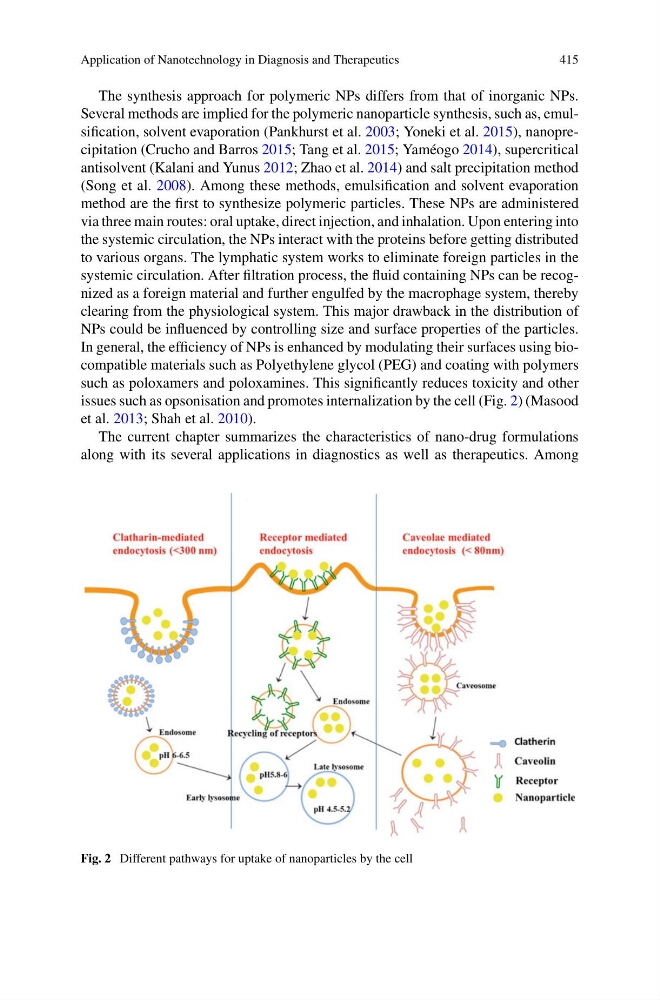
In general, the efficiency of NPs is enhanced by modulating their surfaces using biocompatible materials such as Polyethylene glycol (PEG) and coating with polymers
such as poloxamers and poloxamines. This significantly reduces toxicity and other
issues such as opsonisation and promotes internalization by the cell (Fig. 2) (Masood
et al. 2013; Shah et al. 2010).
The current chapter summarizes the characteristics of nano-drug formulations
along with its several applications in diagnostics as well as therapeutics. Among
Fig. 2 Different pathways for uptake of nanoparticles by the cell
415
The synthesis approach for polymeric NPs differs from that of inorganic NPs.
Several methods are implied for the polymeric nanoparticle synthesis, such as, emulsification, solvent evaporation (Pankhurst et al. 2003; Yoneki et al. 2015), nanoprecipitation (Crucho and Barros 2015; Tang et al. 2015; Yaméogo 2014), supercritical
antisolvent (Kalani and Yunus 2012; Zhao et al. 2014) and salt precipitation method
(Song et al. 2008). Among these methods, emulsification and solvent evaporation
method are the first to synthesize polymeric particles. These NPs are administered
via three main routes: oral uptake, direct injection, and inhalation. Upon entering into
the systemic circulation, the NPs interact with the proteins before getting distributed
to various organs. The lymphatic system works to eliminate foreign particles in the
systemic circulation. After filtration process, the fluid containing NPs can be recognized as a foreign material and further engulfed by the macrophage system, thereby
clearing from the physiological system. This major drawback in the distribution of
NPs could be influenced by controlling size and surface properties of the particles.
In general, the efficiency of NPs is enhanced by modulating their surfaces using biocompatible materials such as Polyethylene glycol (PEG) and coating with polymers
such as poloxamers and poloxamines. This significantly reduces toxicity and other
issues such as opsonisation and promotes internalization by the cell (Fig. 2) (Masood
et al. 2013; Shah et al. 2010).
The current chapter summarizes the characteristics of nano-drug formulations
along with its several applications in diagnostics as well as therapeutics. Among
Fig. 2 Different pathways for uptake of nanoparticles by the cell