

Versatile 1-D Nanostructures for Green Energy Conversion …
345
capacity 31.44 mAh g
−1 with a current density of 30 mAh g
−1 (Zhang et al. 2015).
In case of LiMn 2 O 4 and Al-doped LiMn 2 O 4 nanorods, synthesized by a two-step
method that combines hydrothermal synthesis of β-MnO 2 nanorods and a solid state
reaction to convert them to LiMn 2 O 4 nanorods retains 96% of capacity after 100
cycles (Yang et al. 2009).
As for supercapacitor application, Fe 2 O 3 nanorod hydrothermally synthesized in
an aqueous solution containing sodium nitrate, ferric chloride, and hydrogen chloride
and heated at high temp in N 2 and air, separately resulted in oxygen-deficient Fe 2 O 3
nanorods and pristine Fe 2 O 3 nanorods. Specific capacitance of oxygen-deficient
Fe 2 O 3 (64.5 F g
−1 ) was found to be more than pristine Fe 2 O 3 nanorods (Lu et al.
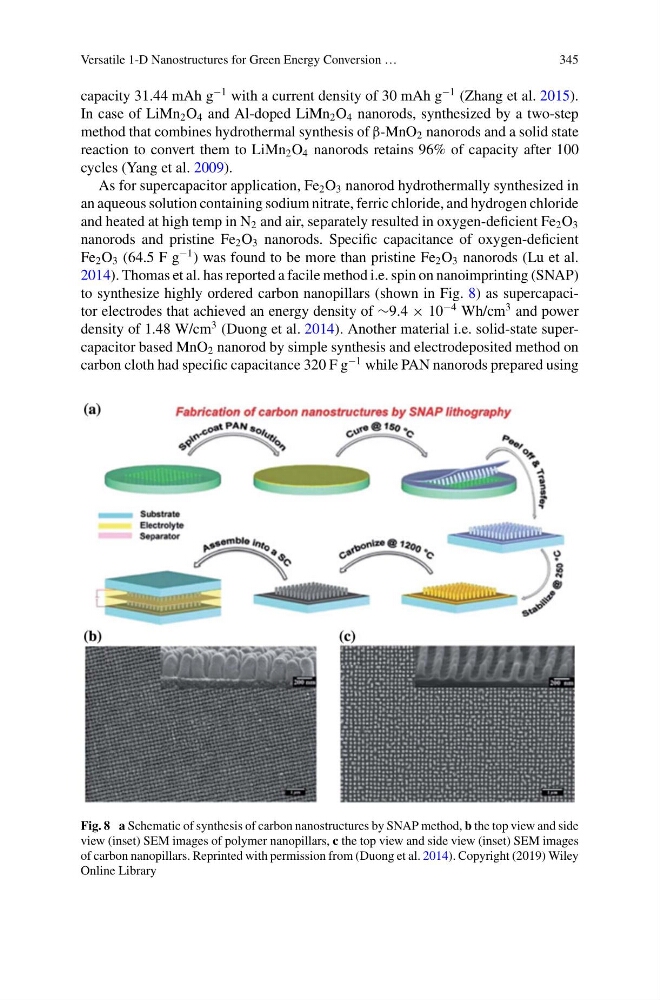
2014). Thomas et al. has reported a facile method i.e. spin on nanoimprinting (SNAP)
to synthesize highly ordered carbon nanopillars (shown in Fig. 8) as supercapacitor electrodes that achieved an energy density of ∼9.4 × 10
−4 Wh/cm
3 and power
density of 1.48 W/cm
3 (Duong et al. 2014). Another material i.e. solid-state supercapacitor based MnO 2 nanorod by simple synthesis and electrodeposited method on
carbon cloth had specific capacitance 320 F g
−1 while PAN nanorods prepared using
Fig. 8 a Schematic of synthesis of carbon nanostructures by SNAP method, b the top view and side
view (inset) SEM images of polymer nanopillars, c the top view and side view (inset) SEM images
of carbon nanopillars. Reprinted with permission from (Duong et al. 2014). Copyright (2019) Wiley
Online Library
345
capacity 31.44 mAh g
−1 with a current density of 30 mAh g
−1 (Zhang et al. 2015).
In case of LiMn 2 O 4 and Al-doped LiMn 2 O 4 nanorods, synthesized by a two-step
method that combines hydrothermal synthesis of β-MnO 2 nanorods and a solid state
reaction to convert them to LiMn 2 O 4 nanorods retains 96% of capacity after 100
cycles (Yang et al. 2009).
As for supercapacitor application, Fe 2 O 3 nanorod hydrothermally synthesized in
an aqueous solution containing sodium nitrate, ferric chloride, and hydrogen chloride
and heated at high temp in N 2 and air, separately resulted in oxygen-deficient Fe 2 O 3
nanorods and pristine Fe 2 O 3 nanorods. Specific capacitance of oxygen-deficient
Fe 2 O 3 (64.5 F g
−1 ) was found to be more than pristine Fe 2 O 3 nanorods (Lu et al.
2014). Thomas et al. has reported a facile method i.e. spin on nanoimprinting (SNAP)
to synthesize highly ordered carbon nanopillars (shown in Fig. 8) as supercapacitor electrodes that achieved an energy density of ∼9.4 × 10
−4 Wh/cm
3 and power
density of 1.48 W/cm
3 (Duong et al. 2014). Another material i.e. solid-state supercapacitor based MnO 2 nanorod by simple synthesis and electrodeposited method on
carbon cloth had specific capacitance 320 F g
−1 while PAN nanorods prepared using
Fig. 8 a Schematic of synthesis of carbon nanostructures by SNAP method, b the top view and side
view (inset) SEM images of polymer nanopillars, c the top view and side view (inset) SEM images
of carbon nanopillars. Reprinted with permission from (Duong et al. 2014). Copyright (2019) Wiley
Online Library