

Versatile 1-D Nanostructures for Green Energy Conversion …
341
transport pathways validate the advantage of high-rate performance. Moreover, their
larger surface area makes redox active material easily accessible to electrolyte, and
their smaller size boosts the capacity of obliging the volume changes, accompanying
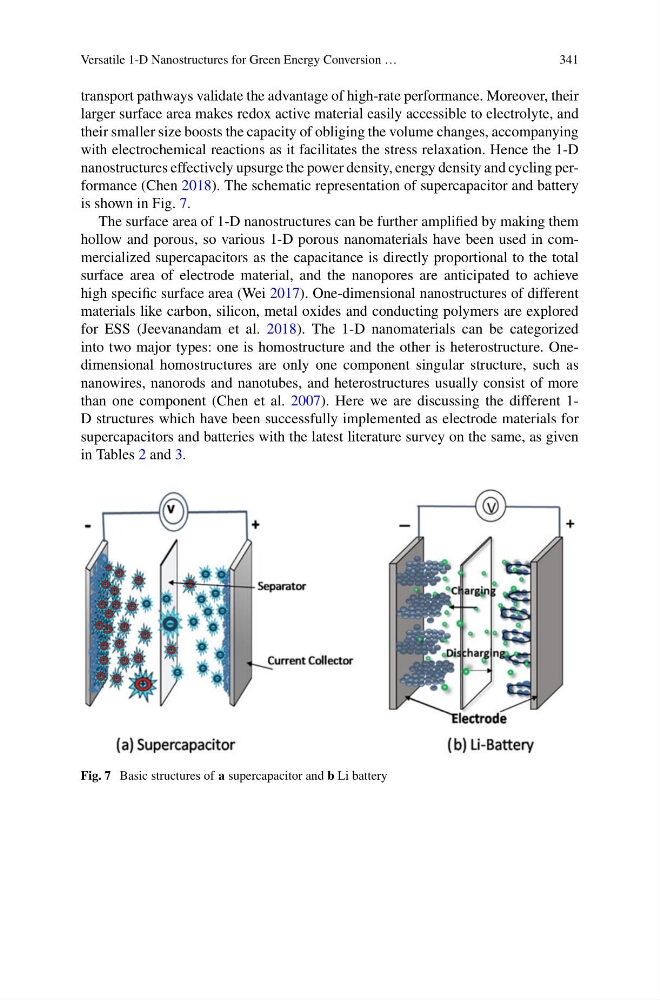
with electrochemical reactions as it facilitates the stress relaxation. Hence the 1-D
nanostructures effectively upsurge the power density, energy density and cycling performance (Chen 2018). The schematic representation of supercapacitor and battery
is shown in Fig. 7.
The surface area of 1-D nanostructures can be further amplified by making them
hollow and porous, so various 1-D porous nanomaterials have been used in commercialized supercapacitors as the capacitance is directly proportional to the total
surface area of electrode material, and the nanopores are anticipated to achieve
high specific surface area (Wei 2017). One-dimensional nanostructures of different
materials like carbon, silicon, metal oxides and conducting polymers are explored
for ESS (Jeevanandam et al. 2018). The 1-D nanomaterials can be categorized
into two major types: one is homostructure and the other is heterostructure. Onedimensional homostructures are only one component singular structure, such as
nanowires, nanorods and nanotubes, and heterostructures usually consist of more
than one component (Chen et al. 2007). Here we are discussing the different 1D structures which have been successfully implemented as electrode materials for
supercapacitors and batteries with the latest literature survey on the same, as given
in Tables 2 and 3.
Fig. 7 Basic structures of a supercapacitor and b Li battery
341
transport pathways validate the advantage of high-rate performance. Moreover, their
larger surface area makes redox active material easily accessible to electrolyte, and
their smaller size boosts the capacity of obliging the volume changes, accompanying
with electrochemical reactions as it facilitates the stress relaxation. Hence the 1-D
nanostructures effectively upsurge the power density, energy density and cycling performance (Chen 2018). The schematic representation of supercapacitor and battery
is shown in Fig. 7.
The surface area of 1-D nanostructures can be further amplified by making them
hollow and porous, so various 1-D porous nanomaterials have been used in commercialized supercapacitors as the capacitance is directly proportional to the total
surface area of electrode material, and the nanopores are anticipated to achieve
high specific surface area (Wei 2017). One-dimensional nanostructures of different
materials like carbon, silicon, metal oxides and conducting polymers are explored
for ESS (Jeevanandam et al. 2018). The 1-D nanomaterials can be categorized
into two major types: one is homostructure and the other is heterostructure. Onedimensional homostructures are only one component singular structure, such as
nanowires, nanorods and nanotubes, and heterostructures usually consist of more
than one component (Chen et al. 2007). Here we are discussing the different 1D structures which have been successfully implemented as electrode materials for
supercapacitors and batteries with the latest literature survey on the same, as given
in Tables 2 and 3.
Fig. 7 Basic structures of a supercapacitor and b Li battery