

Versatile 1-D Nanostructures for Green Energy Conversion …
339
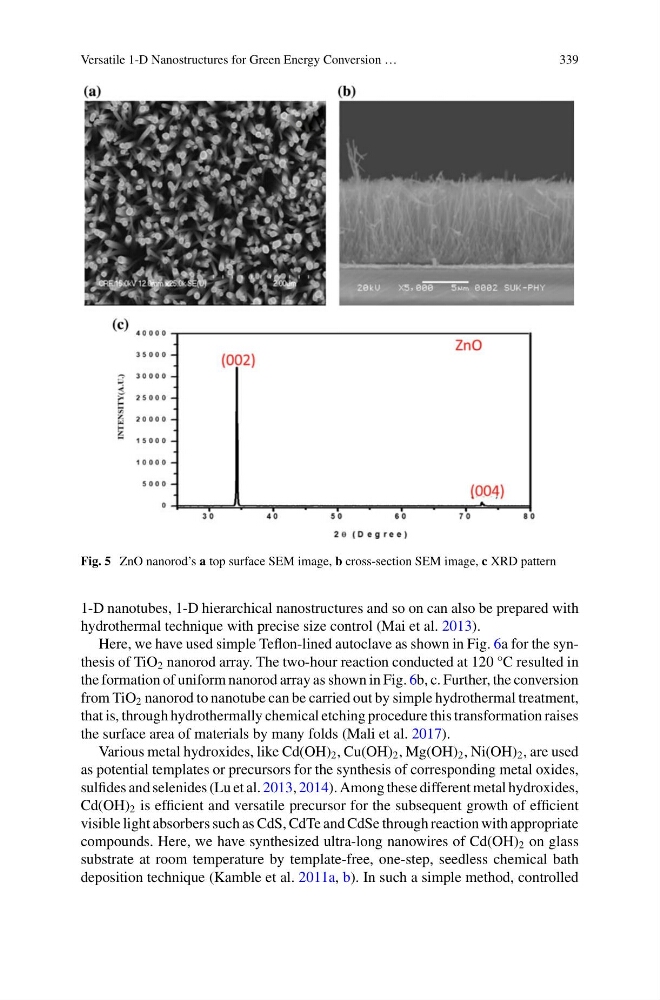
Fig. 5 ZnO nanorod’s a top surface SEM image, b cross-section SEM image, c XRD pattern
1-D nanotubes, 1-D hierarchical nanostructures and so on can also be prepared with
hydrothermal technique with precise size control (Mai et al. 2013).
Here, we have used simple Teflon-lined autoclave as shown in Fig. 6a for the synthesis of TiO 2 nanorod array. The two-hour reaction conducted at 120 °C resulted in
the formation of uniform nanorod array as shown in Fig. 6b, c. Further, the conversion
from TiO 2 nanorod to nanotube can be carried out by simple hydrothermal treatment,
that is, through hydrothermally chemical etching procedure this transformation raises
the surface area of materials by many folds (Mali et al. 2017).
Various metal hydroxides, like Cd(OH) 2 , Cu(OH) 2 , Mg(OH) 2 , Ni(OH) 2 , are used
as potential templates or precursors for the synthesis of corresponding metal oxides,
sulfides and selenides (Lu et al. 2013, 2014). Among these different metal hydroxides,
Cd(OH) 2 is efficient and versatile precursor for the subsequent growth of efficient
visible light absorbers such as CdS, CdTe and CdSe through reaction with appropriate
compounds. Here, we have synthesized ultra-long nanowires of Cd(OH) 2 on glass
substrate at room temperature by template-free, one-step, seedless chemical bath
deposition technique (Kamble et al. 2011a, b). In such a simple method, controlled
339
Fig. 5 ZnO nanorod’s a top surface SEM image, b cross-section SEM image, c XRD pattern
1-D nanotubes, 1-D hierarchical nanostructures and so on can also be prepared with
hydrothermal technique with precise size control (Mai et al. 2013).
Here, we have used simple Teflon-lined autoclave as shown in Fig. 6a for the synthesis of TiO 2 nanorod array. The two-hour reaction conducted at 120 °C resulted in
the formation of uniform nanorod array as shown in Fig. 6b, c. Further, the conversion
from TiO 2 nanorod to nanotube can be carried out by simple hydrothermal treatment,
that is, through hydrothermally chemical etching procedure this transformation raises
the surface area of materials by many folds (Mali et al. 2017).
Various metal hydroxides, like Cd(OH) 2 , Cu(OH) 2 , Mg(OH) 2 , Ni(OH) 2 , are used
as potential templates or precursors for the synthesis of corresponding metal oxides,
sulfides and selenides (Lu et al. 2013, 2014). Among these different metal hydroxides,
Cd(OH) 2 is efficient and versatile precursor for the subsequent growth of efficient
visible light absorbers such as CdS, CdTe and CdSe through reaction with appropriate
compounds. Here, we have synthesized ultra-long nanowires of Cd(OH) 2 on glass
substrate at room temperature by template-free, one-step, seedless chemical bath
deposition technique (Kamble et al. 2011a, b). In such a simple method, controlled