

336
R. R. Deshmukh et al.
newly emerged fourth generation that includes highly efficient Perovskite solar cells
and so on. Among all these types of solar cells the third- and fourth-generation solar
cells has great potential to overcome Shockley Queisser limit; hence the development
of new generation solar cells based on high surface area nanostructures has become
research focal point of all scientists. To get high surface area and efficient charge
transportation in the same nanostructure, the 1-D nanostructures, like nanoribbons,
nanorods, nanoneedles, nanowires, nanotubes, hierarchical 1-D nanoarchitectures
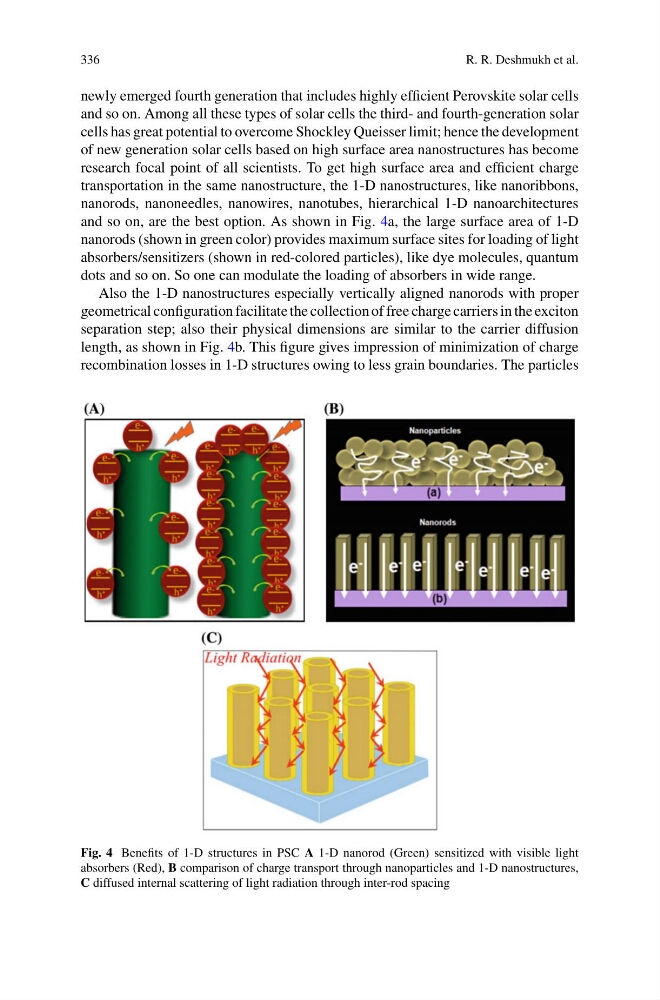
and so on, are the best option. As shown in Fig. 4a, the large surface area of 1-D
nanorods (shown in green color) provides maximum surface sites for loading of light
absorbers/sensitizers (shown in red-colored particles), like dye molecules, quantum
dots and so on. So one can modulate the loading of absorbers in wide range.
Also the 1-D nanostructures especially vertically aligned nanorods with proper
geometrical configuration facilitate the collection of free charge carriers in the exciton
separation step; also their physical dimensions are similar to the carrier diffusion
length, as shown in Fig. 4b. This figure gives impression of minimization of charge
recombination losses in 1-D structures owing to less grain boundaries. The particles
Fig. 4 Benefits of 1-D structures in PSC A 1-D nanorod (Green) sensitized with visible light
absorbers (Red), B comparison of charge transport through nanoparticles and 1-D nanostructures,
C diffused internal scattering of light radiation through inter-rod spacing
R. R. Deshmukh et al.
newly emerged fourth generation that includes highly efficient Perovskite solar cells
and so on. Among all these types of solar cells the third- and fourth-generation solar
cells has great potential to overcome Shockley Queisser limit; hence the development
of new generation solar cells based on high surface area nanostructures has become
research focal point of all scientists. To get high surface area and efficient charge
transportation in the same nanostructure, the 1-D nanostructures, like nanoribbons,
nanorods, nanoneedles, nanowires, nanotubes, hierarchical 1-D nanoarchitectures
and so on, are the best option. As shown in Fig. 4a, the large surface area of 1-D
nanorods (shown in green color) provides maximum surface sites for loading of light
absorbers/sensitizers (shown in red-colored particles), like dye molecules, quantum
dots and so on. So one can modulate the loading of absorbers in wide range.
Also the 1-D nanostructures especially vertically aligned nanorods with proper
geometrical configuration facilitate the collection of free charge carriers in the exciton
separation step; also their physical dimensions are similar to the carrier diffusion
length, as shown in Fig. 4b. This figure gives impression of minimization of charge
recombination losses in 1-D structures owing to less grain boundaries. The particles
Fig. 4 Benefits of 1-D structures in PSC A 1-D nanorod (Green) sensitized with visible light
absorbers (Red), B comparison of charge transport through nanoparticles and 1-D nanostructures,
C diffused internal scattering of light radiation through inter-rod spacing