

334
R. R. Deshmukh et al.
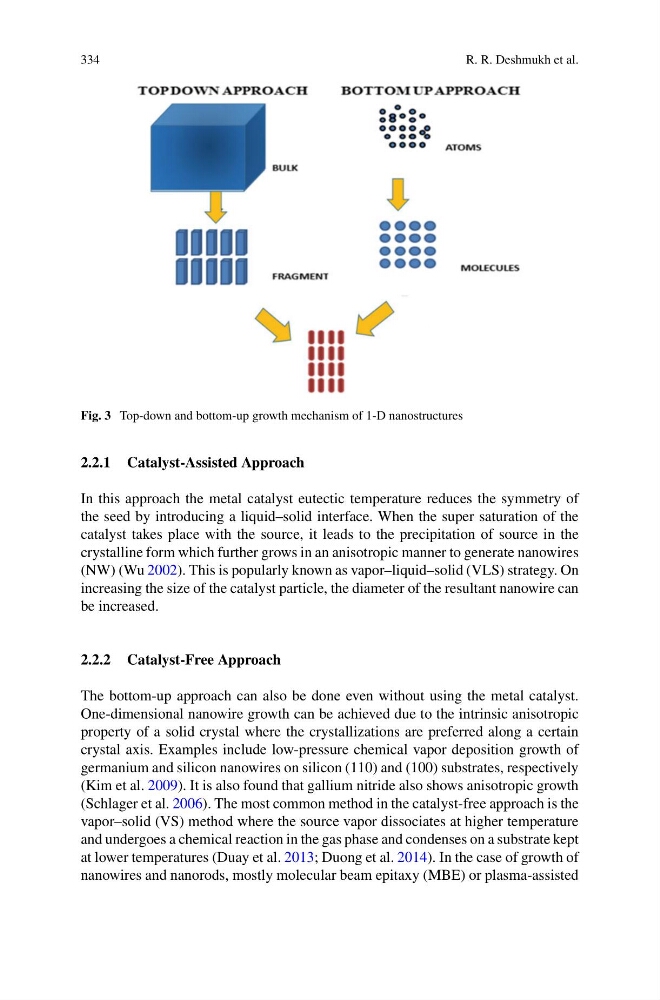
Fig. 3 Top-down and bottom-up growth mechanism of 1-D nanostructures
2.2.1 Catalyst-Assisted Approach
In this approach the metal catalyst eutectic temperature reduces the symmetry of
the seed by introducing a liquid–solid interface. When the super saturation of the
catalyst takes place with the source, it leads to the precipitation of source in the
crystalline form which further grows in an anisotropic manner to generate nanowires
(NW) (Wu 2002). This is popularly known as vapor–liquid–solid (VLS) strategy. On
increasing the size of the catalyst particle, the diameter of the resultant nanowire can
be increased.
2.2.2 Catalyst-Free Approach
The bottom-up approach can also be done even without using the metal catalyst.
One-dimensional nanowire growth can be achieved due to the intrinsic anisotropic
property of a solid crystal where the crystallizations are preferred along a certain
crystal axis. Examples include low-pressure chemical vapor deposition growth of
germanium and silicon nanowires on silicon (110) and (100) substrates, respectively
(Kim et al. 2009). It is also found that gallium nitride also shows anisotropic growth
(Schlager et al. 2006). The most common method in the catalyst-free approach is the
vapor–solid (VS) method where the source vapor dissociates at higher temperature
and undergoes a chemical reaction in the gas phase and condenses on a substrate kept
at lower temperatures (Duay et al. 2013; Duong et al. 2014). In the case of growth of
nanowires and nanorods, mostly molecular beam epitaxy (MBE) or plasma-assisted
R. R. Deshmukh et al.
Fig. 3 Top-down and bottom-up growth mechanism of 1-D nanostructures
2.2.1 Catalyst-Assisted Approach
In this approach the metal catalyst eutectic temperature reduces the symmetry of
the seed by introducing a liquid–solid interface. When the super saturation of the
catalyst takes place with the source, it leads to the precipitation of source in the
crystalline form which further grows in an anisotropic manner to generate nanowires
(NW) (Wu 2002). This is popularly known as vapor–liquid–solid (VLS) strategy. On
increasing the size of the catalyst particle, the diameter of the resultant nanowire can
be increased.
2.2.2 Catalyst-Free Approach
The bottom-up approach can also be done even without using the metal catalyst.
One-dimensional nanowire growth can be achieved due to the intrinsic anisotropic
property of a solid crystal where the crystallizations are preferred along a certain
crystal axis. Examples include low-pressure chemical vapor deposition growth of
germanium and silicon nanowires on silicon (110) and (100) substrates, respectively
(Kim et al. 2009). It is also found that gallium nitride also shows anisotropic growth
(Schlager et al. 2006). The most common method in the catalyst-free approach is the
vapor–solid (VS) method where the source vapor dissociates at higher temperature
and undergoes a chemical reaction in the gas phase and condenses on a substrate kept
at lower temperatures (Duay et al. 2013; Duong et al. 2014). In the case of growth of
nanowires and nanorods, mostly molecular beam epitaxy (MBE) or plasma-assisted