

Interaction of Nanoparticles with Reservoir Fluids and Rocks …
321
mobility increases due to reduction in oil viscosity. With the reduction in viscosity
of the reservoir fluid, swept efficiency of oil increased (Sahar et al. 2018). This
result indicates that Fe 2 O 3 nanoparticles have good influenced over the reduction of
viscosity of heavy oil reservoir fluids.
5 Microbial Method
This is the enhanced oil recovery method in which microbes are used for better
production of the oil from existing dead well. Under this method, suitable microbes
are introduced into oil wells along with water or biodegradable polymer to produce
nontoxic by-products which help in oil recovery. This may include oily substances
or gases that may help in extracting oil out of the well. The released material may
help to mobilize the oil and facilitate oil flow by reducing oil viscosity or altering
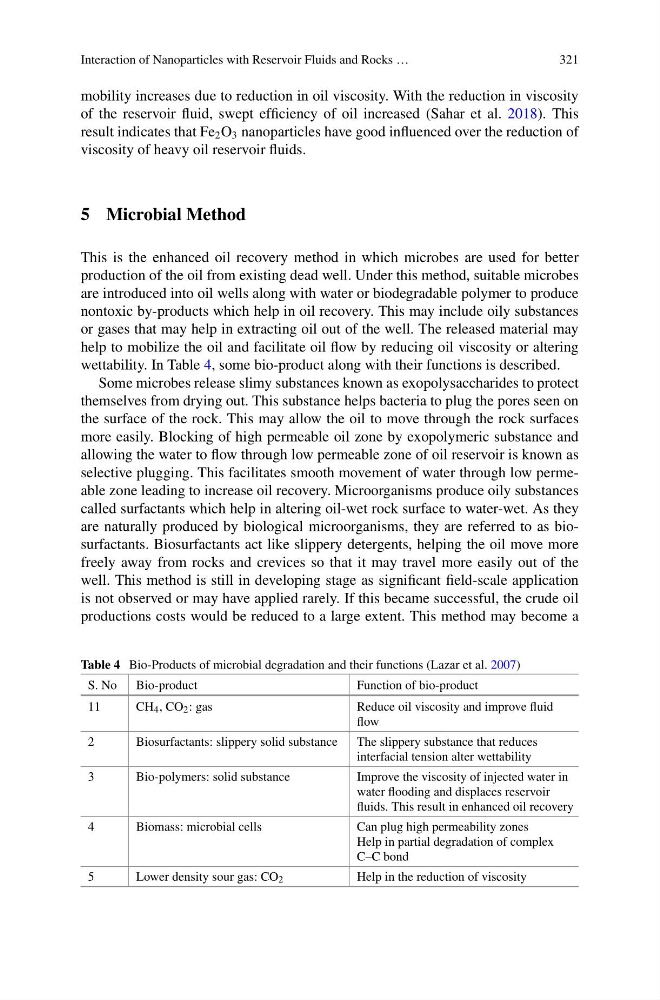
wettability. In Table 4, some bio-product along with their functions is described.
Some microbes release slimy substances known as exopolysaccharides to protect
themselves from drying out. This substance helps bacteria to plug the pores seen on
the surface of the rock. This may allow the oil to move through the rock surfaces
more easily. Blocking of high permeable oil zone by exopolymeric substance and
allowing the water to flow through low permeable zone of oil reservoir is known as
selective plugging. This facilitates smooth movement of water through low permeable zone leading to increase oil recovery. Microorganisms produce oily substances
called surfactants which help in altering oil-wet rock surface to water-wet. As they
are naturally produced by biological microorganisms, they are referred to as biosurfactants. Biosurfactants act like slippery detergents, helping the oil move more
freely away from rocks and crevices so that it may travel more easily out of the
well. This method is still in developing stage as significant field-scale application
is not observed or may have applied rarely. If this became successful, the crude oil
productions costs would be reduced to a large extent. This method may become a
Table 4 Bio-Products of microbial degradation and their functions (Lazar et al. 2007)
S. No
Bio-product
Function of bio-product
11
CH 4 , CO 2 : gas
Reduce oil viscosity and improve fluid
flow
2
Biosurfactants: slippery solid substance
The slippery substance that reduces
interfacial tension alter wettability
3
Bio-polymers: solid substance
Improve the viscosity of injected water in
water flooding and displaces reservoir
fluids. This result in enhanced oil recovery
4
Biomass: microbial cells
Can plug high permeability zones
Help in partial degradation of complex
C–C bond
5
Lower density sour gas: CO 2
Help in the reduction of viscosity
321
mobility increases due to reduction in oil viscosity. With the reduction in viscosity
of the reservoir fluid, swept efficiency of oil increased (Sahar et al. 2018). This
result indicates that Fe 2 O 3 nanoparticles have good influenced over the reduction of
viscosity of heavy oil reservoir fluids.
5 Microbial Method
This is the enhanced oil recovery method in which microbes are used for better
production of the oil from existing dead well. Under this method, suitable microbes
are introduced into oil wells along with water or biodegradable polymer to produce
nontoxic by-products which help in oil recovery. This may include oily substances
or gases that may help in extracting oil out of the well. The released material may
help to mobilize the oil and facilitate oil flow by reducing oil viscosity or altering
wettability. In Table 4, some bio-product along with their functions is described.
Some microbes release slimy substances known as exopolysaccharides to protect
themselves from drying out. This substance helps bacteria to plug the pores seen on
the surface of the rock. This may allow the oil to move through the rock surfaces
more easily. Blocking of high permeable oil zone by exopolymeric substance and
allowing the water to flow through low permeable zone of oil reservoir is known as
selective plugging. This facilitates smooth movement of water through low permeable zone leading to increase oil recovery. Microorganisms produce oily substances
called surfactants which help in altering oil-wet rock surface to water-wet. As they
are naturally produced by biological microorganisms, they are referred to as biosurfactants. Biosurfactants act like slippery detergents, helping the oil move more
freely away from rocks and crevices so that it may travel more easily out of the
well. This method is still in developing stage as significant field-scale application
is not observed or may have applied rarely. If this became successful, the crude oil
productions costs would be reduced to a large extent. This method may become a
Table 4 Bio-Products of microbial degradation and their functions (Lazar et al. 2007)
S. No
Bio-product
Function of bio-product
11
CH 4 , CO 2 : gas
Reduce oil viscosity and improve fluid
flow
2
Biosurfactants: slippery solid substance
The slippery substance that reduces
interfacial tension alter wettability
3
Bio-polymers: solid substance
Improve the viscosity of injected water in
water flooding and displaces reservoir
fluids. This result in enhanced oil recovery
4
Biomass: microbial cells
Can plug high permeability zones
Help in partial degradation of complex
C–C bond
5
Lower density sour gas: CO 2
Help in the reduction of viscosity