

Synthesis and Characterization of Nanofluids …
9
that the thermal conductivity of the interfacial layer is ten times more than the bulk
fluid. A correlation as given in Eq. (1) has been proposed by Leong et al. (2006) for
determining the thermal conductivity of the interfacial layer where k l is the interfacial
layer thermal conductivity, C is a constant specific for a type of nanoparticle, t is
the interfacial layer thickness, r p is the radius of the nano-sized particle and k f is the
thermal conductivity of the basefluid.
k l = C
t
r p
k f
(1)
The authors observed that the thermal conductivity of the layer is 2–3 times greater
than that of the basefluid.
3.2 Measurement of Thermal Conductivity of the Nanofluids
Owing to the fact that there can be a lot of improvement in the thermal transport
properties of the fluids, there has been a lot of increase in the investigation of thermal
conductivity of the nanofluids. For this purpose, many techniques have been used
by researchers which include the steady-state coaxial cylinder method (Glory et al.
2008), transient hot wire (THW) method (Garg et al. 2008; Lee et al. 2008; Rusconi
et al. 2007), IR thermometry method (Gharagozloo and Goodson 2008) and so on.
The newest technique for determining the thermal conductivity of nanofluids that
has been used by numerous researchers lately is the instrument known as KD2 Pro
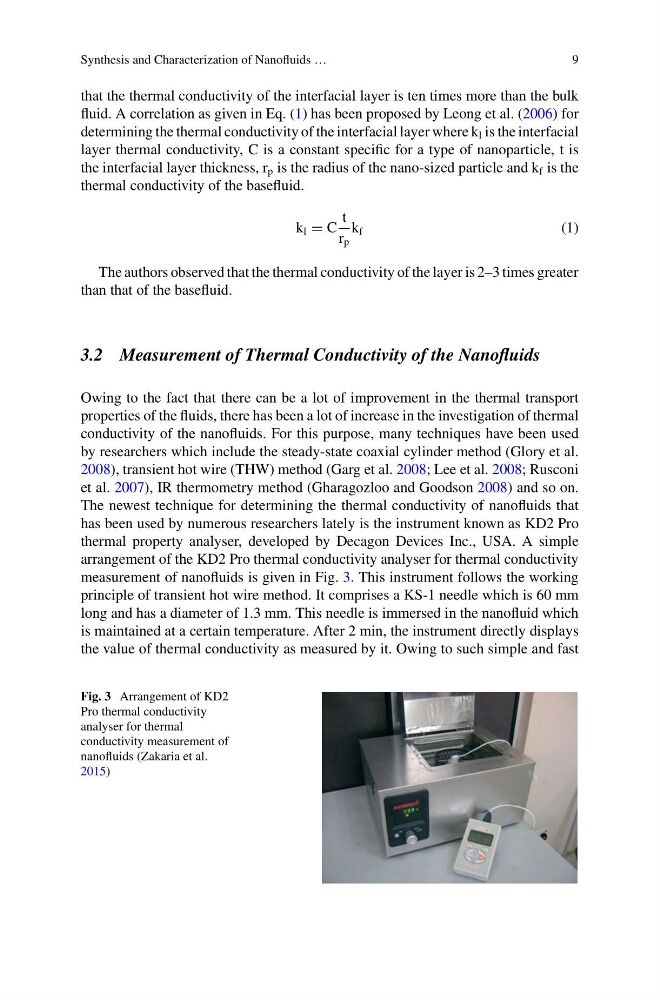
thermal property analyser, developed by Decagon Devices Inc., USA. A simple
arrangement of the KD2 Pro thermal conductivity analyser for thermal conductivity
measurement of nanofluids is given in Fig. 3. This instrument follows the working
principle of transient hot wire method. It comprises a KS-1 needle which is 60 mm
long and has a diameter of 1.3 mm. This needle is immersed in the nanofluid which
is maintained at a certain temperature. After 2 min, the instrument directly displays
the value of thermal conductivity as measured by it. Owing to such simple and fast
Fig. 3 Arrangement of KD2
Pro thermal conductivity
analyser for thermal
conductivity measurement of
nanofluids (Zakaria et al.
2015)
9
that the thermal conductivity of the interfacial layer is ten times more than the bulk
fluid. A correlation as given in Eq. (1) has been proposed by Leong et al. (2006) for
determining the thermal conductivity of the interfacial layer where k l is the interfacial
layer thermal conductivity, C is a constant specific for a type of nanoparticle, t is
the interfacial layer thickness, r p is the radius of the nano-sized particle and k f is the
thermal conductivity of the basefluid.
k l = C
t
r p
k f
(1)
The authors observed that the thermal conductivity of the layer is 2–3 times greater
than that of the basefluid.
3.2 Measurement of Thermal Conductivity of the Nanofluids
Owing to the fact that there can be a lot of improvement in the thermal transport
properties of the fluids, there has been a lot of increase in the investigation of thermal
conductivity of the nanofluids. For this purpose, many techniques have been used
by researchers which include the steady-state coaxial cylinder method (Glory et al.
2008), transient hot wire (THW) method (Garg et al. 2008; Lee et al. 2008; Rusconi
et al. 2007), IR thermometry method (Gharagozloo and Goodson 2008) and so on.
The newest technique for determining the thermal conductivity of nanofluids that
has been used by numerous researchers lately is the instrument known as KD2 Pro
thermal property analyser, developed by Decagon Devices Inc., USA. A simple
arrangement of the KD2 Pro thermal conductivity analyser for thermal conductivity
measurement of nanofluids is given in Fig. 3. This instrument follows the working
principle of transient hot wire method. It comprises a KS-1 needle which is 60 mm
long and has a diameter of 1.3 mm. This needle is immersed in the nanofluid which
is maintained at a certain temperature. After 2 min, the instrument directly displays
the value of thermal conductivity as measured by it. Owing to such simple and fast
Fig. 3 Arrangement of KD2
Pro thermal conductivity
analyser for thermal
conductivity measurement of
nanofluids (Zakaria et al.
2015)