

268
R. Sandeep et al.
where E r is the recovery efficiency expressed as a fraction of the OOIP, E d is the
microscopic oil displacement which reflects the total volume of oil displaced by a
unit segment of rock and E v is the volumetric sweep efficiency which represents the
total volume of the reservoir that is in contact with recovery fluid. Hence if the sweep
efficiency gets lowered, it further reduced the amount of oil recovered (Rellegadla
et al. 2017). Further, the poor sweep efficiency results from the difference of oil
and aqueous phase mobilities. The water tends to move faster compared to oil and
therefore results in the water reaching the production well faster than oil. The mobility
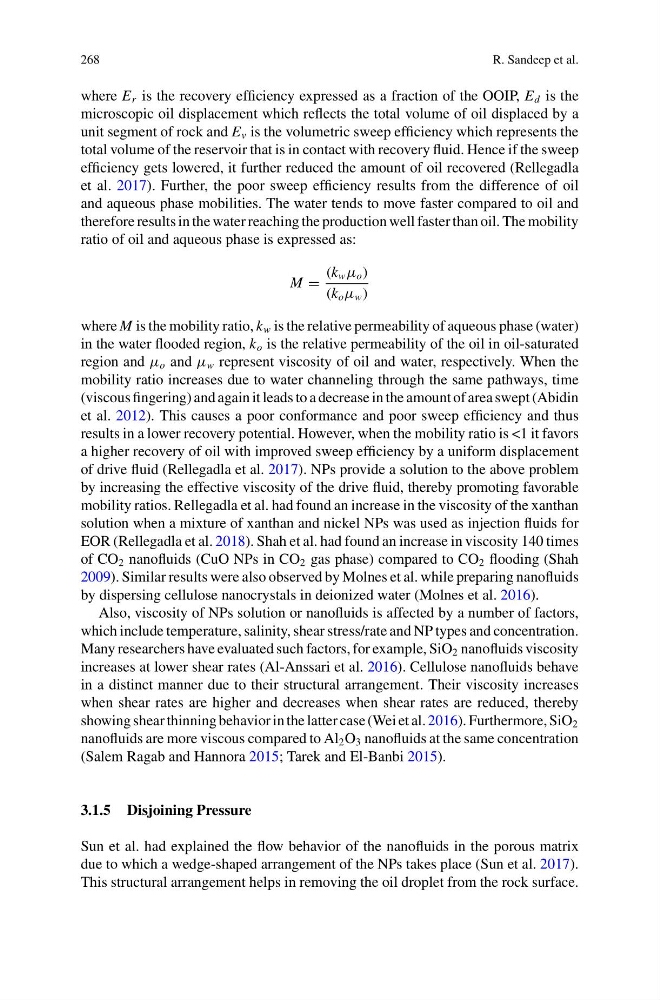
ratio of oil and aqueous phase is expressed as:
M =
(k w µ o )
(k o µ w )
where M is the mobility ratio, k w is the relative permeability of aqueous phase (water)
in the water flooded region, k o is the relative permeability of the oil in oil-saturated
region and µ o and µ w represent viscosity of oil and water, respectively. When the
mobility ratio increases due to water channeling through the same pathways, time
(viscous fingering) and again it leads to a decrease in the amount of area swept (Abidin
et al. 2012). This causes a poor conformance and poor sweep efficiency and thus
results in a lower recovery potential. However, when the mobility ratio is <1 it favors
a higher recovery of oil with improved sweep efficiency by a uniform displacement
of drive fluid (Rellegadla et al. 2017). NPs provide a solution to the above problem
by increasing the effective viscosity of the drive fluid, thereby promoting favorable
mobility ratios. Rellegadla et al. had found an increase in the viscosity of the xanthan
solution when a mixture of xanthan and nickel NPs was used as injection fluids for
EOR (Rellegadla et al. 2018). Shah et al. had found an increase in viscosity 140 times
of CO 2 nanofluids (CuO NPs in CO 2 gas phase) compared to CO 2 flooding (Shah
2009). Similar results were also observed by Molnes et al. while preparing nanofluids
by dispersing cellulose nanocrystals in deionized water (Molnes et al. 2016).
Also, viscosity of NPs solution or nanofluids is affected by a number of factors,
which include temperature, salinity, shear stress/rate and NP types and concentration.
Many researchers have evaluated such factors, for example, SiO 2 nanofluids viscosity
increases at lower shear rates (Al-Anssari et al. 2016). Cellulose nanofluids behave
in a distinct manner due to their structural arrangement. Their viscosity increases
when shear rates are higher and decreases when shear rates are reduced, thereby
showing shear thinning behavior in the latter case (Wei et al. 2016). Furthermore, SiO 2
nanofluids are more viscous compared to Al 2 O 3 nanofluids at the same concentration
(Salem Ragab and Hannora 2015; Tarek and El-Banbi 2015).
3.1.5 Disjoining Pressure
Sun et al. had explained the flow behavior of the nanofluids in the porous matrix
due to which a wedge-shaped arrangement of the NPs takes place (Sun et al. 2017).
This structural arrangement helps in removing the oil droplet from the rock surface.
R. Sandeep et al.
where E r is the recovery efficiency expressed as a fraction of the OOIP, E d is the
microscopic oil displacement which reflects the total volume of oil displaced by a
unit segment of rock and E v is the volumetric sweep efficiency which represents the
total volume of the reservoir that is in contact with recovery fluid. Hence if the sweep
efficiency gets lowered, it further reduced the amount of oil recovered (Rellegadla
et al. 2017). Further, the poor sweep efficiency results from the difference of oil
and aqueous phase mobilities. The water tends to move faster compared to oil and
therefore results in the water reaching the production well faster than oil. The mobility
ratio of oil and aqueous phase is expressed as:
M =
(k w µ o )
(k o µ w )
where M is the mobility ratio, k w is the relative permeability of aqueous phase (water)
in the water flooded region, k o is the relative permeability of the oil in oil-saturated
region and µ o and µ w represent viscosity of oil and water, respectively. When the
mobility ratio increases due to water channeling through the same pathways, time
(viscous fingering) and again it leads to a decrease in the amount of area swept (Abidin
et al. 2012). This causes a poor conformance and poor sweep efficiency and thus
results in a lower recovery potential. However, when the mobility ratio is <1 it favors
a higher recovery of oil with improved sweep efficiency by a uniform displacement
of drive fluid (Rellegadla et al. 2017). NPs provide a solution to the above problem
by increasing the effective viscosity of the drive fluid, thereby promoting favorable
mobility ratios. Rellegadla et al. had found an increase in the viscosity of the xanthan
solution when a mixture of xanthan and nickel NPs was used as injection fluids for
EOR (Rellegadla et al. 2018). Shah et al. had found an increase in viscosity 140 times
of CO 2 nanofluids (CuO NPs in CO 2 gas phase) compared to CO 2 flooding (Shah
2009). Similar results were also observed by Molnes et al. while preparing nanofluids
by dispersing cellulose nanocrystals in deionized water (Molnes et al. 2016).
Also, viscosity of NPs solution or nanofluids is affected by a number of factors,
which include temperature, salinity, shear stress/rate and NP types and concentration.
Many researchers have evaluated such factors, for example, SiO 2 nanofluids viscosity
increases at lower shear rates (Al-Anssari et al. 2016). Cellulose nanofluids behave
in a distinct manner due to their structural arrangement. Their viscosity increases
when shear rates are higher and decreases when shear rates are reduced, thereby
showing shear thinning behavior in the latter case (Wei et al. 2016). Furthermore, SiO 2
nanofluids are more viscous compared to Al 2 O 3 nanofluids at the same concentration
(Salem Ragab and Hannora 2015; Tarek and El-Banbi 2015).
3.1.5 Disjoining Pressure
Sun et al. had explained the flow behavior of the nanofluids in the porous matrix
due to which a wedge-shaped arrangement of the NPs takes place (Sun et al. 2017).
This structural arrangement helps in removing the oil droplet from the rock surface.