

200
J. Prakash et al.
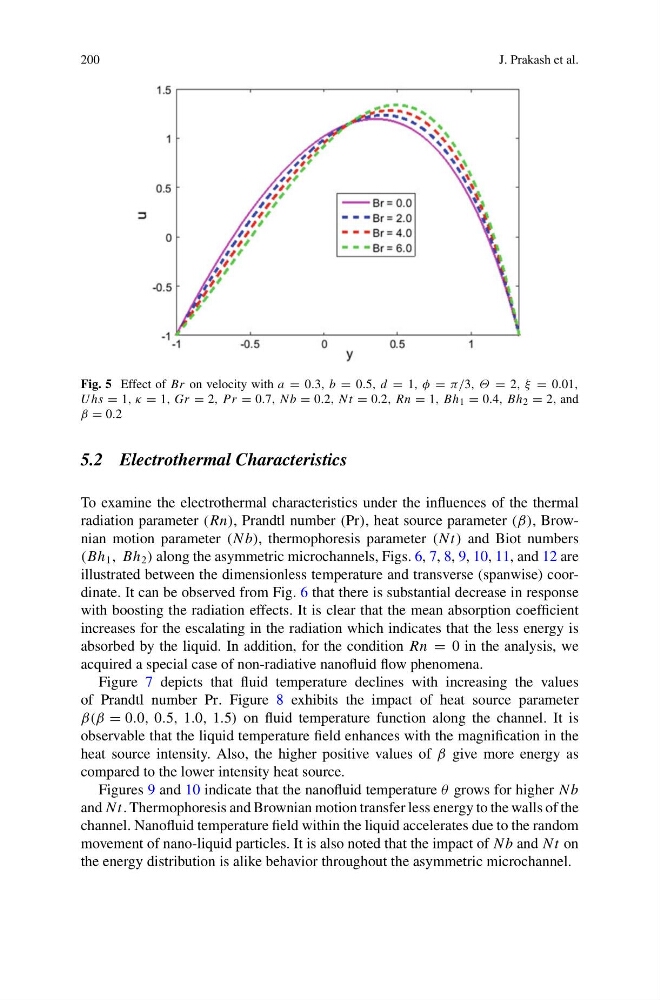
Fig. 5 Effect of Br on velocity with a = 0.3, b = 0.5, d = 1, φ = π/3, Θ = 2, ξ = 0.01,
U hs = 1, κ = 1, Gr = 2, Pr = 0.7, N b = 0.2, N t = 0.2, Rn = 1, Bh 1 = 0.4, Bh 2 = 2, and
β = 0.2
5.2 Electrothermal Characteristics
To examine the electrothermal characteristics under the influences of the thermal
radiation parameter (Rn), Prandtl number (Pr), heat source parameter (β), Brownian motion parameter (N b), thermophoresis parameter (N t) and Biot numbers
(Bh 1 , Bh 2 ) along the asymmetric microchannels, Figs. 6, 7, 8, 9, 10, 11, and 12 are
illustrated between the dimensionless temperature and transverse (spanwise) coordinate. It can be observed from Fig. 6 that there is substantial decrease in response
with boosting the radiation effects. It is clear that the mean absorption coefficient
increases for the escalating in the radiation which indicates that the less energy is
absorbed by the liquid. In addition, for the condition Rn = 0 in the analysis, we
acquired a special case of non-radiative nanofluid flow phenomena.
Figure 7 depicts that fluid temperature declines with increasing the values
of Prandtl number Pr. Figure 8 exhibits the impact of heat source parameter
β(β = 0.0, 0.5, 1.0, 1.5) on fluid temperature function along the channel. It is
observable that the liquid temperature field enhances with the magnification in the
heat source intensity. Also, the higher positive values of β give more energy as
compared to the lower intensity heat source.
Figures 9 and 10 indicate that the nanofluid temperature θ grows for higher N b
and N t. Thermophoresis and Brownian motion transfer less energy to the walls of the
channel. Nanofluid temperature field within the liquid accelerates due to the random
movement of nano-liquid particles. It is also noted that the impact of N b and N t on
the energy distribution is alike behavior throughout the asymmetric microchannel.
J. Prakash et al.
Fig. 5 Effect of Br on velocity with a = 0.3, b = 0.5, d = 1, φ = π/3, Θ = 2, ξ = 0.01,
U hs = 1, κ = 1, Gr = 2, Pr = 0.7, N b = 0.2, N t = 0.2, Rn = 1, Bh 1 = 0.4, Bh 2 = 2, and
β = 0.2
5.2 Electrothermal Characteristics
To examine the electrothermal characteristics under the influences of the thermal
radiation parameter (Rn), Prandtl number (Pr), heat source parameter (β), Brownian motion parameter (N b), thermophoresis parameter (N t) and Biot numbers
(Bh 1 , Bh 2 ) along the asymmetric microchannels, Figs. 6, 7, 8, 9, 10, 11, and 12 are
illustrated between the dimensionless temperature and transverse (spanwise) coordinate. It can be observed from Fig. 6 that there is substantial decrease in response
with boosting the radiation effects. It is clear that the mean absorption coefficient
increases for the escalating in the radiation which indicates that the less energy is
absorbed by the liquid. In addition, for the condition Rn = 0 in the analysis, we
acquired a special case of non-radiative nanofluid flow phenomena.
Figure 7 depicts that fluid temperature declines with increasing the values
of Prandtl number Pr. Figure 8 exhibits the impact of heat source parameter
β(β = 0.0, 0.5, 1.0, 1.5) on fluid temperature function along the channel. It is
observable that the liquid temperature field enhances with the magnification in the
heat source intensity. Also, the higher positive values of β give more energy as
compared to the lower intensity heat source.
Figures 9 and 10 indicate that the nanofluid temperature θ grows for higher N b
and N t. Thermophoresis and Brownian motion transfer less energy to the walls of the
channel. Nanofluid temperature field within the liquid accelerates due to the random
movement of nano-liquid particles. It is also noted that the impact of N b and N t on
the energy distribution is alike behavior throughout the asymmetric microchannel.