

194
J. Prakash et al.
μ
∂U
∂Y
+
∂ V
∂ X
= S XY + λ 1
U
∂ S XY
∂ X
+ V
∂ S XY
∂Y
+
∂ V
∂ X
S X X −
∂U
∂Y
S Y Y
+
1
2
(λ 1 − μ 1 )
(S X X + S Y Y )
∂U
∂Y
+
∂ V
∂ X
,
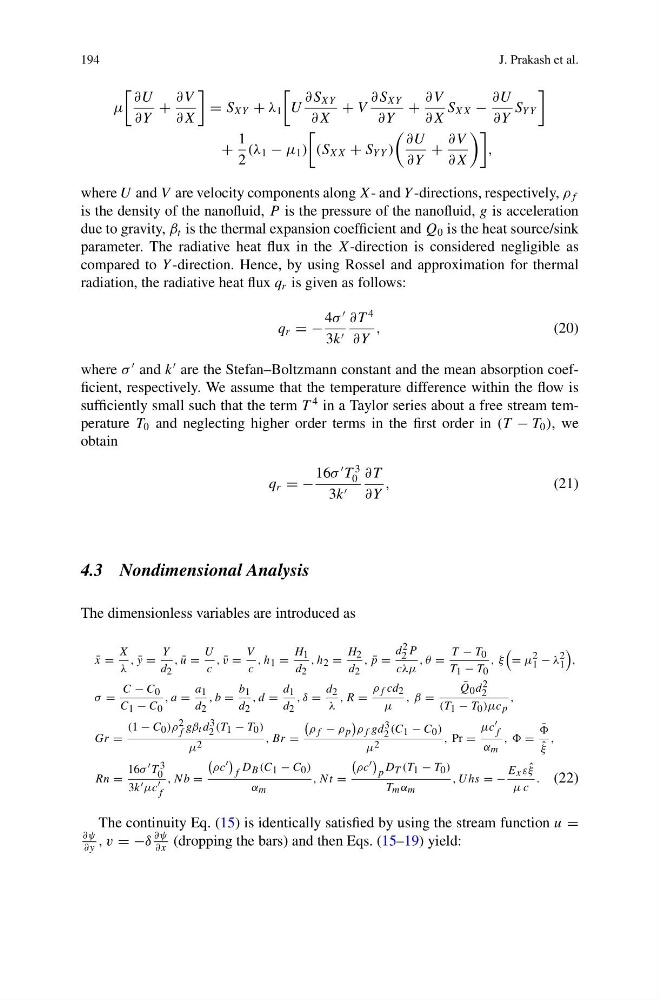
where U and V are velocity components along X - and Y -directions, respectively, ρ f
is the density of the nanofluid, P is the pressure of the nanofluid, g is acceleration
due to gravity, β t is the thermal expansion coefficient and Q 0 is the heat source/sink
parameter. The radiative heat flux in the X -direction is considered negligible as
compared to Y -direction. Hence, by using Rossel and approximation for thermal
radiation, the radiative heat flux q r is given as follows:
q r = −
4σ
3k
∂ T
4
∂Y
,
(20)
where σ
and k
are the Stefan–Boltzmann constant and the mean absorption coefficient, respectively. We assume that the temperature difference within the flow is
sufficiently small such that the term T
4 in a Taylor series about a free stream temperature T 0 and neglecting higher order terms in the first order in (T − T 0 ), we
obtain
q r = −
16σ
T
3
0
3k
∂ T
∂Y
,
(21)
4.3 Nondimensional Analysis
The dimensionless variables are introduced as
¯
x =
X
λ
, ¯
y =
Y
d 2
, ¯
u =
U
c
, ¯
v =
V
c
, h 1 =
H 1
d 2
, h 2 =
H 2
d 2
, ¯
p =
d 2
2 P
cλμ
, θ =
T − T 0
T 1 − T 0
, ξ
= μ 2
1 − λ 2
1
,
σ =
C − C 0
C 1 − C 0
, a =
a 1
d 2
, b =
b 1
d 2
, d =
d 1
d 2
, δ =
d 2
λ
, R =
ρ f cd 2
μ
, β =
¯
Q 0 d 2
2
(T 1 − T 0 )μc p
,
Gr =
(1 − C 0 )ρ 2
f gβ t d 3
2 (T 1 − T 0 )
μ 2
, Br =
ρ f − ρ p
ρ f gd 3
2 (C 1 − C 0 )
μ 2
, Pr =
μc
f
α m
, , =
¯
ˆ
ξ
,
Rn =
16σ T 3
0
3k μc
f
, N b =
ρc
f D B (C 1 − C 0 )
α m
, N t =
ρc
p D T (T 1 − T 0 )
T m α m
, U hs = −
E x ε ˆ
ξ
μ c
. (22)
The continuity Eq. (15) is identically satisfied by using the stream function u =
∂ψ
∂ y
, v = −δ
∂ψ
∂ x
(dropping the bars) and then Eqs. (15–19) yield:
J. Prakash et al.
μ
∂U
∂Y
+
∂ V
∂ X
= S XY + λ 1
U
∂ S XY
∂ X
+ V
∂ S XY
∂Y
+
∂ V
∂ X
S X X −
∂U
∂Y
S Y Y
+
1
2
(λ 1 − μ 1 )
(S X X + S Y Y )
∂U
∂Y
+
∂ V
∂ X
,
where U and V are velocity components along X - and Y -directions, respectively, ρ f
is the density of the nanofluid, P is the pressure of the nanofluid, g is acceleration
due to gravity, β t is the thermal expansion coefficient and Q 0 is the heat source/sink
parameter. The radiative heat flux in the X -direction is considered negligible as
compared to Y -direction. Hence, by using Rossel and approximation for thermal
radiation, the radiative heat flux q r is given as follows:
q r = −
4σ
3k
∂ T
4
∂Y
,
(20)
where σ
and k
are the Stefan–Boltzmann constant and the mean absorption coefficient, respectively. We assume that the temperature difference within the flow is
sufficiently small such that the term T
4 in a Taylor series about a free stream temperature T 0 and neglecting higher order terms in the first order in (T − T 0 ), we
obtain
q r = −
16σ
T
3
0
3k
∂ T
∂Y
,
(21)
4.3 Nondimensional Analysis
The dimensionless variables are introduced as
¯
x =
X
λ
, ¯
y =
Y
d 2
, ¯
u =
U
c
, ¯
v =
V
c
, h 1 =
H 1
d 2
, h 2 =
H 2
d 2
, ¯
p =
d 2
2 P
cλμ
, θ =
T − T 0
T 1 − T 0
, ξ
= μ 2
1 − λ 2
1
,
σ =
C − C 0
C 1 − C 0
, a =
a 1
d 2
, b =
b 1
d 2
, d =
d 1
d 2
, δ =
d 2
λ
, R =
ρ f cd 2
μ
, β =
¯
Q 0 d 2
2
(T 1 − T 0 )μc p
,
Gr =
(1 − C 0 )ρ 2
f gβ t d 3
2 (T 1 − T 0 )
μ 2
, Br =
ρ f − ρ p
ρ f gd 3
2 (C 1 − C 0 )
μ 2
, Pr =
μc
f
α m
, , =
¯
ˆ
ξ
,
Rn =
16σ T 3
0
3k μc
f
, N b =
ρc
f D B (C 1 − C 0 )
α m
, N t =
ρc
p D T (T 1 − T 0 )
T m α m
, U hs = −
E x ε ˆ
ξ
μ c
. (22)
The continuity Eq. (15) is identically satisfied by using the stream function u =
∂ψ
∂ y
, v = −δ
∂ψ
∂ x
(dropping the bars) and then Eqs. (15–19) yield: