

Conjugation of Nanomaterials and Bioanodes for Energy …
173
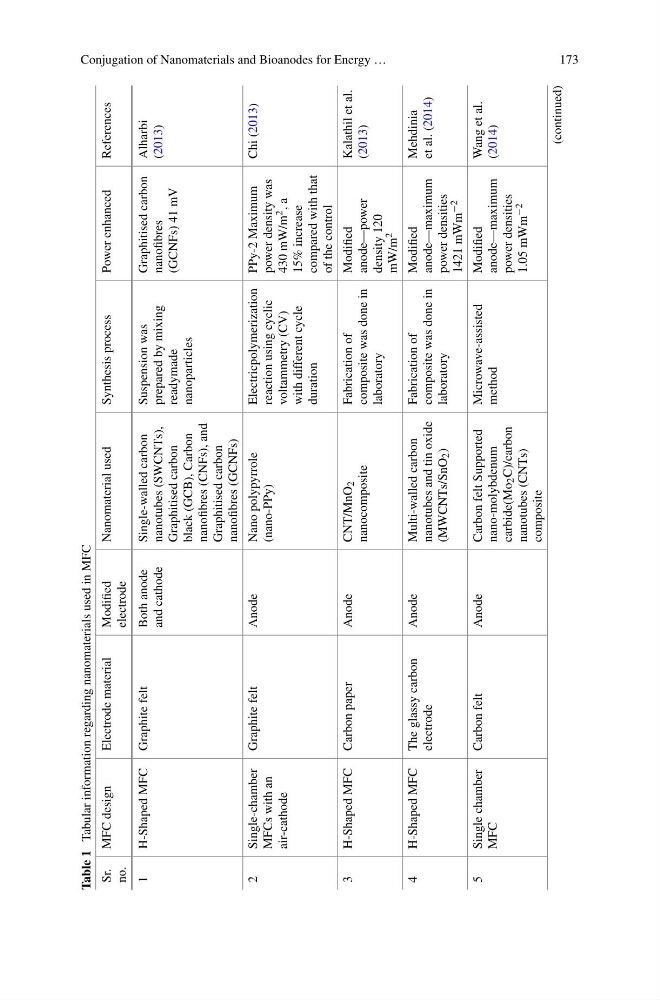
Table 1
Tabular information regarding nanomaterials used in MFC
Sr.
no.
MFC design
Electrode material
Modified
electrode
Nanomaterial used
Synthesis process
Power enhanced
References
1
H-Shaped MFC Graphite felt
Both anode
and cathode
Single-walled carbon
nanotubes (SWCNTs),
Graphitised carbon
black (GCB), Carbon
nanofibres (CNFs), and
Graphitised carbon
nanofibres (GCNFs)
Suspension was
prepared by mixing
readymade
nanoparticles
Graphitised carbon
nanofibres
(GCNFs) 41 mV
Alharbi
(2013)
2
Single-chamber
MFCs with an
air-cathode
Graphite felt
Anode
Nano polypyrrole
(nano-PPy)
Electricpolymerization
reaction using cyclic
voltammetry (CV)
with different cycle
duration
PPy-2 Maximum
power density was
430 mW/m 2
, a
15% increase
compared with that
of the control
Chi (2013)
3
H-Shaped MFC Carbon paper
Anode
CNT/MnO
2
nanocomposite
Fabrication of
composite was done in
laboratory
Modified
anode—power
density 120
mW/m 2
Kalathil et al.
(2013)
4
H-Shaped MFC The glassy carbon
electrode
Anode
Multi-walled carbon
nanotubes and tin oxide
(MWCNTs/SnO
2 )
Fabrication of
composite was done in
laboratory
Modified
anode—maximum
power densities
1421 mWm −2
Mehdinia
et al. (2014)
5
Single chamber
MFC
Carbon felt
Anode
Carbon felt Supported
nano-molybdenum
carbide(Mo
2 C)/carbon
nanotubes (CNTs)
composite
Microwave-assisted
method
Modified
anode—maximum
power densities
1.05 mWm −2
Wang et al.
(2014)
(continued)
173
Table 1
Tabular information regarding nanomaterials used in MFC
Sr.
no.
MFC design
Electrode material
Modified
electrode
Nanomaterial used
Synthesis process
Power enhanced
References
1
H-Shaped MFC Graphite felt
Both anode
and cathode
Single-walled carbon
nanotubes (SWCNTs),
Graphitised carbon
black (GCB), Carbon
nanofibres (CNFs), and
Graphitised carbon
nanofibres (GCNFs)
Suspension was
prepared by mixing
readymade
nanoparticles
Graphitised carbon
nanofibres
(GCNFs) 41 mV
Alharbi
(2013)
2
Single-chamber
MFCs with an
air-cathode
Graphite felt
Anode
Nano polypyrrole
(nano-PPy)
Electricpolymerization
reaction using cyclic
voltammetry (CV)
with different cycle
duration
PPy-2 Maximum
power density was
430 mW/m 2
, a
15% increase
compared with that
of the control
Chi (2013)
3
H-Shaped MFC Carbon paper
Anode
CNT/MnO
2
nanocomposite
Fabrication of
composite was done in
laboratory
Modified
anode—power
density 120
mW/m 2
Kalathil et al.
(2013)
4
H-Shaped MFC The glassy carbon
electrode
Anode
Multi-walled carbon
nanotubes and tin oxide
(MWCNTs/SnO
2 )
Fabrication of
composite was done in
laboratory
Modified
anode—maximum
power densities
1421 mWm −2
Mehdinia
et al. (2014)
5
Single chamber
MFC
Carbon felt
Anode
Carbon felt Supported
nano-molybdenum
carbide(Mo
2 C)/carbon
nanotubes (CNTs)
composite
Microwave-assisted
method
Modified
anode—maximum
power densities
1.05 mWm −2
Wang et al.
(2014)
(continued)