

Conjugation of Nanomaterials and Bioanodes for Energy …
171
mechanism of electron generation and transfer few studies are also carried out on
bioengineered microbes (Choudhury et al. 2017). The focus of this chapter will be
mainly on the anode electrode modification through the use of nanomaterials and
its effect on biofilms on the electrode. The other topics can be studied in detailed
elsewhere.
3 Bioanodes/Microbial Growth in MFC
The anode chamber in MFC reactor is the place where electron and proton are
generated. This generation process completely depends on the microbes, also known
as exoelectrogens. The major factors that affect the electron generation and its flow
in the anode chamber are: (a) choice of substrate; (b) choice of exoelectrogens; (c)
electrode material (i) large surface area (ii) biocompatible and electron conductive
nature; and (d) conductivity of anolyte (Xie et al. 2015).
Theoretically magnitude of substrate degradation is directly proportional to the
magnitude of the generation of electron and protons in a reactor (Logan 2008).
The microorganism may have limitation for the degradation of a particular substrate
(Zhang et al. 2011). Thus the choice of substrate and choice of exoelectrogens are
interrelated issues (Pant et al. 2010). The electrode material should have a conductive,
biocompatible nature with larger surface area (Choudhury et al. 2017; Logan et al.
2006). The biocompatible nature helps in the building of biofilm on the electrode
surface. Larger the surface area better will be the space available for biofilm formation
and capturing of electrons. The conductive nature of both electrode and electrolyte
(anolyte) is important for the smooth flow of electrons (Du et al. 2015).
The generation of electrons will not be restricted to happen in the anode biofilm.
In a mixed culture condition, it is possible that the degradation of substrate and
release of electron may occur at some distance from the anode electrode. Under such
conditions the conductive nature of electrolyte can be helpful for the flow of electrons
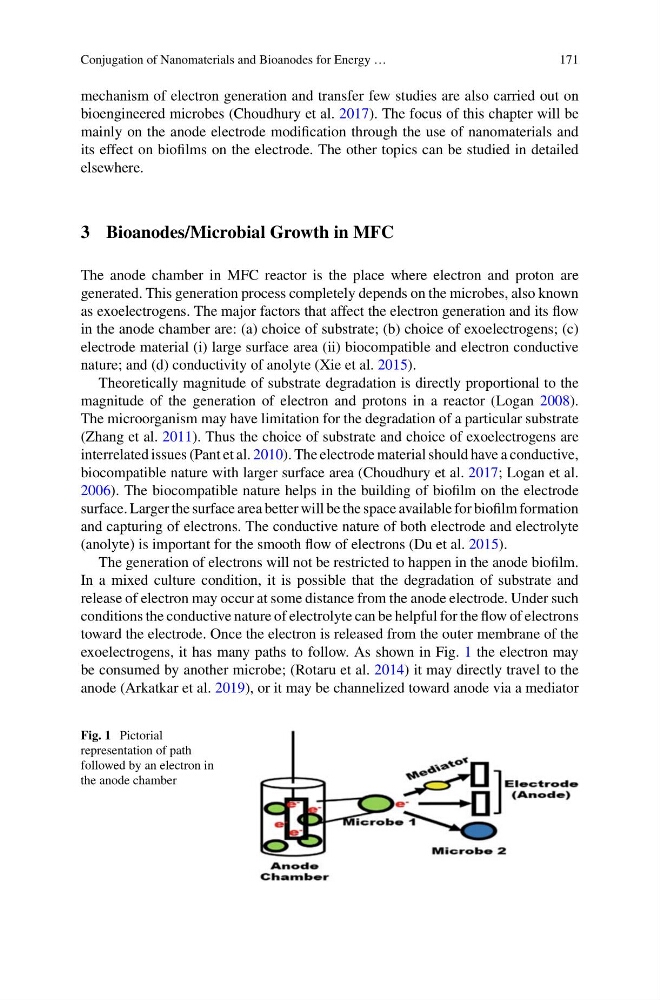
toward the electrode. Once the electron is released from the outer membrane of the
exoelectrogens, it has many paths to follow. As shown in Fig. 1 the electron may
be consumed by another microbe; (Rotaru et al. 2014) it may directly travel to the
anode (Arkatkar et al. 2019), or it may be channelized toward anode via a mediator
Fig. 1 Pictorial
representation of path
followed by an electron in
the anode chamber
171
mechanism of electron generation and transfer few studies are also carried out on
bioengineered microbes (Choudhury et al. 2017). The focus of this chapter will be
mainly on the anode electrode modification through the use of nanomaterials and
its effect on biofilms on the electrode. The other topics can be studied in detailed
elsewhere.
3 Bioanodes/Microbial Growth in MFC
The anode chamber in MFC reactor is the place where electron and proton are
generated. This generation process completely depends on the microbes, also known
as exoelectrogens. The major factors that affect the electron generation and its flow
in the anode chamber are: (a) choice of substrate; (b) choice of exoelectrogens; (c)
electrode material (i) large surface area (ii) biocompatible and electron conductive
nature; and (d) conductivity of anolyte (Xie et al. 2015).
Theoretically magnitude of substrate degradation is directly proportional to the
magnitude of the generation of electron and protons in a reactor (Logan 2008).
The microorganism may have limitation for the degradation of a particular substrate
(Zhang et al. 2011). Thus the choice of substrate and choice of exoelectrogens are
interrelated issues (Pant et al. 2010). The electrode material should have a conductive,
biocompatible nature with larger surface area (Choudhury et al. 2017; Logan et al.
2006). The biocompatible nature helps in the building of biofilm on the electrode
surface. Larger the surface area better will be the space available for biofilm formation
and capturing of electrons. The conductive nature of both electrode and electrolyte
(anolyte) is important for the smooth flow of electrons (Du et al. 2015).
The generation of electrons will not be restricted to happen in the anode biofilm.
In a mixed culture condition, it is possible that the degradation of substrate and
release of electron may occur at some distance from the anode electrode. Under such
conditions the conductive nature of electrolyte can be helpful for the flow of electrons
toward the electrode. Once the electron is released from the outer membrane of the
exoelectrogens, it has many paths to follow. As shown in Fig. 1 the electron may
be consumed by another microbe; (Rotaru et al. 2014) it may directly travel to the
anode (Arkatkar et al. 2019), or it may be channelized toward anode via a mediator
Fig. 1 Pictorial
representation of path
followed by an electron in
the anode chamber