

158
S. Nair and J. V. Gohel
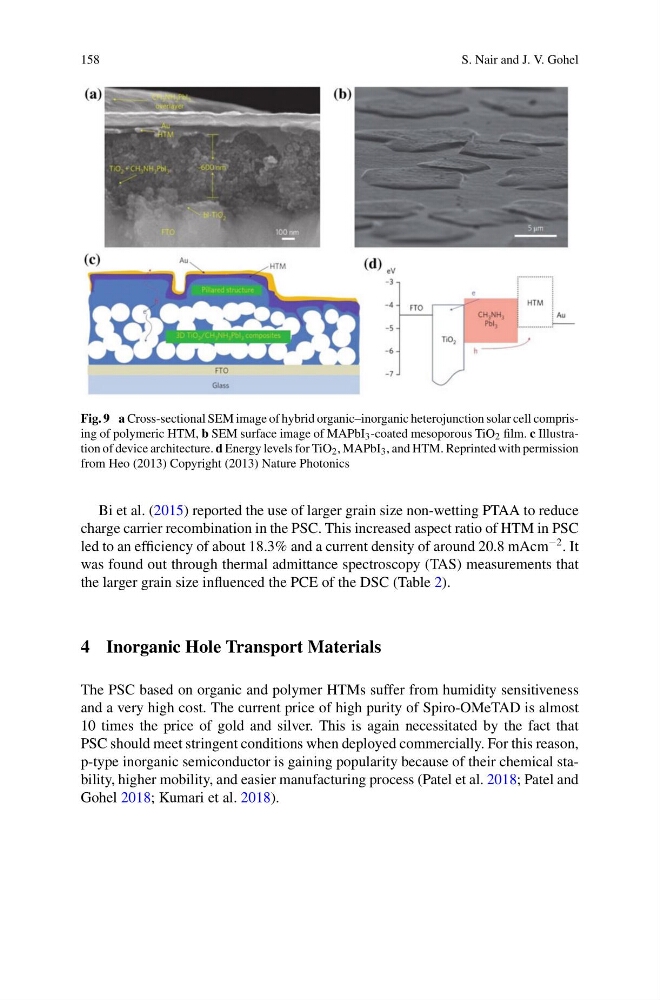
Fig. 9 a Cross-sectional SEM image of hybrid organic–inorganic heterojunction solar cell comprising of polymeric HTM, b SEM surface image of MAPbI 3 -coated mesoporous TiO 2 film. c Illustration of device architecture. d Energy levels for TiO 2 , MAPbI 3 , and HTM. Reprinted with permission
from Heo (2013) Copyright (2013) Nature Photonics
Bi et al. (2015) reported the use of larger grain size non-wetting PTAA to reduce
charge carrier recombination in the PSC. This increased aspect ratio of HTM in PSC
led to an efficiency of about 18.3% and a current density of around 20.8 mAcm
−2 . It
was found out through thermal admittance spectroscopy (TAS) measurements that
the larger grain size influenced the PCE of the DSC (Table 2).
4 Inorganic Hole Transport Materials
The PSC based on organic and polymer HTMs suffer from humidity sensitiveness
and a very high cost. The current price of high purity of Spiro-OMeTAD is almost
10 times the price of gold and silver. This is again necessitated by the fact that
PSC should meet stringent conditions when deployed commercially. For this reason,
p-type inorganic semiconductor is gaining popularity because of their chemical stability, higher mobility, and easier manufacturing process (Patel et al. 2018; Patel and
Gohel 2018; Kumari et al. 2018).
S. Nair and J. V. Gohel
Fig. 9 a Cross-sectional SEM image of hybrid organic–inorganic heterojunction solar cell comprising of polymeric HTM, b SEM surface image of MAPbI 3 -coated mesoporous TiO 2 film. c Illustration of device architecture. d Energy levels for TiO 2 , MAPbI 3 , and HTM. Reprinted with permission
from Heo (2013) Copyright (2013) Nature Photonics
Bi et al. (2015) reported the use of larger grain size non-wetting PTAA to reduce
charge carrier recombination in the PSC. This increased aspect ratio of HTM in PSC
led to an efficiency of about 18.3% and a current density of around 20.8 mAcm
−2 . It
was found out through thermal admittance spectroscopy (TAS) measurements that
the larger grain size influenced the PCE of the DSC (Table 2).
4 Inorganic Hole Transport Materials
The PSC based on organic and polymer HTMs suffer from humidity sensitiveness
and a very high cost. The current price of high purity of Spiro-OMeTAD is almost
10 times the price of gold and silver. This is again necessitated by the fact that
PSC should meet stringent conditions when deployed commercially. For this reason,
p-type inorganic semiconductor is gaining popularity because of their chemical stability, higher mobility, and easier manufacturing process (Patel et al. 2018; Patel and
Gohel 2018; Kumari et al. 2018).