

132
G. Pandey et al.
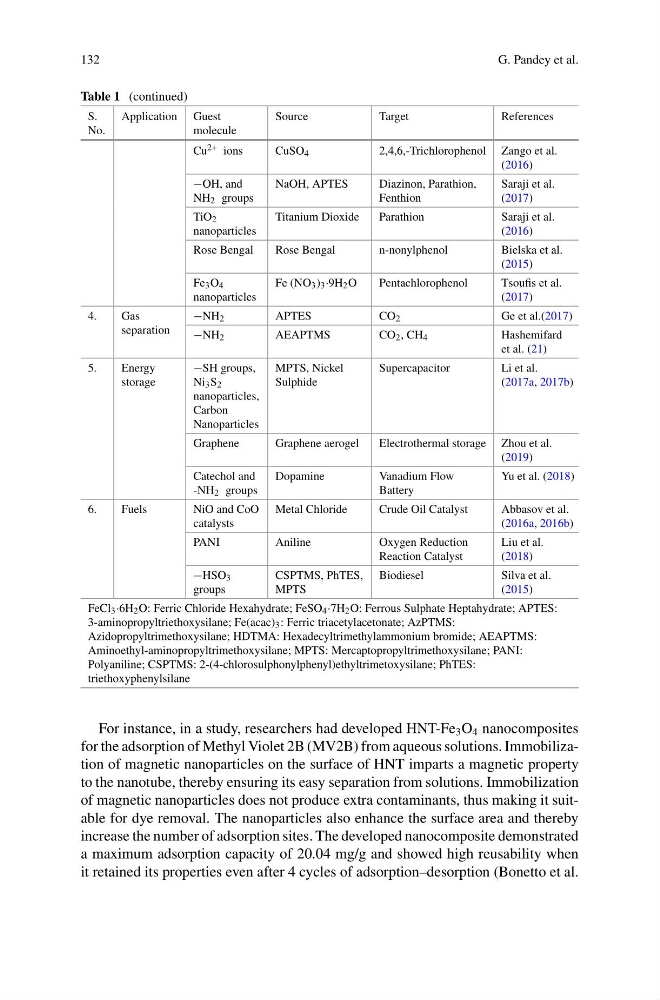
Table 1 (continued)
S.
No.
Application Guest
molecule
Source
Target
References
Cu 2+ ions
CuSO 4
2,4,6,-Trichlorophenol Zango et al.
(2016)
−OH, and
NH 2 groups
NaOH, APTES
Diazinon, Parathion,
Fenthion
Saraji et al.
(2017)
TiO 2
nanoparticles
Titanium Dioxide
Parathion
Saraji et al.
(2016)
Rose Bengal
Rose Bengal
n-nonylphenol
Bielska et al.
(2015)
Fe 3 O 4
nanoparticles
Fe (NO 3 ) 3 ·9H 2 O
Pentachlorophenol
Tsoufis et al.
(2017)
4.
Gas
separation
−NH 2
APTES
CO 2
Ge et al.(2017)
−NH 2
AEAPTMS
CO 2 , CH 4
Hashemifard
et al. (21)
5.
Energy
storage
−SH groups,
Ni 3 S 2
nanoparticles,
Carbon
Nanoparticles
MPTS, Nickel
Sulphide
Supercapacitor
Li et al.
(2017a, 2017b)
Graphene
Graphene aerogel
Electrothermal storage Zhou et al.
(2019)
Catechol and
-NH 2 groups
Dopamine
Vanadium Flow
Battery
Yu et al. (2018)
6.
Fuels
NiO and CoO
catalysts
Metal Chloride
Crude Oil Catalyst
Abbasov et al.
(2016a, 2016b)
PANI
Aniline
Oxygen Reduction
Reaction Catalyst
Liu et al.
(2018)
−HSO 3
groups
CSPTMS, PhTES,
MPTS
Biodiesel
Silva et al.
(2015)
FeCl 3 ·6H 2 O: Ferric Chloride Hexahydrate; FeSO 4 ·7H 2 O: Ferrous Sulphate Heptahydrate; APTES:
3-aminopropyltriethoxysilane; Fe(acac) 3 : Ferric triacetylacetonate; AzPTMS:
Azidopropyltrimethoxysilane; HDTMA: Hexadecyltrimethylammonium bromide; AEAPTMS:
Aminoethyl-aminopropyltrimethoxysilane; MPTS: Mercaptopropyltrimethoxysilane; PANI:
Polyaniline; CSPTMS: 2-(4-chlorosulphonylphenyl)ethyltrimetoxysilane; PhTES:
triethoxyphenylsilane
For instance, in a study, researchers had developed HNT-Fe 3 O 4 nanocomposites
for the adsorption of Methyl Violet 2B (MV2B) from aqueous solutions. Immobilization of magnetic nanoparticles on the surface of HNT imparts a magnetic property
to the nanotube, thereby ensuring its easy separation from solutions. Immobilization
of magnetic nanoparticles does not produce extra contaminants, thus making it suitable for dye removal. The nanoparticles also enhance the surface area and thereby
increase the number of adsorption sites. The developed nanocomposite demonstrated
a maximum adsorption capacity of 20.04 mg/g and showed high reusability when
it retained its properties even after 4 cycles of adsorption–desorption (Bonetto et al.
G. Pandey et al.
Table 1 (continued)
S.
No.
Application Guest
molecule
Source
Target
References
Cu 2+ ions
CuSO 4
2,4,6,-Trichlorophenol Zango et al.
(2016)
−OH, and
NH 2 groups
NaOH, APTES
Diazinon, Parathion,
Fenthion
Saraji et al.
(2017)
TiO 2
nanoparticles
Titanium Dioxide
Parathion
Saraji et al.
(2016)
Rose Bengal
Rose Bengal
n-nonylphenol
Bielska et al.
(2015)
Fe 3 O 4
nanoparticles
Fe (NO 3 ) 3 ·9H 2 O
Pentachlorophenol
Tsoufis et al.
(2017)
4.
Gas
separation
−NH 2
APTES
CO 2
Ge et al.(2017)
−NH 2
AEAPTMS
CO 2 , CH 4
Hashemifard
et al. (21)
5.
Energy
storage
−SH groups,
Ni 3 S 2
nanoparticles,
Carbon
Nanoparticles
MPTS, Nickel
Sulphide
Supercapacitor
Li et al.
(2017a, 2017b)
Graphene
Graphene aerogel
Electrothermal storage Zhou et al.
(2019)
Catechol and
-NH 2 groups
Dopamine
Vanadium Flow
Battery
Yu et al. (2018)
6.
Fuels
NiO and CoO
catalysts
Metal Chloride
Crude Oil Catalyst
Abbasov et al.
(2016a, 2016b)
PANI
Aniline
Oxygen Reduction
Reaction Catalyst
Liu et al.
(2018)
−HSO 3
groups
CSPTMS, PhTES,
MPTS
Biodiesel
Silva et al.
(2015)
FeCl 3 ·6H 2 O: Ferric Chloride Hexahydrate; FeSO 4 ·7H 2 O: Ferrous Sulphate Heptahydrate; APTES:
3-aminopropyltriethoxysilane; Fe(acac) 3 : Ferric triacetylacetonate; AzPTMS:
Azidopropyltrimethoxysilane; HDTMA: Hexadecyltrimethylammonium bromide; AEAPTMS:
Aminoethyl-aminopropyltrimethoxysilane; MPTS: Mercaptopropyltrimethoxysilane; PANI:
Polyaniline; CSPTMS: 2-(4-chlorosulphonylphenyl)ethyltrimetoxysilane; PhTES:
triethoxyphenylsilane
For instance, in a study, researchers had developed HNT-Fe 3 O 4 nanocomposites
for the adsorption of Methyl Violet 2B (MV2B) from aqueous solutions. Immobilization of magnetic nanoparticles on the surface of HNT imparts a magnetic property
to the nanotube, thereby ensuring its easy separation from solutions. Immobilization
of magnetic nanoparticles does not produce extra contaminants, thus making it suitable for dye removal. The nanoparticles also enhance the surface area and thereby
increase the number of adsorption sites. The developed nanocomposite demonstrated
a maximum adsorption capacity of 20.04 mg/g and showed high reusability when
it retained its properties even after 4 cycles of adsorption–desorption (Bonetto et al.