

Halloysite Nanotubes: An ‘Aluminosilicate Nanosupport’ …
127
2 Halloysite Nanotubes: Structure and Properties
Halloysite Nanotubes (HNT) are clay-based nanomaterials, which are having an
alumina- and silica-rich composition (Rawtani and Agrawal 2012a). These are the
nanotubular form of the Halloysite, a clay mineral formed because of the variations
produced by hydrothermal activities in carbonate and volcanic rocks (Tharmavaram
et al. 2018). Other non-dominant forms of Halloysite are plates and spheroidal (Yuan
et al. 2015). The structure as well as properties of HNT are majorly based on its origin,
i.e. the deposit from where HNT has been mined (Cavallaro et al. 2018; Makaremi
et al. 2017). The chemical formula of HNT is Al 2 (OH) 4 Si 2 O 5 ·nH 2 O, and exhibit the
1:1 dioctahedral aluminosilicate structure, in either hydrated or dehydrated forms
(Rawtani and Agrawal 2012b). The earlier notion of HNT being a solid nanotube like
structure has reformed over the years to a layered structure of thin aluminosilicate
sheet, having silica moieties rich external surface, and internal surface being rich
in alumina moieties. The interlayer spaces in these nanotubes (hydrated form) are
having rich content of water (Bates et al. 1950). The disparity between the minor
gibbsite octahedral and major tetrahedral layers is responsible for the tubular structure
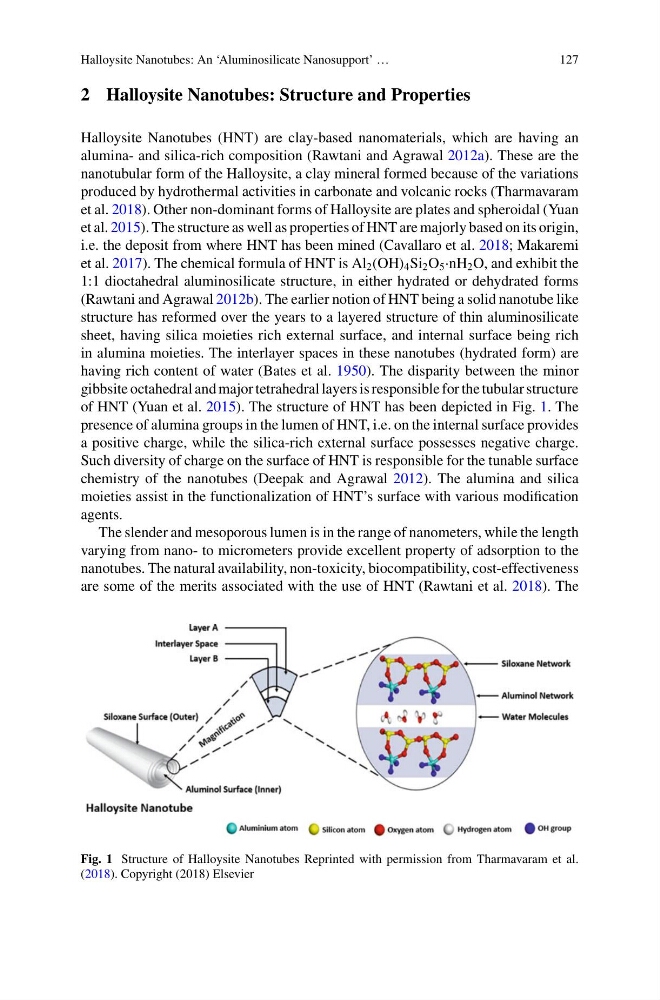
of HNT (Yuan et al. 2015). The structure of HNT has been depicted in Fig. 1. The
presence of alumina groups in the lumen of HNT, i.e. on the internal surface provides
a positive charge, while the silica-rich external surface possesses negative charge.
Such diversity of charge on the surface of HNT is responsible for the tunable surface
chemistry of the nanotubes (Deepak and Agrawal 2012). The alumina and silica
moieties assist in the functionalization of HNT’s surface with various modification
agents.
The slender and mesoporous lumen is in the range of nanometers, while the length
varying from nano- to micrometers provide excellent property of adsorption to the
nanotubes. The natural availability, non-toxicity, biocompatibility, cost-effectiveness
are some of the merits associated with the use of HNT (Rawtani et al. 2018). The
Fig. 1 Structure of Halloysite Nanotubes Reprinted with permission from Tharmavaram et al.
(2018). Copyright (2018) Elsevier
127
2 Halloysite Nanotubes: Structure and Properties
Halloysite Nanotubes (HNT) are clay-based nanomaterials, which are having an
alumina- and silica-rich composition (Rawtani and Agrawal 2012a). These are the
nanotubular form of the Halloysite, a clay mineral formed because of the variations
produced by hydrothermal activities in carbonate and volcanic rocks (Tharmavaram
et al. 2018). Other non-dominant forms of Halloysite are plates and spheroidal (Yuan
et al. 2015). The structure as well as properties of HNT are majorly based on its origin,
i.e. the deposit from where HNT has been mined (Cavallaro et al. 2018; Makaremi
et al. 2017). The chemical formula of HNT is Al 2 (OH) 4 Si 2 O 5 ·nH 2 O, and exhibit the
1:1 dioctahedral aluminosilicate structure, in either hydrated or dehydrated forms
(Rawtani and Agrawal 2012b). The earlier notion of HNT being a solid nanotube like
structure has reformed over the years to a layered structure of thin aluminosilicate
sheet, having silica moieties rich external surface, and internal surface being rich
in alumina moieties. The interlayer spaces in these nanotubes (hydrated form) are
having rich content of water (Bates et al. 1950). The disparity between the minor
gibbsite octahedral and major tetrahedral layers is responsible for the tubular structure
of HNT (Yuan et al. 2015). The structure of HNT has been depicted in Fig. 1. The
presence of alumina groups in the lumen of HNT, i.e. on the internal surface provides
a positive charge, while the silica-rich external surface possesses negative charge.
Such diversity of charge on the surface of HNT is responsible for the tunable surface
chemistry of the nanotubes (Deepak and Agrawal 2012). The alumina and silica
moieties assist in the functionalization of HNT’s surface with various modification
agents.
The slender and mesoporous lumen is in the range of nanometers, while the length
varying from nano- to micrometers provide excellent property of adsorption to the
nanotubes. The natural availability, non-toxicity, biocompatibility, cost-effectiveness
are some of the merits associated with the use of HNT (Rawtani et al. 2018). The
Fig. 1 Structure of Halloysite Nanotubes Reprinted with permission from Tharmavaram et al.
(2018). Copyright (2018) Elsevier