

100
A. Bagaria and S. Ramakumar
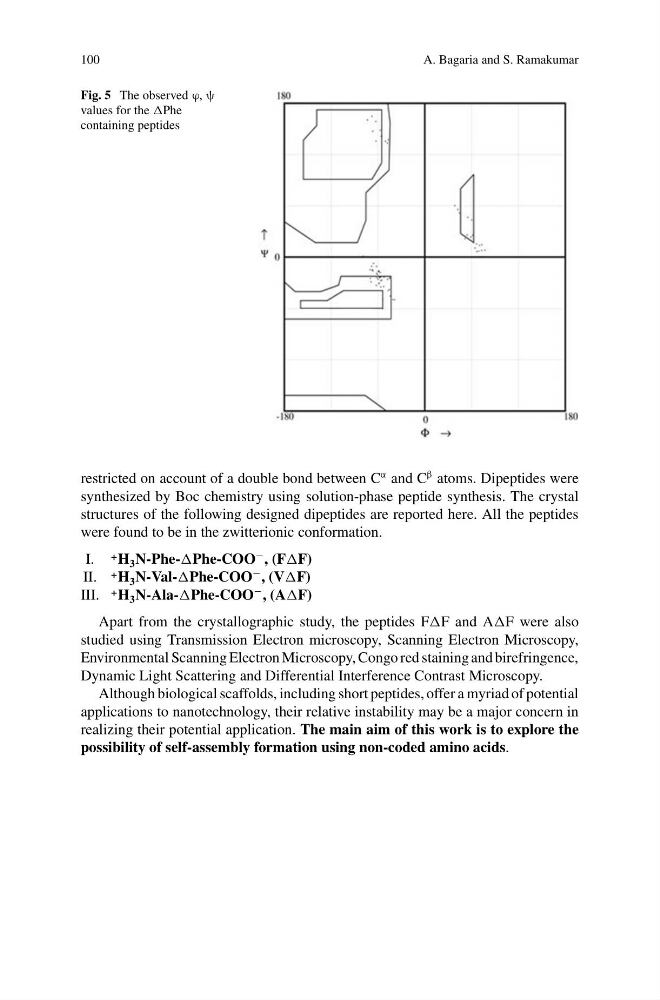
Fig. 5 The observed ϕ, ψ
values for the Phe
containing peptides
restricted on account of a double bond between C
α and C
β atoms. Dipeptides were
synthesized by Boc chemistry using solution-phase peptide synthesis. The crystal
structures of the following designed dipeptides are reported here. All the peptides
were found to be in the zwitterionic conformation.
I. + H 3 N-Phe-Phe-COO
− , (FF)
II. + H 3 N-Val-Phe-COO
− , (VF)
III. + H 3 N-Ala-Phe-COO
− , (AF)
Apart from the crystallographic study, the peptides FF and AF were also
studied using Transmission Electron microscopy, Scanning Electron Microscopy,
Environmental Scanning Electron Microscopy, Congo red staining and birefringence,
Dynamic Light Scattering and Differential Interference Contrast Microscopy.
Although biological scaffolds, including short peptides, offer a myriad of potential
applications to nanotechnology, their relative instability may be a major concern in
realizing their potential application. The main aim of this work is to explore the
possibility of self-assembly formation using non-coded amino acids.
A. Bagaria and S. Ramakumar
Fig. 5 The observed ϕ, ψ
values for the Phe
containing peptides
restricted on account of a double bond between C
α and C
β atoms. Dipeptides were
synthesized by Boc chemistry using solution-phase peptide synthesis. The crystal
structures of the following designed dipeptides are reported here. All the peptides
were found to be in the zwitterionic conformation.
I. + H 3 N-Phe-Phe-COO
− , (FF)
II. + H 3 N-Val-Phe-COO
− , (VF)
III. + H 3 N-Ala-Phe-COO
− , (AF)
Apart from the crystallographic study, the peptides FF and AF were also
studied using Transmission Electron microscopy, Scanning Electron Microscopy,
Environmental Scanning Electron Microscopy, Congo red staining and birefringence,
Dynamic Light Scattering and Differential Interference Contrast Microscopy.
Although biological scaffolds, including short peptides, offer a myriad of potential
applications to nanotechnology, their relative instability may be a major concern in
realizing their potential application. The main aim of this work is to explore the
possibility of self-assembly formation using non-coded amino acids.