

88
C. Balasubramanian
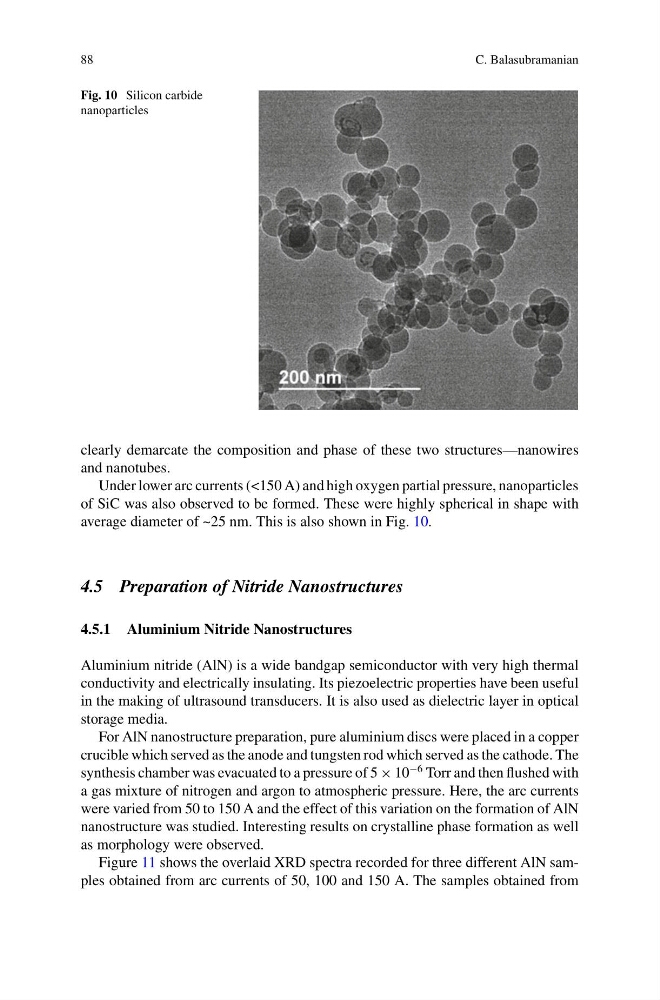
Fig. 10 Silicon carbide
nanoparticles
clearly demarcate the composition and phase of these two structures—nanowires
and nanotubes.
Under lower arc currents (<150 A) and high oxygen partial pressure, nanoparticles
of SiC was also observed to be formed. These were highly spherical in shape with
average diameter of ~25 nm. This is also shown in Fig. 10.
4.5 Preparation of Nitride Nanostructures
4.5.1 Aluminium Nitride Nanostructures
Aluminium nitride (AlN) is a wide bandgap semiconductor with very high thermal
conductivity and electrically insulating. Its piezoelectric properties have been useful
in the making of ultrasound transducers. It is also used as dielectric layer in optical
storage media.
For AlN nanostructure preparation, pure aluminium discs were placed in a copper
crucible which served as the anode and tungsten rod which served as the cathode. The
synthesis chamber was evacuated to a pressure of 5 × 10
−6 Torr and then flushed with
a gas mixture of nitrogen and argon to atmospheric pressure. Here, the arc currents
were varied from 50 to 150 A and the effect of this variation on the formation of AlN
nanostructure was studied. Interesting results on crystalline phase formation as well
as morphology were observed.
Figure 11 shows the overlaid XRD spectra recorded for three different AlN samples obtained from arc currents of 50, 100 and 150 A. The samples obtained from
C. Balasubramanian
Fig. 10 Silicon carbide
nanoparticles
clearly demarcate the composition and phase of these two structures—nanowires
and nanotubes.
Under lower arc currents (<150 A) and high oxygen partial pressure, nanoparticles
of SiC was also observed to be formed. These were highly spherical in shape with
average diameter of ~25 nm. This is also shown in Fig. 10.
4.5 Preparation of Nitride Nanostructures
4.5.1 Aluminium Nitride Nanostructures
Aluminium nitride (AlN) is a wide bandgap semiconductor with very high thermal
conductivity and electrically insulating. Its piezoelectric properties have been useful
in the making of ultrasound transducers. It is also used as dielectric layer in optical
storage media.
For AlN nanostructure preparation, pure aluminium discs were placed in a copper
crucible which served as the anode and tungsten rod which served as the cathode. The
synthesis chamber was evacuated to a pressure of 5 × 10
−6 Torr and then flushed with
a gas mixture of nitrogen and argon to atmospheric pressure. Here, the arc currents
were varied from 50 to 150 A and the effect of this variation on the formation of AlN
nanostructure was studied. Interesting results on crystalline phase formation as well
as morphology were observed.
Figure 11 shows the overlaid XRD spectra recorded for three different AlN samples obtained from arc currents of 50, 100 and 150 A. The samples obtained from