

34
X-Machines for Agent-Based Modeling: FLAME Perspectives
inheriting from the environment and having their own functions as well.
This allows agents to easily communicate with the environment as they
inherit variables from the environment.
T h e i n t e r f a c e
P r o b e s t o c o n t r o l t h e m o d e l
T h e m o d e l
A g e n t s
S w a r m
S u b - S w a r m
E v e r y l e v e l h a s i t s o w n c l o c k
w h i c h i s s y n c h r o n i s e d
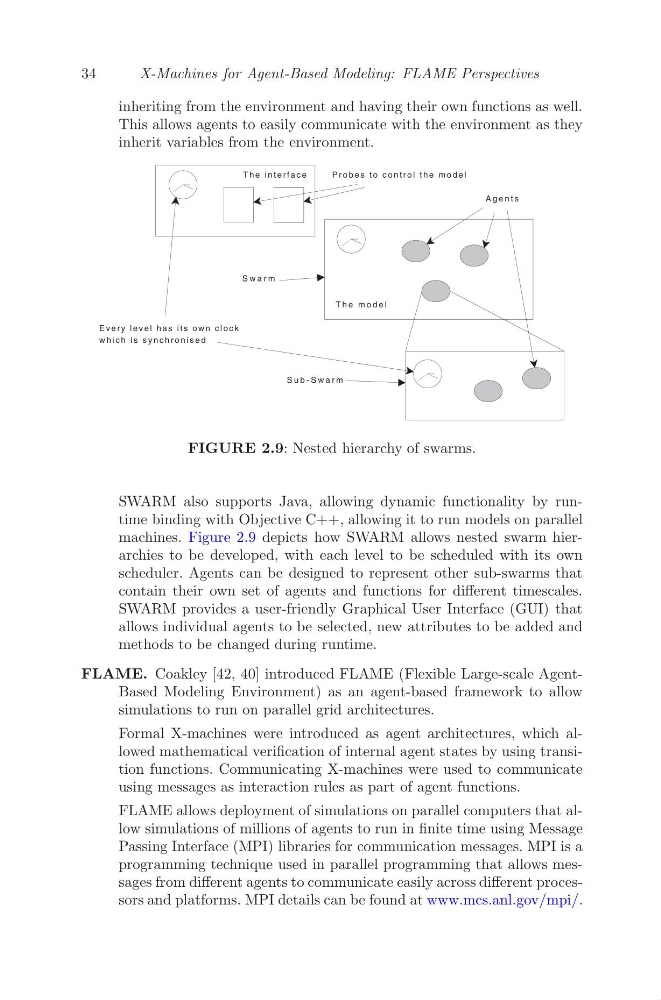
FIGURE 2.9: Nested hierarchy of swarms.
SWARM also supports Java, allowing dynamic functionality by runtime binding with Objective C++, allowing it to run models on parallel
machines. Figure 2.9 depicts how SWARM allows nested swarm hierarchies to be developed, with each level to be scheduled with its own
scheduler. Agents can be designed to represent other sub-swarms that
contain their own set of agents and functions for different timescales.
SWARM provides a user-friendly Graphical User Interface (GUI) that
allows individual agents to be selected, new attributes to be added and
methods to be changed during runtime.
FLAME. Coakley [42, 40] introduced FLAME (Flexible Large-scale AgentBased Modeling Environment) as an agent-based framework to allow
simulations to run on parallel grid architectures.
Formal X-machines were introduced as agent architectures, which allowed mathematical verification of internal agent states by using transition functions. Communicating X-machines were used to communicate
using messages as interaction rules as part of agent functions.
FLAME allows deployment of simulations on parallel computers that allow simulations of millions of agents to run in finite time using Message
Passing Interface (MPI) libraries for communication messages. MPI is a
programming technique used in parallel programming that allows messages from different agents to communicate easily across different processors and platforms. MPI details can be found at www.mcs.anl.gov/mpi/.
X-Machines for Agent-Based Modeling: FLAME Perspectives
inheriting from the environment and having their own functions as well.
This allows agents to easily communicate with the environment as they
inherit variables from the environment.
T h e i n t e r f a c e
P r o b e s t o c o n t r o l t h e m o d e l
T h e m o d e l
A g e n t s
S w a r m
S u b - S w a r m
E v e r y l e v e l h a s i t s o w n c l o c k
w h i c h i s s y n c h r o n i s e d
FIGURE 2.9: Nested hierarchy of swarms.
SWARM also supports Java, allowing dynamic functionality by runtime binding with Objective C++, allowing it to run models on parallel
machines. Figure 2.9 depicts how SWARM allows nested swarm hierarchies to be developed, with each level to be scheduled with its own
scheduler. Agents can be designed to represent other sub-swarms that
contain their own set of agents and functions for different timescales.
SWARM provides a user-friendly Graphical User Interface (GUI) that
allows individual agents to be selected, new attributes to be added and
methods to be changed during runtime.
FLAME. Coakley [42, 40] introduced FLAME (Flexible Large-scale AgentBased Modeling Environment) as an agent-based framework to allow
simulations to run on parallel grid architectures.
Formal X-machines were introduced as agent architectures, which allowed mathematical verification of internal agent states by using transition functions. Communicating X-machines were used to communicate
using messages as interaction rules as part of agent functions.
FLAME allows deployment of simulations on parallel computers that allow simulations of millions of agents to run in finite time using Message
Passing Interface (MPI) libraries for communication messages. MPI is a
programming technique used in parallel programming that allows messages from different agents to communicate easily across different processors and platforms. MPI details can be found at www.mcs.anl.gov/mpi/.