

Artificial Agents
19
E v o l u t i o n a r y
C o m p u t a t i o n
E v o l u t i o n a r y
A l g o r i t h m s
S w a r m
I n t e l l i g e n c e
G e n e t i c a l g o r i t h m
E v o l u t i o n a r y p r o g r a m m i n g
E v o l u t i o n a r y s t r a t e g i e s
G e n e t i c p r o g r a m m i n g
C l a s s i f i e r s y s t e m s
A n t c o l o n y o p t i m i s a t i o n
M e m e t i c a l g o r i t h m
P a r t i c l e s w a r m o p t i m i s a t i o n
O p t i m i s a t i o n
t e c h n i q u e s
D i f f e r e n t i a l e v o l u t i o n
N e u r a l N e t w o r k s
A r t i f i c i a l
I n t e l l i g e n c e
F u z z y s y s t e m s
E x p e r t s y s t e m s
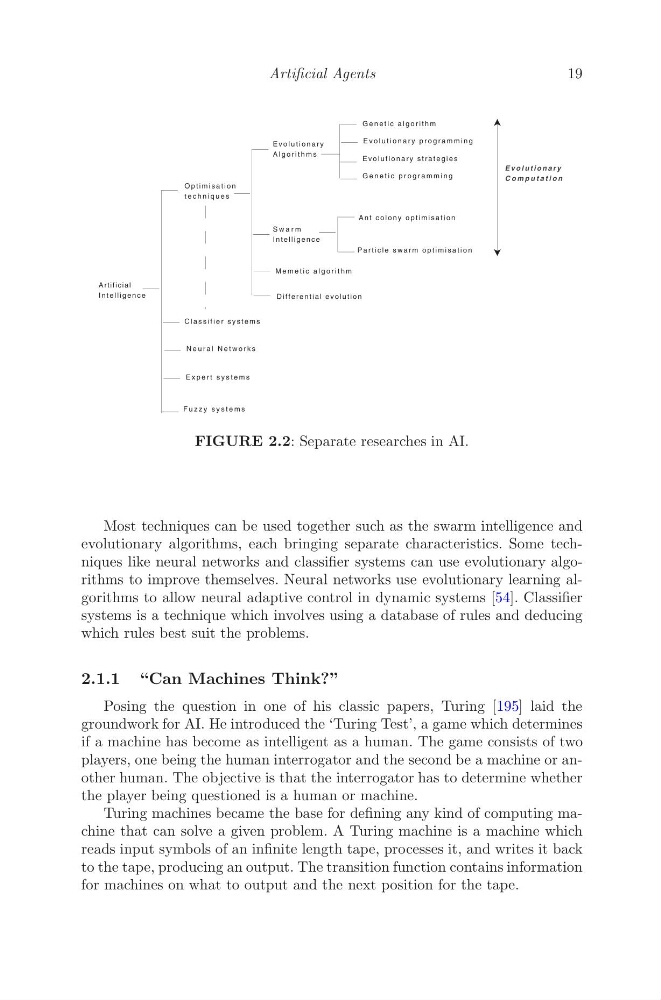
FIGURE 2.2: Separate researches in AI.
Most techniques can be used together such as the swarm intelligence and
evolutionary algorithms, each bringing separate characteristics. Some techniques like neural networks and classifier systems can use evolutionary algorithms to improve themselves. Neural networks use evolutionary learning algorithms to allow neural adaptive control in dynamic systems [54]. Classifier
systems is a technique which involves using a database of rules and deducing
which rules best suit the problems.
2.1.1 “Can Machines Think?”
Posing the question in one of his classic papers, Turing [195] laid the
groundwork for AI. He introduced the ‘Turing Test’, a game which determines
if a machine has become as intelligent as a human. The game consists of two
players, one being the human interrogator and the second be a machine or another human. The objective is that the interrogator has to determine whether
the player being questioned is a human or machine.
Turing machines became the base for defining any kind of computing machine that can solve a given problem. A Turing machine is a machine which
reads input symbols of an infinite length tape, processes it, and writes it back
to the tape, producing an output. The transition function contains information
for machines on what to output and the next position for the tape.
19
E v o l u t i o n a r y
C o m p u t a t i o n
E v o l u t i o n a r y
A l g o r i t h m s
S w a r m
I n t e l l i g e n c e
G e n e t i c a l g o r i t h m
E v o l u t i o n a r y p r o g r a m m i n g
E v o l u t i o n a r y s t r a t e g i e s
G e n e t i c p r o g r a m m i n g
C l a s s i f i e r s y s t e m s
A n t c o l o n y o p t i m i s a t i o n
M e m e t i c a l g o r i t h m
P a r t i c l e s w a r m o p t i m i s a t i o n
O p t i m i s a t i o n
t e c h n i q u e s
D i f f e r e n t i a l e v o l u t i o n
N e u r a l N e t w o r k s
A r t i f i c i a l
I n t e l l i g e n c e
F u z z y s y s t e m s
E x p e r t s y s t e m s
FIGURE 2.2: Separate researches in AI.
Most techniques can be used together such as the swarm intelligence and
evolutionary algorithms, each bringing separate characteristics. Some techniques like neural networks and classifier systems can use evolutionary algorithms to improve themselves. Neural networks use evolutionary learning algorithms to allow neural adaptive control in dynamic systems [54]. Classifier
systems is a technique which involves using a database of rules and deducing
which rules best suit the problems.
2.1.1 “Can Machines Think?”
Posing the question in one of his classic papers, Turing [195] laid the
groundwork for AI. He introduced the ‘Turing Test’, a game which determines
if a machine has become as intelligent as a human. The game consists of two
players, one being the human interrogator and the second be a machine or another human. The objective is that the interrogator has to determine whether
the player being questioned is a human or machine.
Turing machines became the base for defining any kind of computing machine that can solve a given problem. A Turing machine is a machine which
reads input symbols of an infinite length tape, processes it, and writes it back
to the tape, producing an output. The transition function contains information
for machines on what to output and the next position for the tape.