

4
X-Machines for Agent-Based Modeling: FLAME Perspectives
T y p e o f c o m p l e x s y s t e m
( F u n c t i o n o f t h e s y s t e m )
T h e k i n d o f s c e n a r i o s
( A g e n t s )
K e y :
P r e b i o t i c E v o l u t i o n
( E m e r g e n c e o f l i f e )
C h e m i c a l N e t w o r k s
( M o l e c u l e s )
D a r w i n i a n E v o l u t i o n
( F o r m a t i o n o f s p e c i e s )
G e n e t i c A l g o r i t h m s
( G e n e s )
B r a i n E v o l u t i o n
( L e a r n i n g , p r e d i c t i o n s )
N e u r a l N e t w o r k s
( N e u r o n s )
S o c i a l E v o l u t i o n
( E c o l o g i e s , e c o n o m i e s )
E v o l u t i o n a r y G a m e s
( P l a y e r s )
C o m m o n A t t r i b u t e s :
M e m o r y ,
S t o r i n g
i n f o r m a t i o n
C o m p u t a t i o n
i n p u t , a c t i o n
R e w a r d s y s t e m ,
A s s i g n c r e d i t s
N o i s e a n d
c o n t r o l
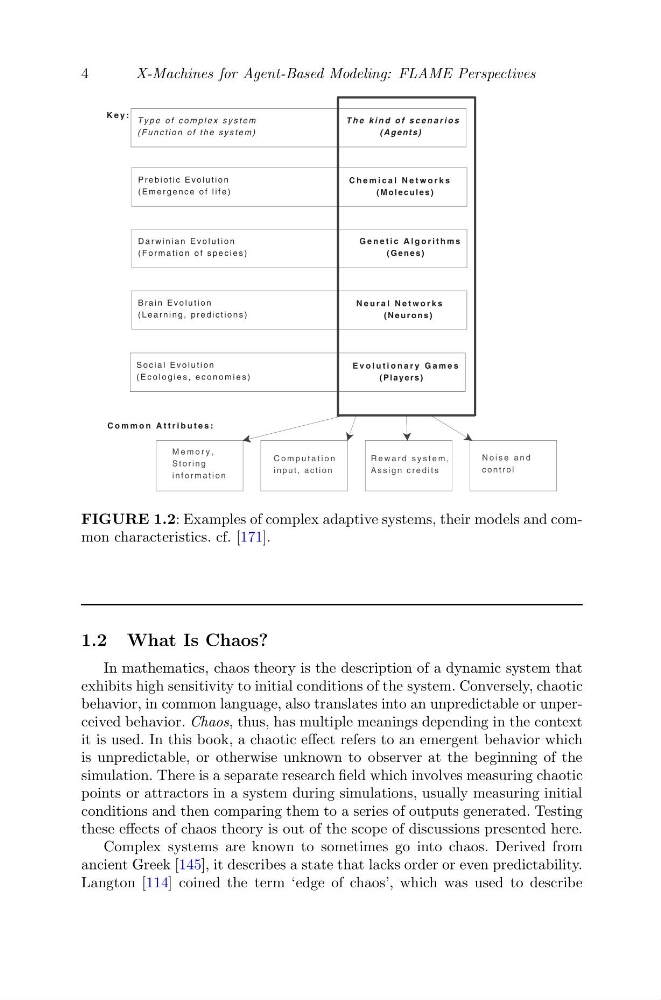
FIGURE 1.2: Examples of complex adaptive systems, their models and common characteristics. cf. [171].
1.2 What Is Chaos?
In mathematics, chaos theory is the description of a dynamic system that
exhibits high sensitivity to initial conditions of the system. Conversely, chaotic
behavior, in common language, also translates into an unpredictable or unperceived behavior. Chaos, thus, has multiple meanings depending in the context
it is used. In this book, a chaotic effect refers to an emergent behavior which
is unpredictable, or otherwise unknown to observer at the beginning of the
simulation. There is a separate research field which involves measuring chaotic
points or attractors in a system during simulations, usually measuring initial
conditions and then comparing them to a series of outputs generated. Testing
these effects of chaos theory is out of the scope of discussions presented here.
Complex systems are known to sometimes go into chaos. Derived from
ancient Greek [145], it describes a state that lacks order or even predictability.
Langton [114] coined the term ‘edge of chaos’, which was used to describe
X-Machines for Agent-Based Modeling: FLAME Perspectives
T y p e o f c o m p l e x s y s t e m
( F u n c t i o n o f t h e s y s t e m )
T h e k i n d o f s c e n a r i o s
( A g e n t s )
K e y :
P r e b i o t i c E v o l u t i o n
( E m e r g e n c e o f l i f e )
C h e m i c a l N e t w o r k s
( M o l e c u l e s )
D a r w i n i a n E v o l u t i o n
( F o r m a t i o n o f s p e c i e s )
G e n e t i c A l g o r i t h m s
( G e n e s )
B r a i n E v o l u t i o n
( L e a r n i n g , p r e d i c t i o n s )
N e u r a l N e t w o r k s
( N e u r o n s )
S o c i a l E v o l u t i o n
( E c o l o g i e s , e c o n o m i e s )
E v o l u t i o n a r y G a m e s
( P l a y e r s )
C o m m o n A t t r i b u t e s :
M e m o r y ,
S t o r i n g
i n f o r m a t i o n
C o m p u t a t i o n
i n p u t , a c t i o n
R e w a r d s y s t e m ,
A s s i g n c r e d i t s
N o i s e a n d
c o n t r o l
FIGURE 1.2: Examples of complex adaptive systems, their models and common characteristics. cf. [171].
1.2 What Is Chaos?
In mathematics, chaos theory is the description of a dynamic system that
exhibits high sensitivity to initial conditions of the system. Conversely, chaotic
behavior, in common language, also translates into an unpredictable or unperceived behavior. Chaos, thus, has multiple meanings depending in the context
it is used. In this book, a chaotic effect refers to an emergent behavior which
is unpredictable, or otherwise unknown to observer at the beginning of the
simulation. There is a separate research field which involves measuring chaotic
points or attractors in a system during simulations, usually measuring initial
conditions and then comparing them to a series of outputs generated. Testing
these effects of chaos theory is out of the scope of discussions presented here.
Complex systems are known to sometimes go into chaos. Derived from
ancient Greek [145], it describes a state that lacks order or even predictability.
Langton [114] coined the term ‘edge of chaos’, which was used to describe