

278
X-Machines for Agent-Based Modeling: FLAME Perspectives
This information is again attached to the patient but will also be broadcast for other staff to read when appropriate, e.g. when making decisions
about who a doctor should see next or during further treatment. The
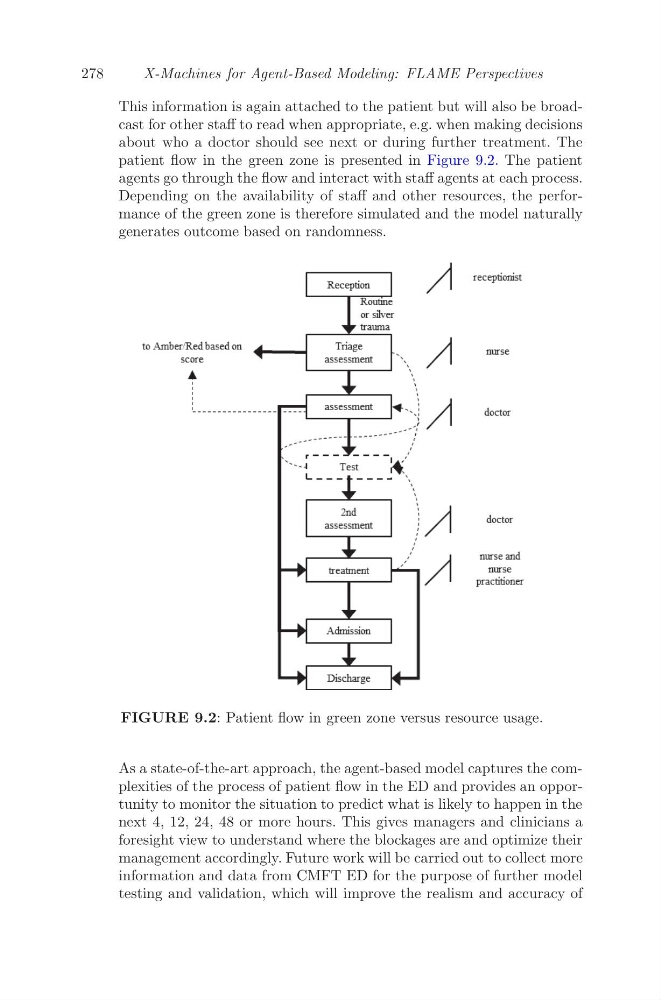
patient flow in the green zone is presented in Figure 9.2. The patient
agents go through the flow and interact with staff agents at each process.
Depending on the availability of staff and other resources, the performance of the green zone is therefore simulated and the model naturally
generates outcome based on randomness.
FIGURE 9.2: Patient flow in green zone versus resource usage.
As a state-of-the-art approach, the agent-based model captures the complexities of the process of patient flow in the ED and provides an opportunity to monitor the situation to predict what is likely to happen in the
next 4, 12, 24, 48 or more hours. This gives managers and clinicians a
foresight view to understand where the blockages are and optimize their
management accordingly. Future work will be carried out to collect more
information and data from CMFT ED for the purpose of further model
testing and validation, which will improve the realism and accuracy of
X-Machines for Agent-Based Modeling: FLAME Perspectives
This information is again attached to the patient but will also be broadcast for other staff to read when appropriate, e.g. when making decisions
about who a doctor should see next or during further treatment. The
patient flow in the green zone is presented in Figure 9.2. The patient
agents go through the flow and interact with staff agents at each process.
Depending on the availability of staff and other resources, the performance of the green zone is therefore simulated and the model naturally
generates outcome based on randomness.
FIGURE 9.2: Patient flow in green zone versus resource usage.
As a state-of-the-art approach, the agent-based model captures the complexities of the process of patient flow in the ED and provides an opportunity to monitor the situation to predict what is likely to happen in the
next 4, 12, 24, 48 or more hours. This gives managers and clinicians a
foresight view to understand where the blockages are and optimize their
management accordingly. Future work will be carried out to collect more
information and data from CMFT ED for the purpose of further model
testing and validation, which will improve the realism and accuracy of