

276
X-Machines for Agent-Based Modeling: FLAME Perspectives
x
y
steer_x
steer_y
agent_type
p_one
continuous
65536
9.1.2 Utilizing Vector Calculations
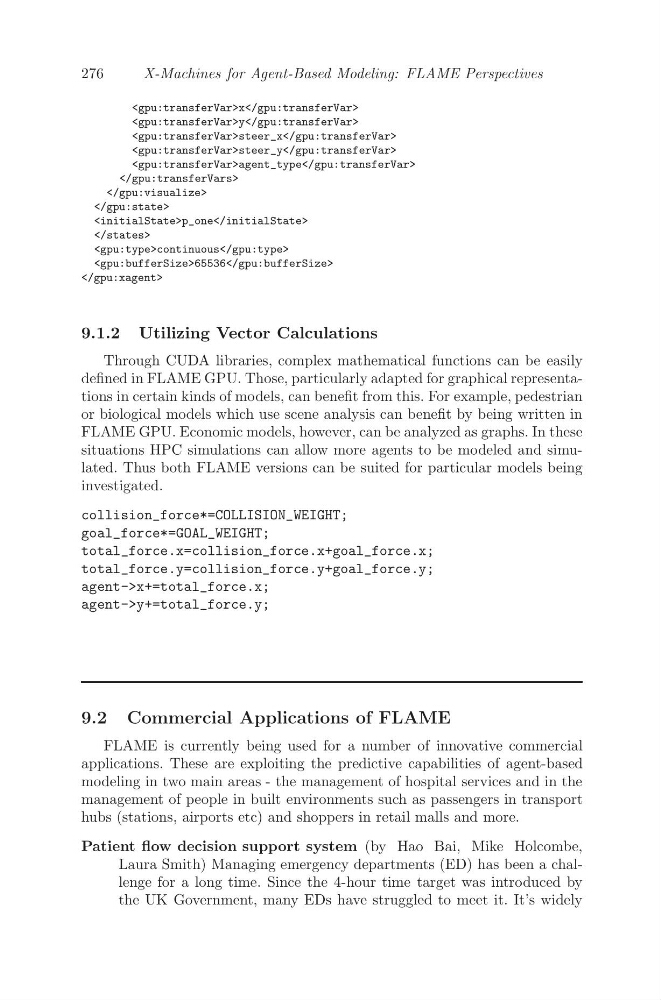
Through CUDA libraries, complex mathematical functions can be easily
defined in FLAME GPU. Those, particularly adapted for graphical representations in certain kinds of models, can benefit from this. For example, pedestrian
or biological models which use scene analysis can benefit by being written in
FLAME GPU. Economic models, however, can be analyzed as graphs. In these
situations HPC simulations can allow more agents to be modeled and simulated. Thus both FLAME versions can be suited for particular models being
investigated.
collision_force*=COLLISION_WEIGHT;
goal_force*=GOAL_WEIGHT;
total_force.x=collision_force.x+goal_force.x;
total_force.y=collision_force.y+goal_force.y;
agent->x+=total_force.x;
agent->y+=total_force.y;
9.2 Commercial Applications of FLAME
FLAME is currently being used for a number of innovative commercial
applications. These are exploiting the predictive capabilities of agent-based
modeling in two main areas - the management of hospital services and in the
management of people in built environments such as passengers in transport
hubs (stations, airports etc) and shoppers in retail malls and more.
Patient flow decision support system (by Hao Bai, Mike Holcombe,
Laura Smith) Managing emergency departments (ED) has been a challenge for a long time. Since the 4-hour time target was introduced by
the UK Government, many EDs have struggled to meet it. It’s widely
X-Machines for Agent-Based Modeling: FLAME Perspectives
9.1.2 Utilizing Vector Calculations
Through CUDA libraries, complex mathematical functions can be easily
defined in FLAME GPU. Those, particularly adapted for graphical representations in certain kinds of models, can benefit from this. For example, pedestrian
or biological models which use scene analysis can benefit by being written in
FLAME GPU. Economic models, however, can be analyzed as graphs. In these
situations HPC simulations can allow more agents to be modeled and simulated. Thus both FLAME versions can be suited for particular models being
investigated.
collision_force*=COLLISION_WEIGHT;
goal_force*=GOAL_WEIGHT;
total_force.x=collision_force.x+goal_force.x;
total_force.y=collision_force.y+goal_force.y;
agent->x+=total_force.x;
agent->y+=total_force.y;
9.2 Commercial Applications of FLAME
FLAME is currently being used for a number of innovative commercial
applications. These are exploiting the predictive capabilities of agent-based
modeling in two main areas - the management of hospital services and in the
management of people in built environments such as passengers in transport
hubs (stations, airports etc) and shoppers in retail malls and more.
Patient flow decision support system (by Hao Bai, Mike Holcombe,
Laura Smith) Managing emergency departments (ED) has been a challenge for a long time. Since the 4-hour time target was introduced by
the UK Government, many EDs have struggled to meet it. It’s widely