

Testing Agent Behavior
245
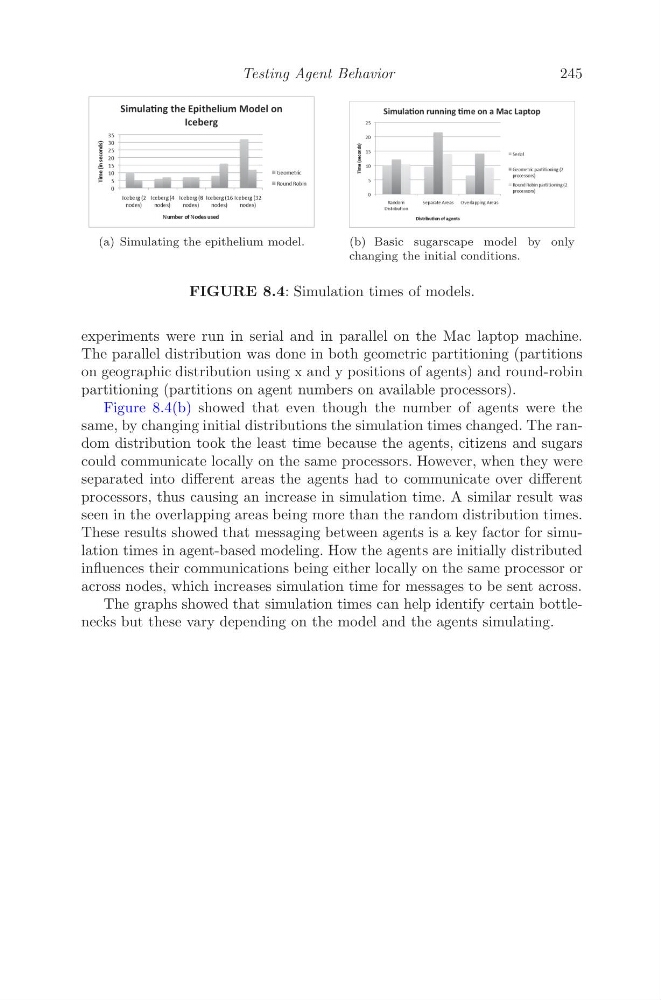
(a) Simulating the epithelium model.
(b) Basic sugarscape model by only
changing the initial conditions.
FIGURE 8.4: Simulation times of models.
experiments were run in serial and in parallel on the Mac laptop machine.
The parallel distribution was done in both geometric partitioning (partitions
on geographic distribution using x and y positions of agents) and round-robin
partitioning (partitions on agent numbers on available processors).
Figure 8.4(b) showed that even though the number of agents were the
same, by changing initial distributions the simulation times changed. The random distribution took the least time because the agents, citizens and sugars
could communicate locally on the same processors. However, when they were
separated into different areas the agents had to communicate over different
processors, thus causing an increase in simulation time. A similar result was
seen in the overlapping areas being more than the random distribution times.
These results showed that messaging between agents is a key factor for simulation times in agent-based modeling. How the agents are initially distributed
influences their communications being either locally on the same processor or
across nodes, which increases simulation time for messages to be sent across.
The graphs showed that simulation times can help identify certain bottlenecks but these vary depending on the model and the agents simulating.
245
(a) Simulating the epithelium model.
(b) Basic sugarscape model by only
changing the initial conditions.
FIGURE 8.4: Simulation times of models.
experiments were run in serial and in parallel on the Mac laptop machine.
The parallel distribution was done in both geometric partitioning (partitions
on geographic distribution using x and y positions of agents) and round-robin
partitioning (partitions on agent numbers on available processors).
Figure 8.4(b) showed that even though the number of agents were the
same, by changing initial distributions the simulation times changed. The random distribution took the least time because the agents, citizens and sugars
could communicate locally on the same processors. However, when they were
separated into different areas the agents had to communicate over different
processors, thus causing an increase in simulation time. A similar result was
seen in the overlapping areas being more than the random distribution times.
These results showed that messaging between agents is a key factor for simulation times in agent-based modeling. How the agents are initially distributed
influences their communications being either locally on the same processor or
across nodes, which increases simulation time for messages to be sent across.
The graphs showed that simulation times can help identify certain bottlenecks but these vary depending on the model and the agents simulating.