

Agents in Biology
189
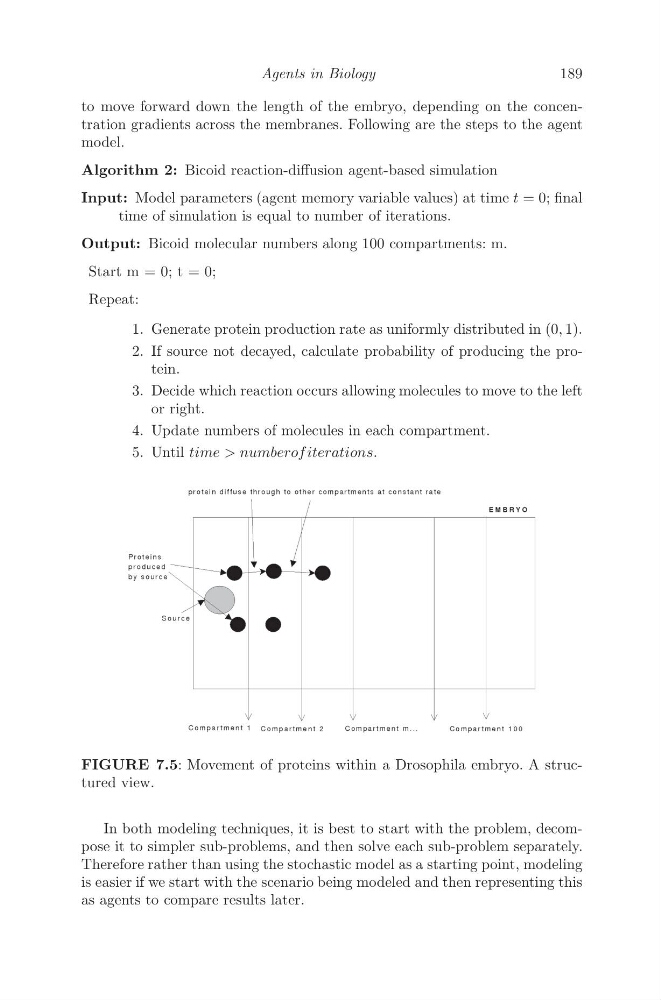
to move forward down the length of the embryo, depending on the concentration gradients across the membranes. Following are the steps to the agent
model.
Algorithm 2: Bicoid reaction-diffusion agent-based simulation
Input: Model parameters (agent memory variable values) at time t = 0; final
time of simulation is equal to number of iterations.
Output: Bicoid molecular numbers along 100 compartments: m.
Start m = 0; t = 0;
Repeat:
1. Generate protein production rate as uniformly distributed in (0, 1).
2. If source not decayed, calculate probability of producing the protein.
3. Decide which reaction occurs allowing molecules to move to the left
or right.
4. Update numbers of molecules in each compartment.
5. Until time > numberof iterations.
FIGURE 7.5: Movement of proteins within a Drosophila embryo. A structured view.
In both modeling techniques, it is best to start with the problem, decompose it to simpler sub-problems, and then solve each sub-problem separately.
Therefore rather than using the stochastic model as a starting point, modeling
is easier if we start with the scenario being modeled and then representing this
as agents to compare results later.
189
to move forward down the length of the embryo, depending on the concentration gradients across the membranes. Following are the steps to the agent
model.
Algorithm 2: Bicoid reaction-diffusion agent-based simulation
Input: Model parameters (agent memory variable values) at time t = 0; final
time of simulation is equal to number of iterations.
Output: Bicoid molecular numbers along 100 compartments: m.
Start m = 0; t = 0;
Repeat:
1. Generate protein production rate as uniformly distributed in (0, 1).
2. If source not decayed, calculate probability of producing the protein.
3. Decide which reaction occurs allowing molecules to move to the left
or right.
4. Update numbers of molecules in each compartment.
5. Until time > numberof iterations.
FIGURE 7.5: Movement of proteins within a Drosophila embryo. A structured view.
In both modeling techniques, it is best to start with the problem, decompose it to simpler sub-problems, and then solve each sub-problem separately.
Therefore rather than using the stochastic model as a starting point, modeling
is easier if we start with the scenario being modeled and then representing this
as agents to compare results later.