

Agents in Economic Markets and Games
161
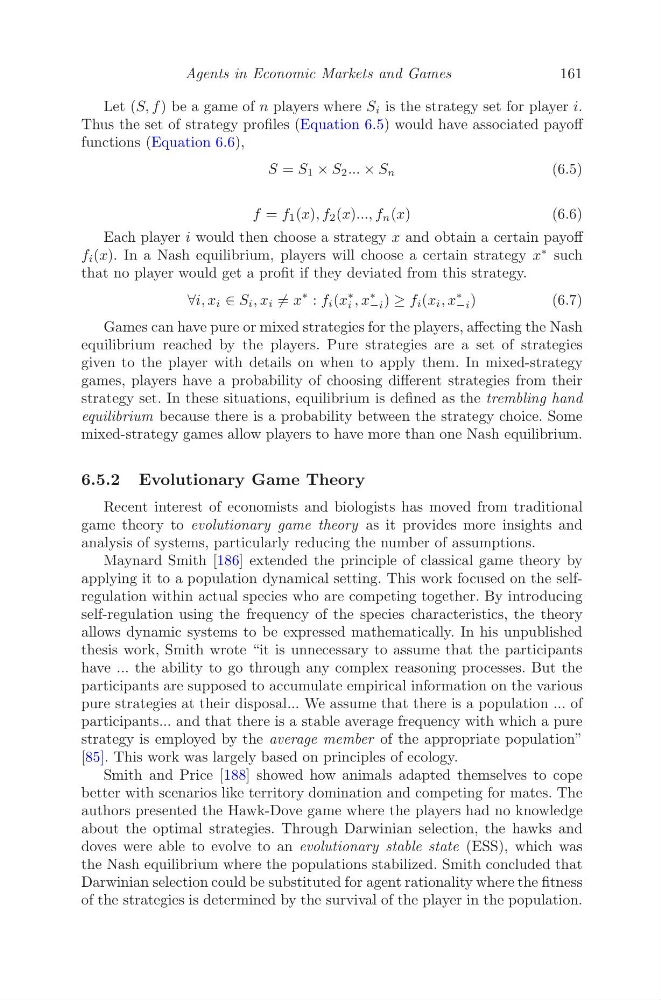
Let (S, f ) be a game of n players where S i is the strategy set for player i.
Thus the set of strategy profiles (Equation 6.5) would have associated payoff
functions (Equation 6.6),
S = S 1 × S 2 ... × S n
(6.5)
f = f 1 (x), f 2 (x)..., f n (x)
(6.6)
Each player i would then choose a strategy x and obtain a certain payoff
f i (x). In a Nash equilibrium, players will choose a certain strategy x
∗ such
that no player would get a profit if they deviated from this strategy.
∀i, x i ∈ S i , x i = x
∗ : f i (x
∗
i , x
∗
−i ) ≥ f i (x i , x
∗
−i )
(6.7)
Games can have pure or mixed strategies for the players, affecting the Nash
equilibrium reached by the players. Pure strategies are a set of strategies
given to the player with details on when to apply them. In mixed-strategy
games, players have a probability of choosing different strategies from their
strategy set. In these situations, equilibrium is defined as the trembling hand
equilibrium because there is a probability between the strategy choice. Some
mixed-strategy games allow players to have more than one Nash equilibrium.
6.5.2 Evolutionary Game Theory
Recent interest of economists and biologists has moved from traditional
game theory to evolutionary game theory as it provides more insights and
analysis of systems, particularly reducing the number of assumptions.
Maynard Smith [186] extended the principle of classical game theory by
applying it to a population dynamical setting. This work focused on the selfregulation within actual species who are competing together. By introducing
self-regulation using the frequency of the species characteristics, the theory
allows dynamic systems to be expressed mathematically. In his unpublished
thesis work, Smith wrote “it is unnecessary to assume that the participants
have ... the ability to go through any complex reasoning processes. But the
participants are supposed to accumulate empirical information on the various
pure strategies at their disposal... We assume that there is a population ... of
participants... and that there is a stable average frequency with which a pure
strategy is employed by the average member of the appropriate population”
[85]. This work was largely based on principles of ecology.
Smith and Price [188] showed how animals adapted themselves to cope
better with scenarios like territory domination and competing for mates. The
authors presented the Hawk-Dove game where the players had no knowledge
about the optimal strategies. Through Darwinian selection, the hawks and
doves were able to evolve to an evolutionary stable state (ESS), which was
the Nash equilibrium where the populations stabilized. Smith concluded that
Darwinian selection could be substituted for agent rationality where the fitness
of the strategies is determined by the survival of the player in the population.
161
Let (S, f ) be a game of n players where S i is the strategy set for player i.
Thus the set of strategy profiles (Equation 6.5) would have associated payoff
functions (Equation 6.6),
S = S 1 × S 2 ... × S n
(6.5)
f = f 1 (x), f 2 (x)..., f n (x)
(6.6)
Each player i would then choose a strategy x and obtain a certain payoff
f i (x). In a Nash equilibrium, players will choose a certain strategy x
∗ such
that no player would get a profit if they deviated from this strategy.
∀i, x i ∈ S i , x i = x
∗ : f i (x
∗
i , x
∗
−i ) ≥ f i (x i , x
∗
−i )
(6.7)
Games can have pure or mixed strategies for the players, affecting the Nash
equilibrium reached by the players. Pure strategies are a set of strategies
given to the player with details on when to apply them. In mixed-strategy
games, players have a probability of choosing different strategies from their
strategy set. In these situations, equilibrium is defined as the trembling hand
equilibrium because there is a probability between the strategy choice. Some
mixed-strategy games allow players to have more than one Nash equilibrium.
6.5.2 Evolutionary Game Theory
Recent interest of economists and biologists has moved from traditional
game theory to evolutionary game theory as it provides more insights and
analysis of systems, particularly reducing the number of assumptions.
Maynard Smith [186] extended the principle of classical game theory by
applying it to a population dynamical setting. This work focused on the selfregulation within actual species who are competing together. By introducing
self-regulation using the frequency of the species characteristics, the theory
allows dynamic systems to be expressed mathematically. In his unpublished
thesis work, Smith wrote “it is unnecessary to assume that the participants
have ... the ability to go through any complex reasoning processes. But the
participants are supposed to accumulate empirical information on the various
pure strategies at their disposal... We assume that there is a population ... of
participants... and that there is a stable average frequency with which a pure
strategy is employed by the average member of the appropriate population”
[85]. This work was largely based on principles of ecology.
Smith and Price [188] showed how animals adapted themselves to cope
better with scenarios like territory domination and competing for mates. The
authors presented the Hawk-Dove game where the players had no knowledge
about the optimal strategies. Through Darwinian selection, the hawks and
doves were able to evolve to an evolutionary stable state (ESS), which was
the Nash equilibrium where the populations stabilized. Smith concluded that
Darwinian selection could be substituted for agent rationality where the fitness
of the strategies is determined by the survival of the player in the population.