

134
X-Machines for Agent-Based Modeling: FLAME Perspectives
quantity produced is more than the demand in the system, the product is
given away for free or on negative market prices (Equation 6.3).
Figure 6.8 shows that Nash equilibrium occurs when both firms’ reaction
curves cross at values of x = y = 24. This is when both firms are producing
the same output.
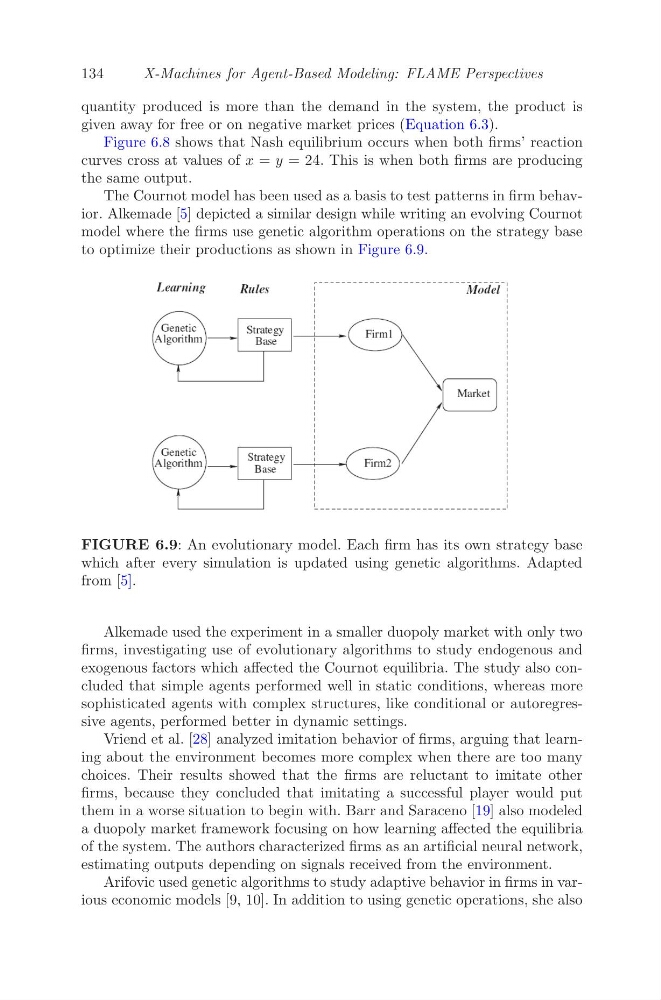
The Cournot model has been used as a basis to test patterns in firm behavior. Alkemade [5] depicted a similar design while writing an evolving Cournot
model where the firms use genetic algorithm operations on the strategy base
to optimize their productions as shown in Figure 6.9.
FIGURE 6.9: An evolutionary model. Each firm has its own strategy base
which after every simulation is updated using genetic algorithms. Adapted
from [5].
Alkemade used the experiment in a smaller duopoly market with only two
firms, investigating use of evolutionary algorithms to study endogenous and
exogenous factors which affected the Cournot equilibria. The study also concluded that simple agents performed well in static conditions, whereas more
sophisticated agents with complex structures, like conditional or autoregressive agents, performed better in dynamic settings.
Vriend et al. [28] analyzed imitation behavior of firms, arguing that learning about the environment becomes more complex when there are too many
choices. Their results showed that the firms are reluctant to imitate other
firms, because they concluded that imitating a successful player would put
them in a worse situation to begin with. Barr and Saraceno [19] also modeled
a duopoly market framework focusing on how learning affected the equilibria
of the system. The authors characterized firms as an artificial neural network,
estimating outputs depending on signals received from the environment.
Arifovic used genetic algorithms to study adaptive behavior in firms in various economic models [9, 10]. In addition to using genetic operations, she also
X-Machines for Agent-Based Modeling: FLAME Perspectives
quantity produced is more than the demand in the system, the product is
given away for free or on negative market prices (Equation 6.3).
Figure 6.8 shows that Nash equilibrium occurs when both firms’ reaction
curves cross at values of x = y = 24. This is when both firms are producing
the same output.
The Cournot model has been used as a basis to test patterns in firm behavior. Alkemade [5] depicted a similar design while writing an evolving Cournot
model where the firms use genetic algorithm operations on the strategy base
to optimize their productions as shown in Figure 6.9.
FIGURE 6.9: An evolutionary model. Each firm has its own strategy base
which after every simulation is updated using genetic algorithms. Adapted
from [5].
Alkemade used the experiment in a smaller duopoly market with only two
firms, investigating use of evolutionary algorithms to study endogenous and
exogenous factors which affected the Cournot equilibria. The study also concluded that simple agents performed well in static conditions, whereas more
sophisticated agents with complex structures, like conditional or autoregressive agents, performed better in dynamic settings.
Vriend et al. [28] analyzed imitation behavior of firms, arguing that learning about the environment becomes more complex when there are too many
choices. Their results showed that the firms are reluctant to imitate other
firms, because they concluded that imitating a successful player would put
them in a worse situation to begin with. Barr and Saraceno [19] also modeled
a duopoly market framework focusing on how learning affected the equilibria
of the system. The authors characterized firms as an artificial neural network,
estimating outputs depending on signals received from the environment.
Arifovic used genetic algorithms to study adaptive behavior in firms in various economic models [9, 10]. In addition to using genetic operations, she also