

80
S. Ghosh et al.
specimen, discussed in Sect. 3.2. 3D statistically equivalent virtual polycrystalline
microstructures (3D-SEVM) of various sizes are created using the method. The
DREAM.3D generated parent grain microstructure in a 250×250×250 μm domain,
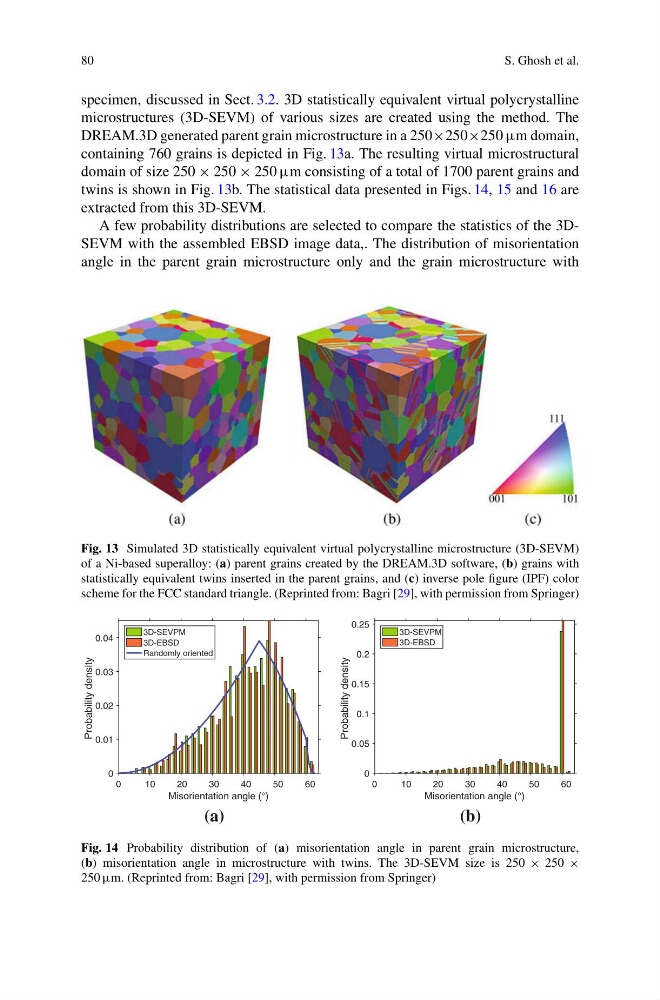
containing 760 grains is depicted in Fig. 13a. The resulting virtual microstructural
domain of size 250 × 250 × 250 μm consisting of a total of 1700 parent grains and
twins is shown in Fig. 13b. The statistical data presented in Figs. 14, 15 and 16 are
extracted from this 3D-SEVM.
A few probability distributions are selected to compare the statistics of the 3DSEVM with the assembled EBSD image data,. The distribution of misorientation
angle in the parent grain microstructure only and the grain microstructure with
Fig. 13 Simulated 3D statistically equivalent virtual polycrystalline microstructure (3D-SEVM)
of a Ni-based superalloy: (a) parent grains created by the DREAM.3D software, (b) grains with
statistically equivalent twins inserted in the parent grains, and (c) inverse pole figure (IPF) color
scheme for the FCC standard triangle. (Reprinted from: Bagri [29], with permission from Springer)
0
1 0
2 0
3 0
4 0
5 0
6 0
Misorientation angle (°)
0
0.01
0.02
0.03
0.04
Probability density
3D-SEVPM
3D-EBSD
Randomly oriented
(a)
0
1 0
2 0
3 0
4 0
5 0
6 0
Misorientation angle (°)
0
0.05
0.1
0.15
0.2
0.25
Probability density
3D-SEVPM
3D-EBSD
(b)
Fig. 14 Probability distribution of (a) misorientation angle in parent grain microstructure,
(b) misorientation angle in microstructure with twins. The 3D-SEVM size is 250 × 250 ×
250 μm. (Reprinted from: Bagri [29], with permission from Springer)
S. Ghosh et al.
specimen, discussed in Sect. 3.2. 3D statistically equivalent virtual polycrystalline
microstructures (3D-SEVM) of various sizes are created using the method. The
DREAM.3D generated parent grain microstructure in a 250×250×250 μm domain,
containing 760 grains is depicted in Fig. 13a. The resulting virtual microstructural
domain of size 250 × 250 × 250 μm consisting of a total of 1700 parent grains and
twins is shown in Fig. 13b. The statistical data presented in Figs. 14, 15 and 16 are
extracted from this 3D-SEVM.
A few probability distributions are selected to compare the statistics of the 3DSEVM with the assembled EBSD image data,. The distribution of misorientation
angle in the parent grain microstructure only and the grain microstructure with
Fig. 13 Simulated 3D statistically equivalent virtual polycrystalline microstructure (3D-SEVM)
of a Ni-based superalloy: (a) parent grains created by the DREAM.3D software, (b) grains with
statistically equivalent twins inserted in the parent grains, and (c) inverse pole figure (IPF) color
scheme for the FCC standard triangle. (Reprinted from: Bagri [29], with permission from Springer)
0
1 0
2 0
3 0
4 0
5 0
6 0
Misorientation angle (°)
0
0.01
0.02
0.03
0.04
Probability density
3D-SEVPM
3D-EBSD
Randomly oriented
(a)
0
1 0
2 0
3 0
4 0
5 0
6 0
Misorientation angle (°)
0
0.05
0.1
0.15
0.2
0.25
Probability density
3D-SEVPM
3D-EBSD
(b)
Fig. 14 Probability distribution of (a) misorientation angle in parent grain microstructure,
(b) misorientation angle in microstructure with twins. The 3D-SEVM size is 250 × 250 ×
250 μm. (Reprinted from: Bagri [29], with permission from Springer)