

M-SERVE and P-SERVE
75
(a)
(b)
(c)
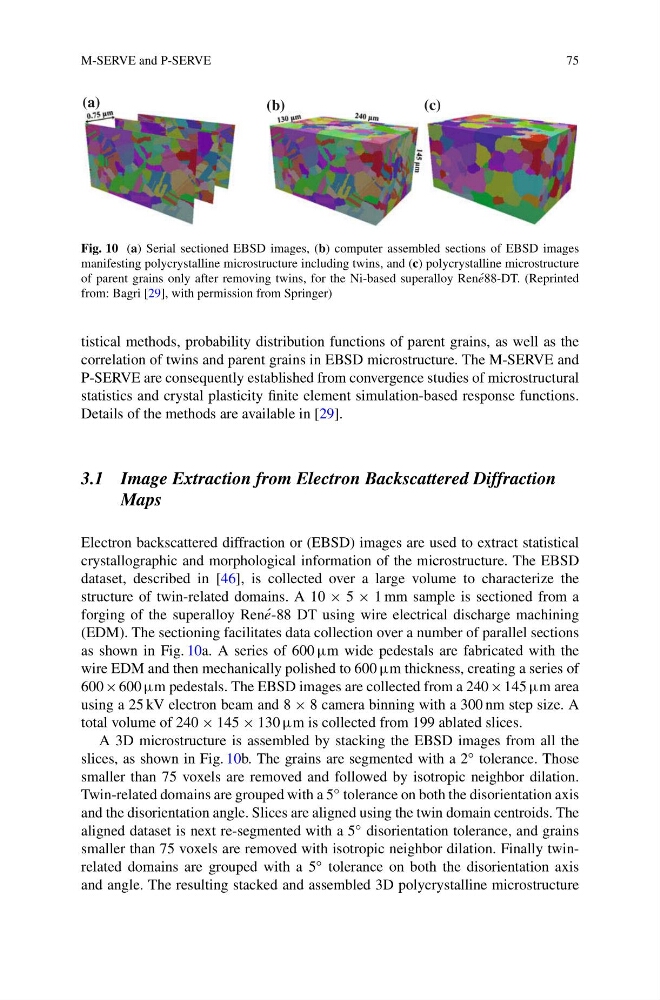
Fig. 10 (a) Serial sectioned EBSD images, (b) computer assembled sections of EBSD images
manifesting polycrystalline microstructure including twins, and (c) polycrystalline microstructure
of parent grains only after removing twins, for the Ni-based superalloy Ren ´
e88-DT. (Reprinted
from: Bagri [29], with permission from Springer)
tistical methods, probability distribution functions of parent grains, as well as the
correlation of twins and parent grains in EBSD microstructure. The M-SERVE and
P-SERVE are consequently established from convergence studies of microstructural
statistics and crystal plasticity finite element simulation-based response functions.
Details of the methods are available in [29].
3.1 Image Extraction from Electron Backscattered Diffraction
Maps
Electron backscattered diffraction or (EBSD) images are used to extract statistical
crystallographic and morphological information of the microstructure. The EBSD
dataset, described in [46], is collected over a large volume to characterize the
structure of twin-related domains. A 10 × 5 × 1 mm sample is sectioned from a
forging of the superalloy Ren ´
e-88 DT using wire electrical discharge machining
(EDM). The sectioning facilitates data collection over a number of parallel sections
as shown in Fig. 10a. A series of 600 μm wide pedestals are fabricated with the
wire EDM and then mechanically polished to 600 μm thickness, creating a series of
600 × 600 μm pedestals. The EBSD images are collected from a 240 × 145 μm area
using a 25 kV electron beam and 8 × 8 camera binning with a 300 nm step size. A
total volume of 240 × 145 × 130 μm is collected from 199 ablated slices.
A 3D microstructure is assembled by stacking the EBSD images from all the
slices, as shown in Fig. 10b. The grains are segmented with a 2 ◦ tolerance. Those
smaller than 75 voxels are removed and followed by isotropic neighbor dilation.
Twin-related domains are grouped with a 5 ◦ tolerance on both the disorientation axis
and the disorientation angle. Slices are aligned using the twin domain centroids. The
aligned dataset is next re-segmented with a 5 ◦ disorientation tolerance, and grains
smaller than 75 voxels are removed with isotropic neighbor dilation. Finally twinrelated domains are grouped with a 5 ◦ tolerance on both the disorientation axis
and angle. The resulting stacked and assembled 3D polycrystalline microstructure
75
(a)
(b)
(c)
Fig. 10 (a) Serial sectioned EBSD images, (b) computer assembled sections of EBSD images
manifesting polycrystalline microstructure including twins, and (c) polycrystalline microstructure
of parent grains only after removing twins, for the Ni-based superalloy Ren ´
e88-DT. (Reprinted
from: Bagri [29], with permission from Springer)
tistical methods, probability distribution functions of parent grains, as well as the
correlation of twins and parent grains in EBSD microstructure. The M-SERVE and
P-SERVE are consequently established from convergence studies of microstructural
statistics and crystal plasticity finite element simulation-based response functions.
Details of the methods are available in [29].
3.1 Image Extraction from Electron Backscattered Diffraction
Maps
Electron backscattered diffraction or (EBSD) images are used to extract statistical
crystallographic and morphological information of the microstructure. The EBSD
dataset, described in [46], is collected over a large volume to characterize the
structure of twin-related domains. A 10 × 5 × 1 mm sample is sectioned from a
forging of the superalloy Ren ´
e-88 DT using wire electrical discharge machining
(EDM). The sectioning facilitates data collection over a number of parallel sections
as shown in Fig. 10a. A series of 600 μm wide pedestals are fabricated with the
wire EDM and then mechanically polished to 600 μm thickness, creating a series of
600 × 600 μm pedestals. The EBSD images are collected from a 240 × 145 μm area
using a 25 kV electron beam and 8 × 8 camera binning with a 300 nm step size. A
total volume of 240 × 145 × 130 μm is collected from 199 ablated slices.
A 3D microstructure is assembled by stacking the EBSD images from all the
slices, as shown in Fig. 10b. The grains are segmented with a 2 ◦ tolerance. Those
smaller than 75 voxels are removed and followed by isotropic neighbor dilation.
Twin-related domains are grouped with a 5 ◦ tolerance on both the disorientation axis
and the disorientation angle. Slices are aligned using the twin domain centroids. The
aligned dataset is next re-segmented with a 5 ◦ disorientation tolerance, and grains
smaller than 75 voxels are removed with isotropic neighbor dilation. Finally twinrelated domains are grouped with a 5 ◦ tolerance on both the disorientation axis
and angle. The resulting stacked and assembled 3D polycrystalline microstructure