

Data Structures and Workflows for ICME
35
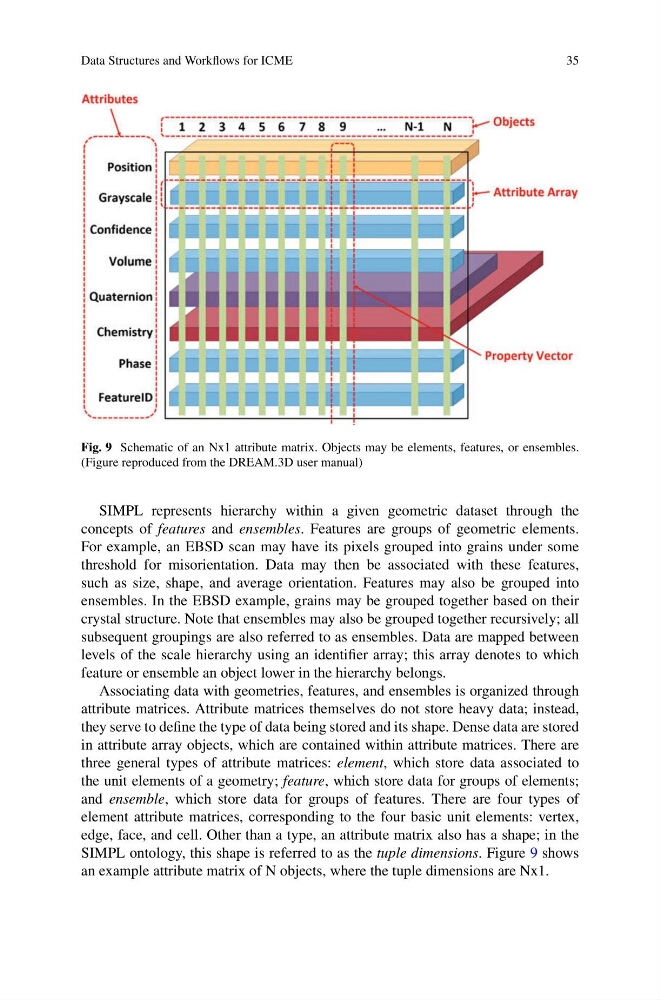
Fig. 9 Schematic of an Nx1 attribute matrix. Objects may be elements, features, or ensembles.
(Figure reproduced from the DREAM.3D user manual)
SIMPL represents hierarchy within a given geometric dataset through the
concepts of features and ensembles. Features are groups of geometric elements.
For example, an EBSD scan may have its pixels grouped into grains under some
threshold for misorientation. Data may then be associated with these features,
such as size, shape, and average orientation. Features may also be grouped into
ensembles. In the EBSD example, grains may be grouped together based on their
crystal structure. Note that ensembles may also be grouped together recursively; all
subsequent groupings are also referred to as ensembles. Data are mapped between
levels of the scale hierarchy using an identifier array; this array denotes to which
feature or ensemble an object lower in the hierarchy belongs.
Associating data with geometries, features, and ensembles is organized through
attribute matrices. Attribute matrices themselves do not store heavy data; instead,
they serve to define the type of data being stored and its shape. Dense data are stored
in attribute array objects, which are contained within attribute matrices. There are
three general types of attribute matrices: element, which store data associated to
the unit elements of a geometry; feature, which store data for groups of elements;
and ensemble, which store data for groups of features. There are four types of
element attribute matrices, corresponding to the four basic unit elements: vertex,
edge, face, and cell. Other than a type, an attribute matrix also has a shape; in the
SIMPL ontology, this shape is referred to as the tuple dimensions. Figure 9 shows
an example attribute matrix of N objects, where the tuple dimensions are Nx1.
35
Fig. 9 Schematic of an Nx1 attribute matrix. Objects may be elements, features, or ensembles.
(Figure reproduced from the DREAM.3D user manual)
SIMPL represents hierarchy within a given geometric dataset through the
concepts of features and ensembles. Features are groups of geometric elements.
For example, an EBSD scan may have its pixels grouped into grains under some
threshold for misorientation. Data may then be associated with these features,
such as size, shape, and average orientation. Features may also be grouped into
ensembles. In the EBSD example, grains may be grouped together based on their
crystal structure. Note that ensembles may also be grouped together recursively; all
subsequent groupings are also referred to as ensembles. Data are mapped between
levels of the scale hierarchy using an identifier array; this array denotes to which
feature or ensemble an object lower in the hierarchy belongs.
Associating data with geometries, features, and ensembles is organized through
attribute matrices. Attribute matrices themselves do not store heavy data; instead,
they serve to define the type of data being stored and its shape. Dense data are stored
in attribute array objects, which are contained within attribute matrices. There are
three general types of attribute matrices: element, which store data associated to
the unit elements of a geometry; feature, which store data for groups of elements;
and ensemble, which store data for groups of features. There are four types of
element attribute matrices, corresponding to the four basic unit elements: vertex,
edge, face, and cell. Other than a type, an attribute matrix also has a shape; in the
SIMPL ontology, this shape is referred to as the tuple dimensions. Figure 9 shows
an example attribute matrix of N objects, where the tuple dimensions are Nx1.