

32
S. P. Donegan and M. A. Groeber
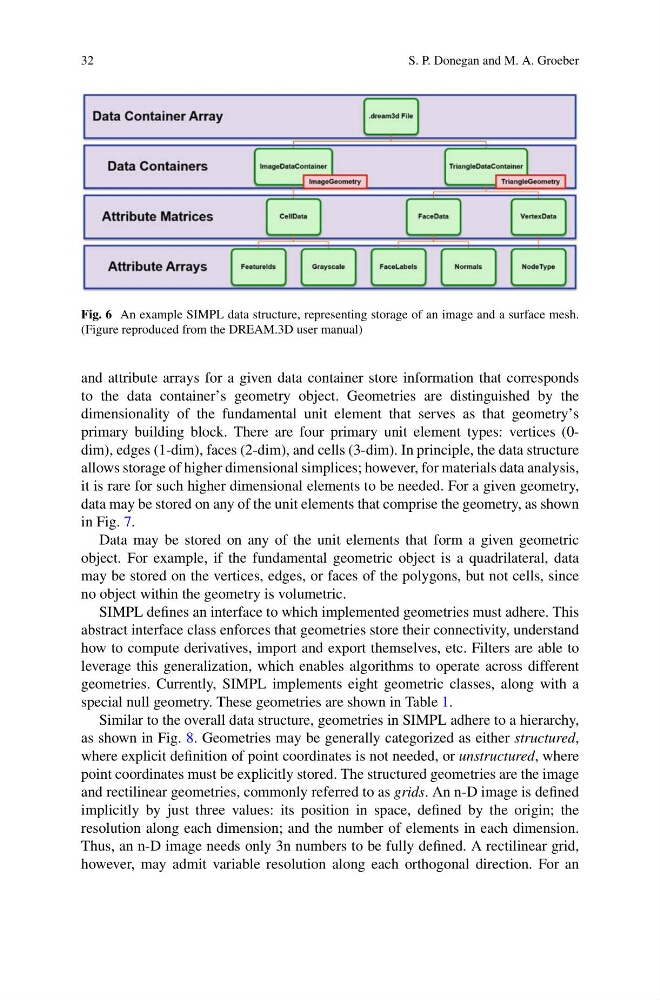
Fig. 6 An example SIMPL data structure, representing storage of an image and a surface mesh.
(Figure reproduced from the DREAM.3D user manual)
and attribute arrays for a given data container store information that corresponds
to the data container’s geometry object. Geometries are distinguished by the
dimensionality of the fundamental unit element that serves as that geometry’s
primary building block. There are four primary unit element types: vertices (0dim), edges (1-dim), faces (2-dim), and cells (3-dim). In principle, the data structure
allows storage of higher dimensional simplices; however, for materials data analysis,
it is rare for such higher dimensional elements to be needed. For a given geometry,
data may be stored on any of the unit elements that comprise the geometry, as shown
in Fig. 7.
Data may be stored on any of the unit elements that form a given geometric
object. For example, if the fundamental geometric object is a quadrilateral, data
may be stored on the vertices, edges, or faces of the polygons, but not cells, since
no object within the geometry is volumetric.
SIMPL defines an interface to which implemented geometries must adhere. This
abstract interface class enforces that geometries store their connectivity, understand
how to compute derivatives, import and export themselves, etc. Filters are able to
leverage this generalization, which enables algorithms to operate across different
geometries. Currently, SIMPL implements eight geometric classes, along with a
special null geometry. These geometries are shown in Table 1.
Similar to the overall data structure, geometries in SIMPL adhere to a hierarchy,
as shown in Fig. 8. Geometries may be generally categorized as either structured,
where explicit definition of point coordinates is not needed, or unstructured, where
point coordinates must be explicitly stored. The structured geometries are the image
and rectilinear geometries, commonly referred to as grids. An n-D image is defined
implicitly by just three values: its position in space, defined by the origin; the
resolution along each dimension; and the number of elements in each dimension.
Thus, an n-D image needs only 3n numbers to be fully defined. A rectilinear grid,
however, may admit variable resolution along each orthogonal direction. For an
S. P. Donegan and M. A. Groeber
Fig. 6 An example SIMPL data structure, representing storage of an image and a surface mesh.
(Figure reproduced from the DREAM.3D user manual)
and attribute arrays for a given data container store information that corresponds
to the data container’s geometry object. Geometries are distinguished by the
dimensionality of the fundamental unit element that serves as that geometry’s
primary building block. There are four primary unit element types: vertices (0dim), edges (1-dim), faces (2-dim), and cells (3-dim). In principle, the data structure
allows storage of higher dimensional simplices; however, for materials data analysis,
it is rare for such higher dimensional elements to be needed. For a given geometry,
data may be stored on any of the unit elements that comprise the geometry, as shown
in Fig. 7.
Data may be stored on any of the unit elements that form a given geometric
object. For example, if the fundamental geometric object is a quadrilateral, data
may be stored on the vertices, edges, or faces of the polygons, but not cells, since
no object within the geometry is volumetric.
SIMPL defines an interface to which implemented geometries must adhere. This
abstract interface class enforces that geometries store their connectivity, understand
how to compute derivatives, import and export themselves, etc. Filters are able to
leverage this generalization, which enables algorithms to operate across different
geometries. Currently, SIMPL implements eight geometric classes, along with a
special null geometry. These geometries are shown in Table 1.
Similar to the overall data structure, geometries in SIMPL adhere to a hierarchy,
as shown in Fig. 8. Geometries may be generally categorized as either structured,
where explicit definition of point coordinates is not needed, or unstructured, where
point coordinates must be explicitly stored. The structured geometries are the image
and rectilinear geometries, commonly referred to as grids. An n-D image is defined
implicitly by just three values: its position in space, defined by the origin; the
resolution along each dimension; and the number of elements in each dimension.
Thus, an n-D image needs only 3n numbers to be fully defined. A rectilinear grid,
however, may admit variable resolution along each orthogonal direction. For an