

28
S. P. Donegan and M. A. Groeber
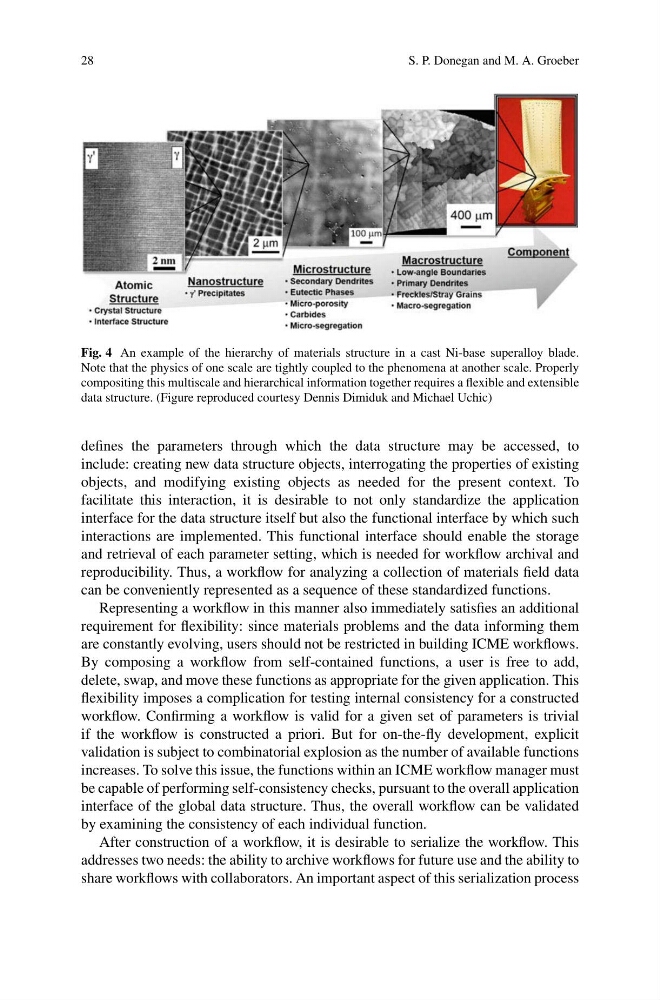
Fig. 4 An example of the hierarchy of materials structure in a cast Ni-base superalloy blade.
Note that the physics of one scale are tightly coupled to the phenomena at another scale. Properly
compositing this multiscale and hierarchical information together requires a flexible and extensible
data structure. (Figure reproduced courtesy Dennis Dimiduk and Michael Uchic)
defines the parameters through which the data structure may be accessed, to
include: creating new data structure objects, interrogating the properties of existing
objects, and modifying existing objects as needed for the present context. To
facilitate this interaction, it is desirable to not only standardize the application
interface for the data structure itself but also the functional interface by which such
interactions are implemented. This functional interface should enable the storage
and retrieval of each parameter setting, which is needed for workflow archival and
reproducibility. Thus, a workflow for analyzing a collection of materials field data
can be conveniently represented as a sequence of these standardized functions.
Representing a workflow in this manner also immediately satisfies an additional
requirement for flexibility: since materials problems and the data informing them
are constantly evolving, users should not be restricted in building ICME workflows.
By composing a workflow from self-contained functions, a user is free to add,
delete, swap, and move these functions as appropriate for the given application. This
flexibility imposes a complication for testing internal consistency for a constructed
workflow. Confirming a workflow is valid for a given set of parameters is trivial
if the workflow is constructed a priori. But for on-the-fly development, explicit
validation is subject to combinatorial explosion as the number of available functions
increases. To solve this issue, the functions within an ICME workflow manager must
be capable of performing self-consistency checks, pursuant to the overall application
interface of the global data structure. Thus, the overall workflow can be validated
by examining the consistency of each individual function.
After construction of a workflow, it is desirable to serialize the workflow. This
addresses two needs: the ability to archive workflows for future use and the ability to
share workflows with collaborators. An important aspect of this serialization process
S. P. Donegan and M. A. Groeber
Fig. 4 An example of the hierarchy of materials structure in a cast Ni-base superalloy blade.
Note that the physics of one scale are tightly coupled to the phenomena at another scale. Properly
compositing this multiscale and hierarchical information together requires a flexible and extensible
data structure. (Figure reproduced courtesy Dennis Dimiduk and Michael Uchic)
defines the parameters through which the data structure may be accessed, to
include: creating new data structure objects, interrogating the properties of existing
objects, and modifying existing objects as needed for the present context. To
facilitate this interaction, it is desirable to not only standardize the application
interface for the data structure itself but also the functional interface by which such
interactions are implemented. This functional interface should enable the storage
and retrieval of each parameter setting, which is needed for workflow archival and
reproducibility. Thus, a workflow for analyzing a collection of materials field data
can be conveniently represented as a sequence of these standardized functions.
Representing a workflow in this manner also immediately satisfies an additional
requirement for flexibility: since materials problems and the data informing them
are constantly evolving, users should not be restricted in building ICME workflows.
By composing a workflow from self-contained functions, a user is free to add,
delete, swap, and move these functions as appropriate for the given application. This
flexibility imposes a complication for testing internal consistency for a constructed
workflow. Confirming a workflow is valid for a given set of parameters is trivial
if the workflow is constructed a priori. But for on-the-fly development, explicit
validation is subject to combinatorial explosion as the number of available functions
increases. To solve this issue, the functions within an ICME workflow manager must
be capable of performing self-consistency checks, pursuant to the overall application
interface of the global data structure. Thus, the overall workflow can be validated
by examining the consistency of each individual function.
After construction of a workflow, it is desirable to serialize the workflow. This
addresses two needs: the ability to archive workflows for future use and the ability to
share workflows with collaborators. An important aspect of this serialization process