

Challenges in Understanding the Dynamic Behavior of Heterogeneous Materials
391
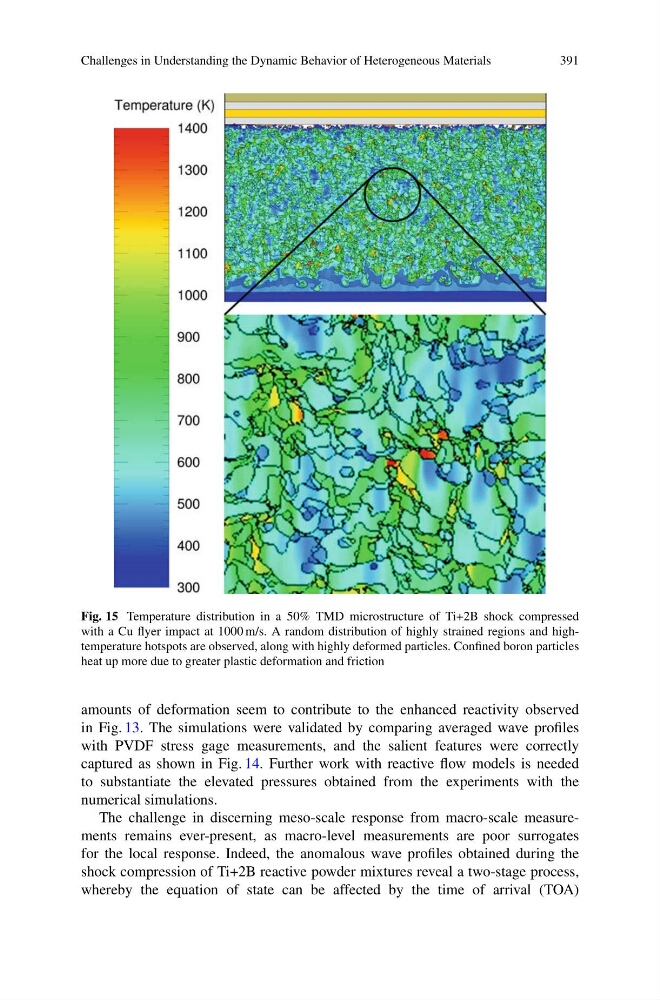
Fig. 15 Temperature distribution in a 50% TMD microstructure of Ti+2B shock compressed
with a Cu flyer impact at 1000 m/s. A random distribution of highly strained regions and hightemperature hotspots are observed, along with highly deformed particles. Confined boron particles
heat up more due to greater plastic deformation and friction
amounts of deformation seem to contribute to the enhanced reactivity observed
in Fig. 13. The simulations were validated by comparing averaged wave profiles
with PVDF stress gage measurements, and the salient features were correctly
captured as shown in Fig. 14. Further work with reactive flow models is needed
to substantiate the elevated pressures obtained from the experiments with the
numerical simulations.
The challenge in discerning meso-scale response from macro-scale measurements remains ever-present, as macro-level measurements are poor surrogates
for the local response. Indeed, the anomalous wave profiles obtained during the
shock compression of Ti+2B reactive powder mixtures reveal a two-stage process,
whereby the equation of state can be affected by the time of arrival (TOA)
391
Fig. 15 Temperature distribution in a 50% TMD microstructure of Ti+2B shock compressed
with a Cu flyer impact at 1000 m/s. A random distribution of highly strained regions and hightemperature hotspots are observed, along with highly deformed particles. Confined boron particles
heat up more due to greater plastic deformation and friction
amounts of deformation seem to contribute to the enhanced reactivity observed
in Fig. 13. The simulations were validated by comparing averaged wave profiles
with PVDF stress gage measurements, and the salient features were correctly
captured as shown in Fig. 14. Further work with reactive flow models is needed
to substantiate the elevated pressures obtained from the experiments with the
numerical simulations.
The challenge in discerning meso-scale response from macro-scale measurements remains ever-present, as macro-level measurements are poor surrogates
for the local response. Indeed, the anomalous wave profiles obtained during the
shock compression of Ti+2B reactive powder mixtures reveal a two-stage process,
whereby the equation of state can be affected by the time of arrival (TOA)