

386
M. Gonzales and N. N. Thadhani
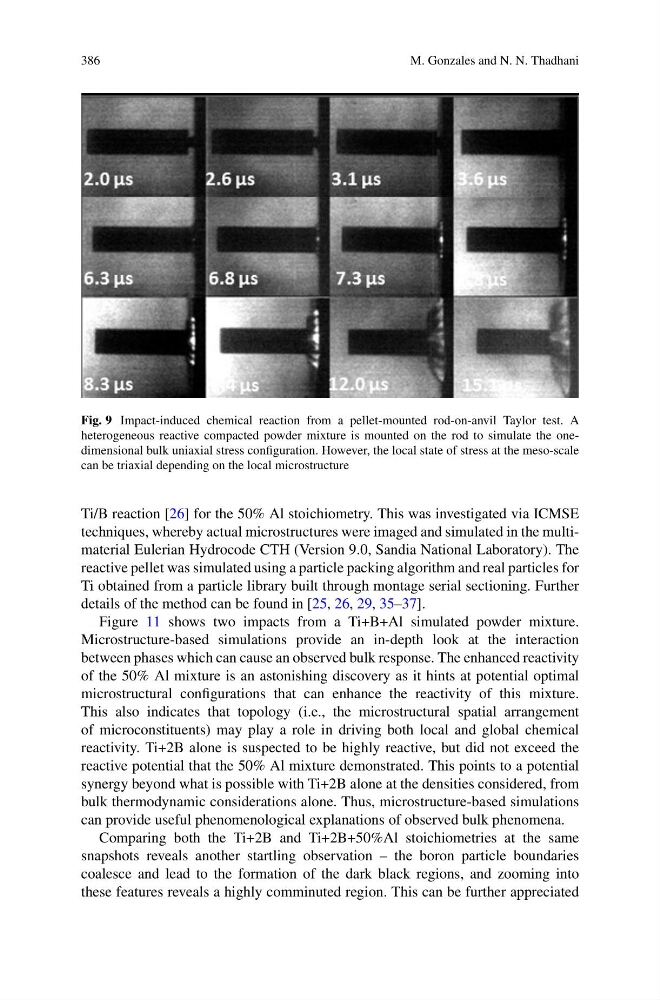
Fig. 9 Impact-induced chemical reaction from a pellet-mounted rod-on-anvil Taylor test. A
heterogeneous reactive compacted powder mixture is mounted on the rod to simulate the onedimensional bulk uniaxial stress configuration. However, the local state of stress at the meso-scale
can be triaxial depending on the local microstructure
Ti/B reaction [26] for the 50% Al stoichiometry. This was investigated via ICMSE
techniques, whereby actual microstructures were imaged and simulated in the multimaterial Eulerian Hydrocode CTH (Version 9.0, Sandia National Laboratory). The
reactive pellet was simulated using a particle packing algorithm and real particles for
Ti obtained from a particle library built through montage serial sectioning. Further
details of the method can be found in [25, 26, 29, 35–37].
Figure 11 shows two impacts from a Ti+B+Al simulated powder mixture.
Microstructure-based simulations provide an in-depth look at the interaction
between phases which can cause an observed bulk response. The enhanced reactivity
of the 50% Al mixture is an astonishing discovery as it hints at potential optimal
microstructural configurations that can enhance the reactivity of this mixture.
This also indicates that topology (i.e., the microstructural spatial arrangement
of microconstituents) may play a role in driving both local and global chemical
reactivity. Ti+2B alone is suspected to be highly reactive, but did not exceed the
reactive potential that the 50% Al mixture demonstrated. This points to a potential
synergy beyond what is possible with Ti+2B alone at the densities considered, from
bulk thermodynamic considerations alone. Thus, microstructure-based simulations
can provide useful phenomenological explanations of observed bulk phenomena.
Comparing both the Ti+2B and Ti+2B+50%Al stoichiometries at the same
snapshots reveals another startling observation – the boron particle boundaries
coalesce and lead to the formation of the dark black regions, and zooming into
these features reveals a highly comminuted region. This can be further appreciated
M. Gonzales and N. N. Thadhani
Fig. 9 Impact-induced chemical reaction from a pellet-mounted rod-on-anvil Taylor test. A
heterogeneous reactive compacted powder mixture is mounted on the rod to simulate the onedimensional bulk uniaxial stress configuration. However, the local state of stress at the meso-scale
can be triaxial depending on the local microstructure
Ti/B reaction [26] for the 50% Al stoichiometry. This was investigated via ICMSE
techniques, whereby actual microstructures were imaged and simulated in the multimaterial Eulerian Hydrocode CTH (Version 9.0, Sandia National Laboratory). The
reactive pellet was simulated using a particle packing algorithm and real particles for
Ti obtained from a particle library built through montage serial sectioning. Further
details of the method can be found in [25, 26, 29, 35–37].
Figure 11 shows two impacts from a Ti+B+Al simulated powder mixture.
Microstructure-based simulations provide an in-depth look at the interaction
between phases which can cause an observed bulk response. The enhanced reactivity
of the 50% Al mixture is an astonishing discovery as it hints at potential optimal
microstructural configurations that can enhance the reactivity of this mixture.
This also indicates that topology (i.e., the microstructural spatial arrangement
of microconstituents) may play a role in driving both local and global chemical
reactivity. Ti+2B alone is suspected to be highly reactive, but did not exceed the
reactive potential that the 50% Al mixture demonstrated. This points to a potential
synergy beyond what is possible with Ti+2B alone at the densities considered, from
bulk thermodynamic considerations alone. Thus, microstructure-based simulations
can provide useful phenomenological explanations of observed bulk phenomena.
Comparing both the Ti+2B and Ti+2B+50%Al stoichiometries at the same
snapshots reveals another startling observation – the boron particle boundaries
coalesce and lead to the formation of the dark black regions, and zooming into
these features reveals a highly comminuted region. This can be further appreciated