

384
M. Gonzales and N. N. Thadhani
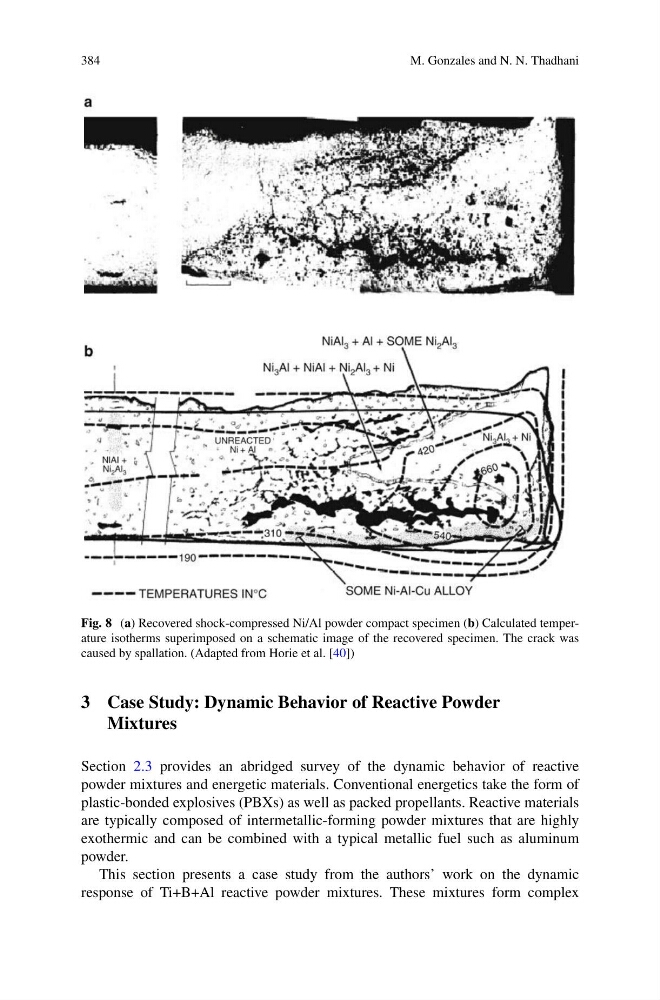
Fig. 8 (a) Recovered shock-compressed Ni/Al powder compact specimen (b) Calculated temperature isotherms superimposed on a schematic image of the recovered specimen. The crack was
caused by spallation. (Adapted from Horie et al. [40])
3 Case Study: Dynamic Behavior of Reactive Powder
Mixtures
Section 2.3 provides an abridged survey of the dynamic behavior of reactive
powder mixtures and energetic materials. Conventional energetics take the form of
plastic-bonded explosives (PBXs) as well as packed propellants. Reactive materials
are typically composed of intermetallic-forming powder mixtures that are highly
exothermic and can be combined with a typical metallic fuel such as aluminum
powder.
This section presents a case study from the authors’ work on the dynamic
response of Ti+B+Al reactive powder mixtures. These mixtures form complex
M. Gonzales and N. N. Thadhani
Fig. 8 (a) Recovered shock-compressed Ni/Al powder compact specimen (b) Calculated temperature isotherms superimposed on a schematic image of the recovered specimen. The crack was
caused by spallation. (Adapted from Horie et al. [40])
3 Case Study: Dynamic Behavior of Reactive Powder
Mixtures
Section 2.3 provides an abridged survey of the dynamic behavior of reactive
powder mixtures and energetic materials. Conventional energetics take the form of
plastic-bonded explosives (PBXs) as well as packed propellants. Reactive materials
are typically composed of intermetallic-forming powder mixtures that are highly
exothermic and can be combined with a typical metallic fuel such as aluminum
powder.
This section presents a case study from the authors’ work on the dynamic
response of Ti+B+Al reactive powder mixtures. These mixtures form complex