

382
M. Gonzales and N. N. Thadhani
shock front embodied by the Rankine-Hugoniot jump conditions (Eqs. 21, 24,
and 32). Three-dimensional forms of the equations can be found in Meyers [54]
and Forbes [22]. The tensorial forms of the equations are required for simulation of
the shock compression process in hydrocodes and are essential when considering
local material heterogeneity, as the uniaxial strain condition will not be rigorously
satisfied at the meso-scale.
2.2.1 Theoretical Equations of State for Reactive Powders
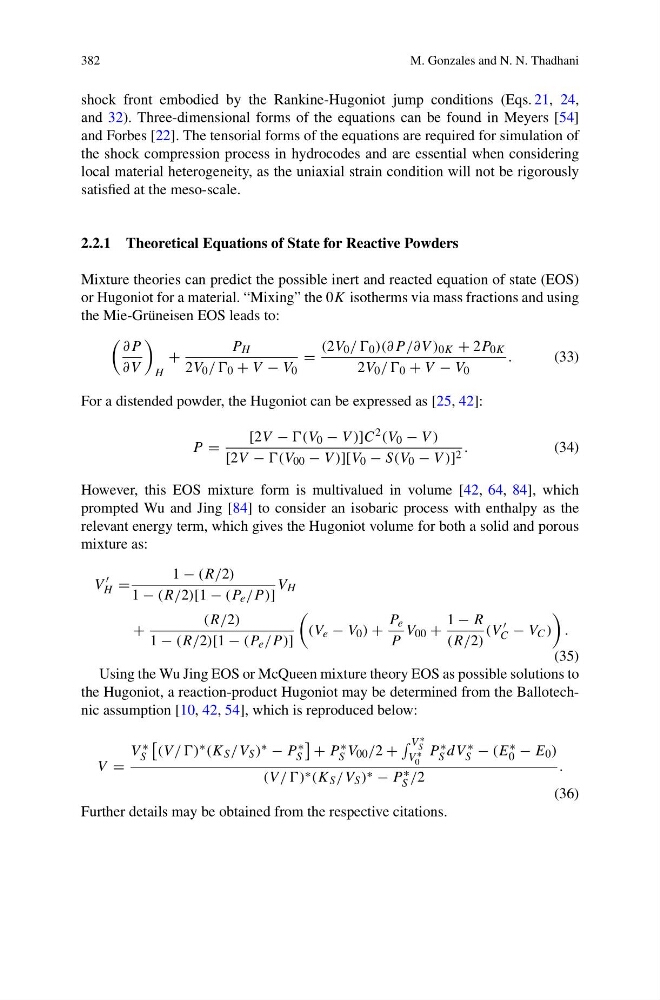
Mixture theories can predict the possible inert and reacted equation of state (EOS)
or Hugoniot for a material. “Mixing” the 0K isotherms via mass fractions and using
the Mie-Grüneisen EOS leads to:
∂P
∂V
H
+
P H
2V 0 / / 0 + V − V 0
=
(2V 0 / / 0 )(∂P /∂V ) 0K + 2P 0K
2V 0 / / 0 + V − V 0
.
(33)
For a distended powder, the Hugoniot can be expressed as [25, 42]:
P =
[2V − 0 − V )]C 2 (V 0 − V )
[2V − (V 00 − V )][V 0 − S(V 0 − V )] 2 .
(34)
However, this EOS mixture form is multivalued in volume [42, 64, 84], which
prompted Wu and Jing [84] to consider an isobaric process with enthalpy as the
relevant energy term, which gives the Hugoniot volume for both a solid and porous
mixture as:
V
H =
1 − (R/2)
1 − (R/2)[1 − (P e /P )]
V H
+
(R/2)
1 − (R/2)[1 − (P e /P )]
(V e − V 0 ) +
P e
P
V 00 +
1 − R
(R/2)
(V
C − V C )
.
(35)
Using the Wu Jing EOS or McQueen mixture theory EOS as possible solutions to
the Hugoniot, a reaction-product Hugoniot may be determined from the Ballotechnic assumption [10, 42, 54], which is reproduced below:
V =
V ∗
S
(V / /) ∗ (K S /V S ) ∗ − P ∗
S
+ P ∗
S V 00 /2 +
V ∗
S
V ∗
0
P ∗
S dV ∗
S − (E ∗
0 − E 0 )
(V / /) ∗ (K S /V S ) ∗ − P ∗
S /2
.
(36)
Further details may be obtained from the respective citations.
M. Gonzales and N. N. Thadhani
shock front embodied by the Rankine-Hugoniot jump conditions (Eqs. 21, 24,
and 32). Three-dimensional forms of the equations can be found in Meyers [54]
and Forbes [22]. The tensorial forms of the equations are required for simulation of
the shock compression process in hydrocodes and are essential when considering
local material heterogeneity, as the uniaxial strain condition will not be rigorously
satisfied at the meso-scale.
2.2.1 Theoretical Equations of State for Reactive Powders
Mixture theories can predict the possible inert and reacted equation of state (EOS)
or Hugoniot for a material. “Mixing” the 0K isotherms via mass fractions and using
the Mie-Grüneisen EOS leads to:
∂P
∂V
H
+
P H
2V 0 / / 0 + V − V 0
=
(2V 0 / / 0 )(∂P /∂V ) 0K + 2P 0K
2V 0 / / 0 + V − V 0
.
(33)
For a distended powder, the Hugoniot can be expressed as [25, 42]:
P =
[2V − 0 − V )]C 2 (V 0 − V )
[2V − (V 00 − V )][V 0 − S(V 0 − V )] 2 .
(34)
However, this EOS mixture form is multivalued in volume [42, 64, 84], which
prompted Wu and Jing [84] to consider an isobaric process with enthalpy as the
relevant energy term, which gives the Hugoniot volume for both a solid and porous
mixture as:
V
H =
1 − (R/2)
1 − (R/2)[1 − (P e /P )]
V H
+
(R/2)
1 − (R/2)[1 − (P e /P )]
(V e − V 0 ) +
P e
P
V 00 +
1 − R
(R/2)
(V
C − V C )
.
(35)
Using the Wu Jing EOS or McQueen mixture theory EOS as possible solutions to
the Hugoniot, a reaction-product Hugoniot may be determined from the Ballotechnic assumption [10, 42, 54], which is reproduced below:
V =
V ∗
S
(V / /) ∗ (K S /V S ) ∗ − P ∗
S
+ P ∗
S V 00 /2 +
V ∗
S
V ∗
0
P ∗
S dV ∗
S − (E ∗
0 − E 0 )
(V / /) ∗ (K S /V S ) ∗ − P ∗
S /2
.
(36)
Further details may be obtained from the respective citations.