

380
M. Gonzales and N. N. Thadhani
into a medium moving at a velocity U 0 . Considering the shock wave front as the
moving reference frame, the mass of material exiting the wave (to the left of the
shock front in Fig. 7) will have a new density ρ and will be moving at a velocity
U s − U p relative to the shock front. Considering the mass conservation through the
shock wave as the moving reference frame, the general expression becomes (after
canceling the cross-sectional area and δt terms which are the same across the shock
front) [22, 54]:
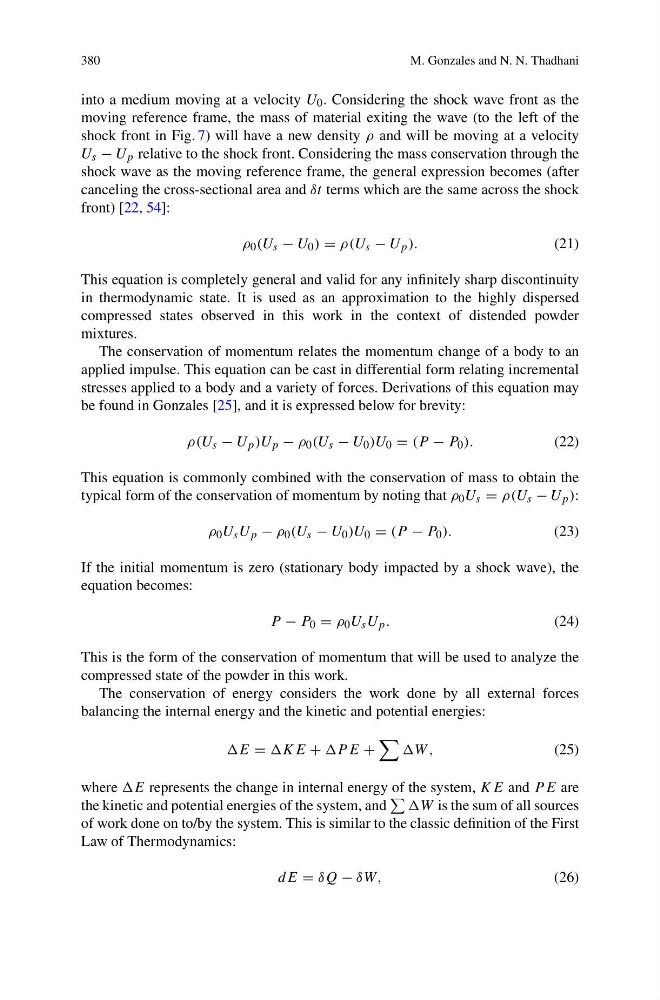
ρ 0 (U s − U 0 ) = ρ(U s − U p ).
(21)
This equation is completely general and valid for any infinitely sharp discontinuity
in thermodynamic state. It is used as an approximation to the highly dispersed
compressed states observed in this work in the context of distended powder
mixtures.
The conservation of momentum relates the momentum change of a body to an
applied impulse. This equation can be cast in differential form relating incremental
stresses applied to a body and a variety of forces. Derivations of this equation may
be found in Gonzales [25], and it is expressed below for brevity:
ρ(U s − U p )U p − ρ 0 (U s − U 0 )U 0 = (P − P 0 ).
(22)
This equation is commonly combined with the conservation of mass to obtain the
typical form of the conservation of momentum by noting that ρ 0 U s = ρ(U s − U p ):
ρ 0 U s U p − ρ 0 (U s − U 0 )U 0 = (P − P 0 ).
(23)
If the initial momentum is zero (stationary body impacted by a shock wave), the
equation becomes:
P − P 0 = ρ 0 U s U p .
(24)
This is the form of the conservation of momentum that will be used to analyze the
compressed state of the powder in this work.
The conservation of energy considers the work done by all external forces
balancing the internal energy and the kinetic and potential energies:
E = + E +
W ,
(25)
where E represents the change in internal energy of the system, KE and P E are
the kinetic and potential energies of the system, and
W is the sum of all sources
of work done on to/by the system. This is similar to the classic definition of the First
Law of Thermodynamics:
dE = δQ − δW,
(26)
M. Gonzales and N. N. Thadhani
into a medium moving at a velocity U 0 . Considering the shock wave front as the
moving reference frame, the mass of material exiting the wave (to the left of the
shock front in Fig. 7) will have a new density ρ and will be moving at a velocity
U s − U p relative to the shock front. Considering the mass conservation through the
shock wave as the moving reference frame, the general expression becomes (after
canceling the cross-sectional area and δt terms which are the same across the shock
front) [22, 54]:
ρ 0 (U s − U 0 ) = ρ(U s − U p ).
(21)
This equation is completely general and valid for any infinitely sharp discontinuity
in thermodynamic state. It is used as an approximation to the highly dispersed
compressed states observed in this work in the context of distended powder
mixtures.
The conservation of momentum relates the momentum change of a body to an
applied impulse. This equation can be cast in differential form relating incremental
stresses applied to a body and a variety of forces. Derivations of this equation may
be found in Gonzales [25], and it is expressed below for brevity:
ρ(U s − U p )U p − ρ 0 (U s − U 0 )U 0 = (P − P 0 ).
(22)
This equation is commonly combined with the conservation of mass to obtain the
typical form of the conservation of momentum by noting that ρ 0 U s = ρ(U s − U p ):
ρ 0 U s U p − ρ 0 (U s − U 0 )U 0 = (P − P 0 ).
(23)
If the initial momentum is zero (stationary body impacted by a shock wave), the
equation becomes:
P − P 0 = ρ 0 U s U p .
(24)
This is the form of the conservation of momentum that will be used to analyze the
compressed state of the powder in this work.
The conservation of energy considers the work done by all external forces
balancing the internal energy and the kinetic and potential energies:
E = + E +
W ,
(25)
where E represents the change in internal energy of the system, KE and P E are
the kinetic and potential energies of the system, and
W is the sum of all sources
of work done on to/by the system. This is similar to the classic definition of the First
Law of Thermodynamics:
dE = δQ − δW,
(26)