

378
M. Gonzales and N. N. Thadhani
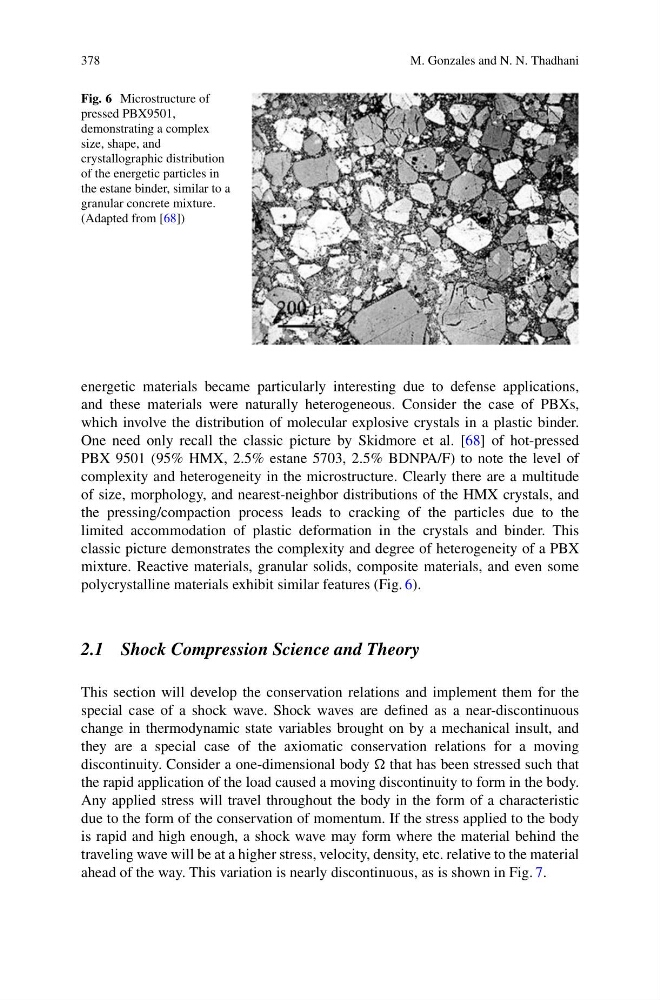
Fig. 6 Microstructure of
pressed PBX9501,
demonstrating a complex
size, shape, and
crystallographic distribution
of the energetic particles in
the estane binder, similar to a
granular concrete mixture.
(Adapted from [68])
energetic materials became particularly interesting due to defense applications,
and these materials were naturally heterogeneous. Consider the case of PBXs,
which involve the distribution of molecular explosive crystals in a plastic binder.
One need only recall the classic picture by Skidmore et al. [68] of hot-pressed
PBX 9501 (95% HMX, 2.5% estane 5703, 2.5% BDNPA/F) to note the level of
complexity and heterogeneity in the microstructure. Clearly there are a multitude
of size, morphology, and nearest-neighbor distributions of the HMX crystals, and
the pressing/compaction process leads to cracking of the particles due to the
limited accommodation of plastic deformation in the crystals and binder. This
classic picture demonstrates the complexity and degree of heterogeneity of a PBX
mixture. Reactive materials, granular solids, composite materials, and even some
polycrystalline materials exhibit similar features (Fig. 6).
2.1 Shock Compression Science and Theory
This section will develop the conservation relations and implement them for the
special case of a shock wave. Shock waves are defined as a near-discontinuous
change in thermodynamic state variables brought on by a mechanical insult, and
they are a special case of the axiomatic conservation relations for a moving
discontinuity. Consider a one-dimensional body that has been stressed such that
the rapid application of the load caused a moving discontinuity to form in the body.
Any applied stress will travel throughout the body in the form of a characteristic
due to the form of the conservation of momentum. If the stress applied to the body
is rapid and high enough, a shock wave may form where the material behind the
traveling wave will be at a higher stress, velocity, density, etc. relative to the material
ahead of the way. This variation is nearly discontinuous, as is shown in Fig. 7.
M. Gonzales and N. N. Thadhani
Fig. 6 Microstructure of
pressed PBX9501,
demonstrating a complex
size, shape, and
crystallographic distribution
of the energetic particles in
the estane binder, similar to a
granular concrete mixture.
(Adapted from [68])
energetic materials became particularly interesting due to defense applications,
and these materials were naturally heterogeneous. Consider the case of PBXs,
which involve the distribution of molecular explosive crystals in a plastic binder.
One need only recall the classic picture by Skidmore et al. [68] of hot-pressed
PBX 9501 (95% HMX, 2.5% estane 5703, 2.5% BDNPA/F) to note the level of
complexity and heterogeneity in the microstructure. Clearly there are a multitude
of size, morphology, and nearest-neighbor distributions of the HMX crystals, and
the pressing/compaction process leads to cracking of the particles due to the
limited accommodation of plastic deformation in the crystals and binder. This
classic picture demonstrates the complexity and degree of heterogeneity of a PBX
mixture. Reactive materials, granular solids, composite materials, and even some
polycrystalline materials exhibit similar features (Fig. 6).
2.1 Shock Compression Science and Theory
This section will develop the conservation relations and implement them for the
special case of a shock wave. Shock waves are defined as a near-discontinuous
change in thermodynamic state variables brought on by a mechanical insult, and
they are a special case of the axiomatic conservation relations for a moving
discontinuity. Consider a one-dimensional body that has been stressed such that
the rapid application of the load caused a moving discontinuity to form in the body.
Any applied stress will travel throughout the body in the form of a characteristic
due to the form of the conservation of momentum. If the stress applied to the body
is rapid and high enough, a shock wave may form where the material behind the
traveling wave will be at a higher stress, velocity, density, etc. relative to the material
ahead of the way. This variation is nearly discontinuous, as is shown in Fig. 7.