

Challenges in Understanding the Dynamic Behavior of Heterogeneous Materials
371
a
b
c
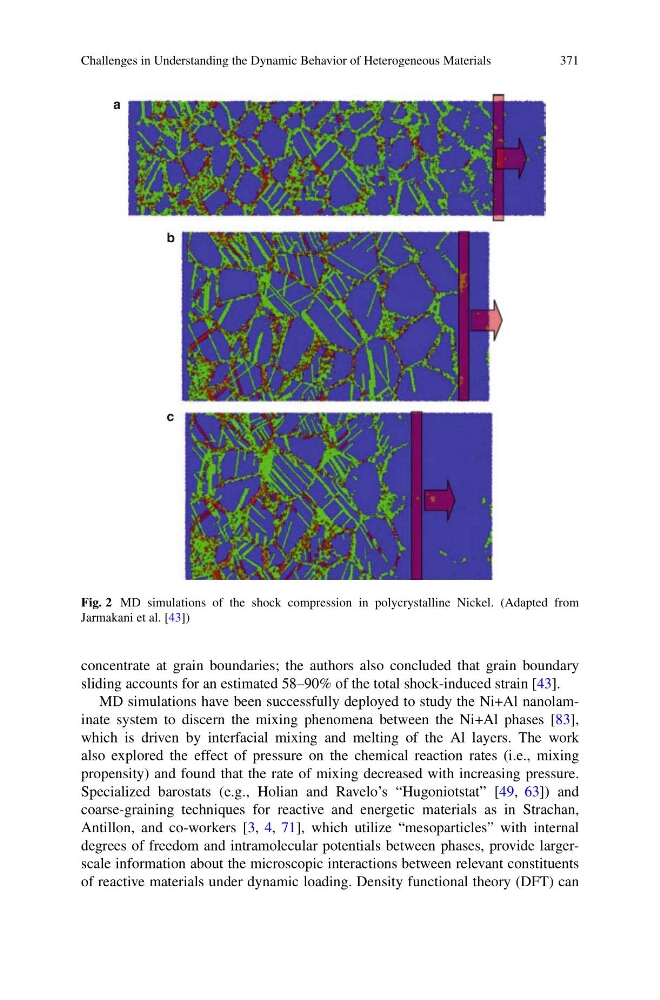
Fig. 2 MD simulations of the shock compression in polycrystalline Nickel. (Adapted from
Jarmakani et al. [43])
concentrate at grain boundaries; the authors also concluded that grain boundary
sliding accounts for an estimated 58–90% of the total shock-induced strain [43].
MD simulations have been successfully deployed to study the Ni+Al nanolaminate system to discern the mixing phenomena between the Ni+Al phases [83],
which is driven by interfacial mixing and melting of the Al layers. The work
also explored the effect of pressure on the chemical reaction rates (i.e., mixing
propensity) and found that the rate of mixing decreased with increasing pressure.
Specialized barostats (e.g., Holian and Ravelo’s “Hugoniotstat” [49, 63]) and
coarse-graining techniques for reactive and energetic materials as in Strachan,
Antillon, and co-workers [3, 4, 71], which utilize “mesoparticles” with internal
degrees of freedom and intramolecular potentials between phases, provide largerscale information about the microscopic interactions between relevant constituents
of reactive materials under dynamic loading. Density functional theory (DFT) can
371
a
b
c
Fig. 2 MD simulations of the shock compression in polycrystalline Nickel. (Adapted from
Jarmakani et al. [43])
concentrate at grain boundaries; the authors also concluded that grain boundary
sliding accounts for an estimated 58–90% of the total shock-induced strain [43].
MD simulations have been successfully deployed to study the Ni+Al nanolaminate system to discern the mixing phenomena between the Ni+Al phases [83],
which is driven by interfacial mixing and melting of the Al layers. The work
also explored the effect of pressure on the chemical reaction rates (i.e., mixing
propensity) and found that the rate of mixing decreased with increasing pressure.
Specialized barostats (e.g., Holian and Ravelo’s “Hugoniotstat” [49, 63]) and
coarse-graining techniques for reactive and energetic materials as in Strachan,
Antillon, and co-workers [3, 4, 71], which utilize “mesoparticles” with internal
degrees of freedom and intramolecular potentials between phases, provide largerscale information about the microscopic interactions between relevant constituents
of reactive materials under dynamic loading. Density functional theory (DFT) can