

Challenges in Understanding the Dynamic Behavior of Heterogeneous Materials
369
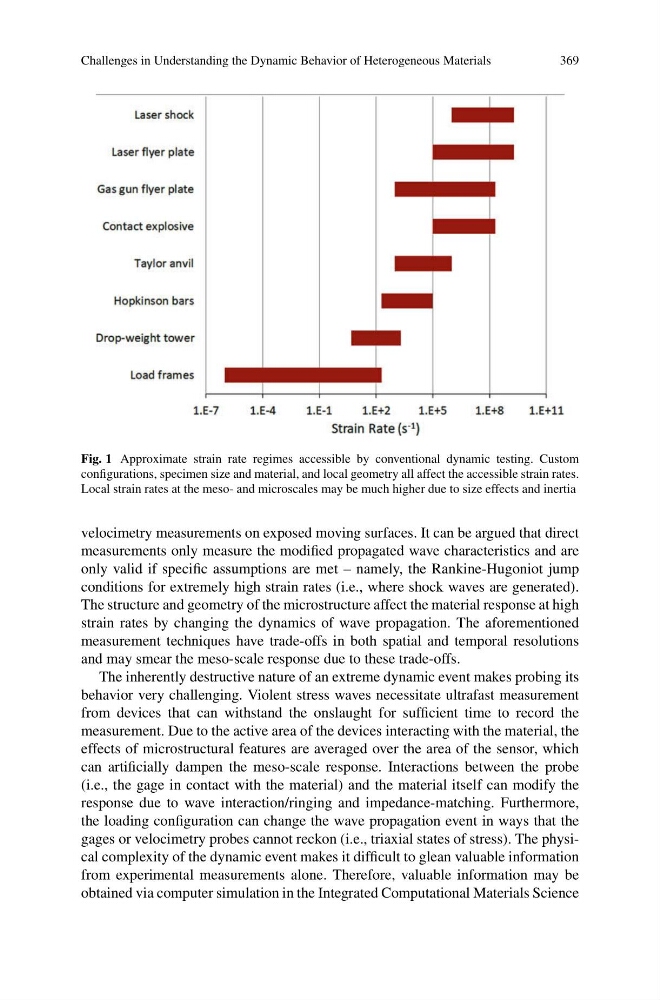
Fig. 1 Approximate strain rate regimes accessible by conventional dynamic testing. Custom
configurations, specimen size and material, and local geometry all affect the accessible strain rates.
Local strain rates at the meso- and microscales may be much higher due to size effects and inertia
velocimetry measurements on exposed moving surfaces. It can be argued that direct
measurements only measure the modified propagated wave characteristics and are
only valid if specific assumptions are met – namely, the Rankine-Hugoniot jump
conditions for extremely high strain rates (i.e., where shock waves are generated).
The structure and geometry of the microstructure affect the material response at high
strain rates by changing the dynamics of wave propagation. The aforementioned
measurement techniques have trade-offs in both spatial and temporal resolutions
and may smear the meso-scale response due to these trade-offs.
The inherently destructive nature of an extreme dynamic event makes probing its
behavior very challenging. Violent stress waves necessitate ultrafast measurement
from devices that can withstand the onslaught for sufficient time to record the
measurement. Due to the active area of the devices interacting with the material, the
effects of microstructural features are averaged over the area of the sensor, which
can artificially dampen the meso-scale response. Interactions between the probe
(i.e., the gage in contact with the material) and the material itself can modify the
response due to wave interaction/ringing and impedance-matching. Furthermore,
the loading configuration can change the wave propagation event in ways that the
gages or velocimetry probes cannot reckon (i.e., triaxial states of stress). The physical complexity of the dynamic event makes it difficult to glean valuable information
from experimental measurements alone. Therefore, valuable information may be
obtained via computer simulation in the Integrated Computational Materials Science
369
Fig. 1 Approximate strain rate regimes accessible by conventional dynamic testing. Custom
configurations, specimen size and material, and local geometry all affect the accessible strain rates.
Local strain rates at the meso- and microscales may be much higher due to size effects and inertia
velocimetry measurements on exposed moving surfaces. It can be argued that direct
measurements only measure the modified propagated wave characteristics and are
only valid if specific assumptions are met – namely, the Rankine-Hugoniot jump
conditions for extremely high strain rates (i.e., where shock waves are generated).
The structure and geometry of the microstructure affect the material response at high
strain rates by changing the dynamics of wave propagation. The aforementioned
measurement techniques have trade-offs in both spatial and temporal resolutions
and may smear the meso-scale response due to these trade-offs.
The inherently destructive nature of an extreme dynamic event makes probing its
behavior very challenging. Violent stress waves necessitate ultrafast measurement
from devices that can withstand the onslaught for sufficient time to record the
measurement. Due to the active area of the devices interacting with the material, the
effects of microstructural features are averaged over the area of the sensor, which
can artificially dampen the meso-scale response. Interactions between the probe
(i.e., the gage in contact with the material) and the material itself can modify the
response due to wave interaction/ringing and impedance-matching. Furthermore,
the loading configuration can change the wave propagation event in ways that the
gages or velocimetry probes cannot reckon (i.e., triaxial states of stress). The physical complexity of the dynamic event makes it difficult to glean valuable information
from experimental measurements alone. Therefore, valuable information may be
obtained via computer simulation in the Integrated Computational Materials Science