

274
X. Wu and J. A. El-Awady
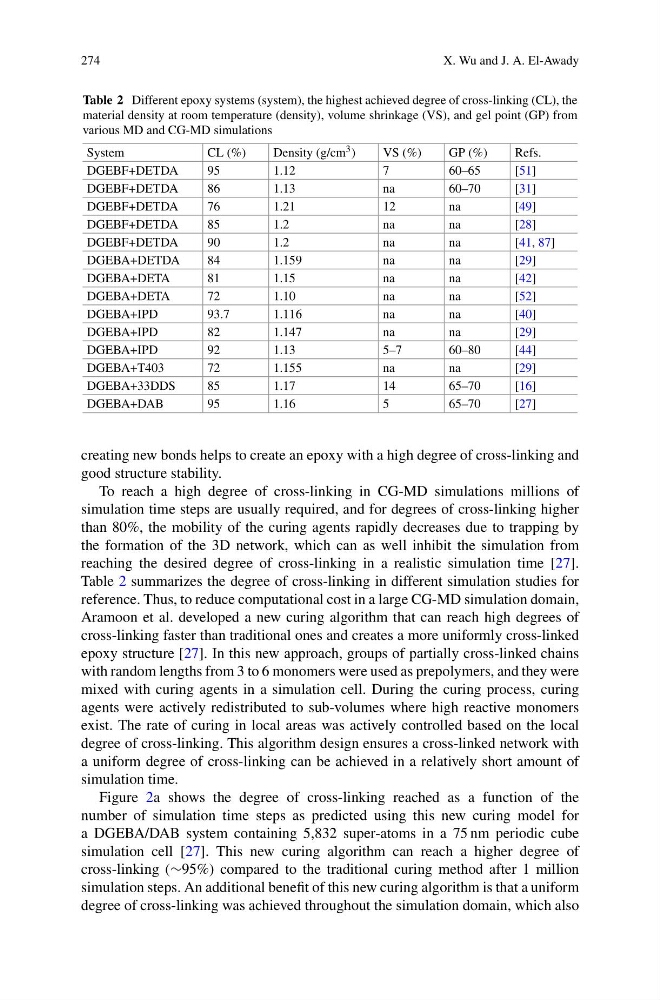
Table 2 Different epoxy systems (system), the highest achieved degree of cross-linking (CL), the
material density at room temperature (density), volume shrinkage (VS), and gel point (GP) from
various MD and CG-MD simulations
System
CL (%)
Density (g/cm 3 )
VS (%)
GP (%)
Refs.
DGEBF+DETDA
95
1.12
7
60–65
[51]
DGEBF+DETDA
86
1.13
na
60–70
[31]
DGEBF+DETDA
76
1.21
12
na
[49]
DGEBF+DETDA
85
1.2
na
na
[28]
DGEBF+DETDA
90
1.2
na
na
[41, 87]
DGEBA+DETDA
84
1.159
na
na
[29]
DGEBA+DETA
81
1.15
na
na
[42]
DGEBA+DETA
72
1.10
na
na
[52]
DGEBA+IPD
93.7
1.116
na
na
[40]
DGEBA+IPD
82
1.147
na
na
[29]
DGEBA+IPD
92
1.13
5–7
60–80
[44]
DGEBA+T403
72
1.155
na
na
[29]
DGEBA+33DDS
85
1.17
14
65–70
[16]
DGEBA+DAB
95
1.16
5
65–70
[27]
creating new bonds helps to create an epoxy with a high degree of cross-linking and
good structure stability.
To reach a high degree of cross-linking in CG-MD simulations millions of
simulation time steps are usually required, and for degrees of cross-linking higher
than 80%, the mobility of the curing agents rapidly decreases due to trapping by
the formation of the 3D network, which can as well inhibit the simulation from
reaching the desired degree of cross-linking in a realistic simulation time [27].
Table 2 summarizes the degree of cross-linking in different simulation studies for
reference. Thus, to reduce computational cost in a large CG-MD simulation domain,
Aramoon et al. developed a new curing algorithm that can reach high degrees of
cross-linking faster than traditional ones and creates a more uniformly cross-linked
epoxy structure [27]. In this new approach, groups of partially cross-linked chains
with random lengths from 3 to 6 monomers were used as prepolymers, and they were
mixed with curing agents in a simulation cell. During the curing process, curing
agents were actively redistributed to sub-volumes where high reactive monomers
exist. The rate of curing in local areas was actively controlled based on the local
degree of cross-linking. This algorithm design ensures a cross-linked network with
a uniform degree of cross-linking can be achieved in a relatively short amount of
simulation time.
Figure 2a shows the degree of cross-linking reached as a function of the
number of simulation time steps as predicted using this new curing model for
a DGEBA/DAB system containing 5,832 super-atoms in a 75 nm periodic cube
simulation cell [27]. This new curing algorithm can reach a higher degree of
cross-linking (∼95%) compared to the traditional curing method after 1 million
simulation steps. An additional benefit of this new curing algorithm is that a uniform
degree of cross-linking was achieved throughout the simulation domain, which also
X. Wu and J. A. El-Awady
Table 2 Different epoxy systems (system), the highest achieved degree of cross-linking (CL), the
material density at room temperature (density), volume shrinkage (VS), and gel point (GP) from
various MD and CG-MD simulations
System
CL (%)
Density (g/cm 3 )
VS (%)
GP (%)
Refs.
DGEBF+DETDA
95
1.12
7
60–65
[51]
DGEBF+DETDA
86
1.13
na
60–70
[31]
DGEBF+DETDA
76
1.21
12
na
[49]
DGEBF+DETDA
85
1.2
na
na
[28]
DGEBF+DETDA
90
1.2
na
na
[41, 87]
DGEBA+DETDA
84
1.159
na
na
[29]
DGEBA+DETA
81
1.15
na
na
[42]
DGEBA+DETA
72
1.10
na
na
[52]
DGEBA+IPD
93.7
1.116
na
na
[40]
DGEBA+IPD
82
1.147
na
na
[29]
DGEBA+IPD
92
1.13
5–7
60–80
[44]
DGEBA+T403
72
1.155
na
na
[29]
DGEBA+33DDS
85
1.17
14
65–70
[16]
DGEBA+DAB
95
1.16
5
65–70
[27]
creating new bonds helps to create an epoxy with a high degree of cross-linking and
good structure stability.
To reach a high degree of cross-linking in CG-MD simulations millions of
simulation time steps are usually required, and for degrees of cross-linking higher
than 80%, the mobility of the curing agents rapidly decreases due to trapping by
the formation of the 3D network, which can as well inhibit the simulation from
reaching the desired degree of cross-linking in a realistic simulation time [27].
Table 2 summarizes the degree of cross-linking in different simulation studies for
reference. Thus, to reduce computational cost in a large CG-MD simulation domain,
Aramoon et al. developed a new curing algorithm that can reach high degrees of
cross-linking faster than traditional ones and creates a more uniformly cross-linked
epoxy structure [27]. In this new approach, groups of partially cross-linked chains
with random lengths from 3 to 6 monomers were used as prepolymers, and they were
mixed with curing agents in a simulation cell. During the curing process, curing
agents were actively redistributed to sub-volumes where high reactive monomers
exist. The rate of curing in local areas was actively controlled based on the local
degree of cross-linking. This algorithm design ensures a cross-linked network with
a uniform degree of cross-linking can be achieved in a relatively short amount of
simulation time.
Figure 2a shows the degree of cross-linking reached as a function of the
number of simulation time steps as predicted using this new curing model for
a DGEBA/DAB system containing 5,832 super-atoms in a 75 nm periodic cube
simulation cell [27]. This new curing algorithm can reach a higher degree of
cross-linking (∼95%) compared to the traditional curing method after 1 million
simulation steps. An additional benefit of this new curing algorithm is that a uniform
degree of cross-linking was achieved throughout the simulation domain, which also