

272
X. Wu and J. A. El-Awady
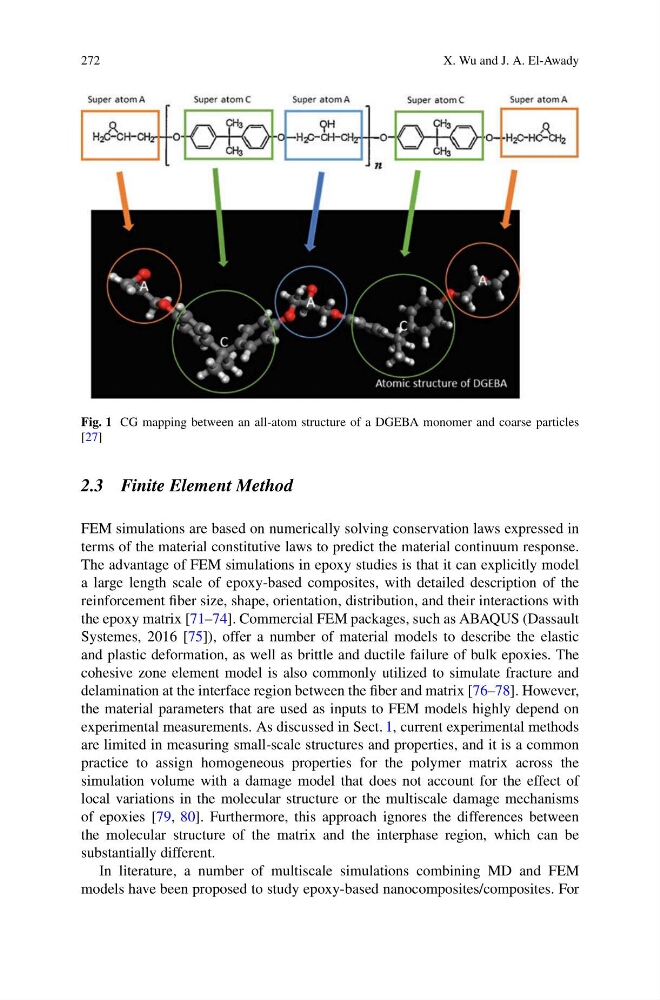
Fig. 1 CG mapping between an all-atom structure of a DGEBA monomer and coarse particles
[27]
2.3 Finite Element Method
FEM simulations are based on numerically solving conservation laws expressed in
terms of the material constitutive laws to predict the material continuum response.
The advantage of FEM simulations in epoxy studies is that it can explicitly model
a large length scale of epoxy-based composites, with detailed description of the
reinforcement fiber size, shape, orientation, distribution, and their interactions with
the epoxy matrix [71–74]. Commercial FEM packages, such as ABAQUS (Dassault
Systemes, 2016 [75]), offer a number of material models to describe the elastic
and plastic deformation, as well as brittle and ductile failure of bulk epoxies. The
cohesive zone element model is also commonly utilized to simulate fracture and
delamination at the interface region between the fiber and matrix [76–78]. However,
the material parameters that are used as inputs to FEM models highly depend on
experimental measurements. As discussed in Sect. 1, current experimental methods
are limited in measuring small-scale structures and properties, and it is a common
practice to assign homogeneous properties for the polymer matrix across the
simulation volume with a damage model that does not account for the effect of
local variations in the molecular structure or the multiscale damage mechanisms
of epoxies [79, 80]. Furthermore, this approach ignores the differences between
the molecular structure of the matrix and the interphase region, which can be
substantially different.
In literature, a number of multiscale simulations combining MD and FEM
models have been proposed to study epoxy-based nanocomposites/composites. For
X. Wu and J. A. El-Awady
Fig. 1 CG mapping between an all-atom structure of a DGEBA monomer and coarse particles
[27]
2.3 Finite Element Method
FEM simulations are based on numerically solving conservation laws expressed in
terms of the material constitutive laws to predict the material continuum response.
The advantage of FEM simulations in epoxy studies is that it can explicitly model
a large length scale of epoxy-based composites, with detailed description of the
reinforcement fiber size, shape, orientation, distribution, and their interactions with
the epoxy matrix [71–74]. Commercial FEM packages, such as ABAQUS (Dassault
Systemes, 2016 [75]), offer a number of material models to describe the elastic
and plastic deformation, as well as brittle and ductile failure of bulk epoxies. The
cohesive zone element model is also commonly utilized to simulate fracture and
delamination at the interface region between the fiber and matrix [76–78]. However,
the material parameters that are used as inputs to FEM models highly depend on
experimental measurements. As discussed in Sect. 1, current experimental methods
are limited in measuring small-scale structures and properties, and it is a common
practice to assign homogeneous properties for the polymer matrix across the
simulation volume with a damage model that does not account for the effect of
local variations in the molecular structure or the multiscale damage mechanisms
of epoxies [79, 80]. Furthermore, this approach ignores the differences between
the molecular structure of the matrix and the interphase region, which can be
substantially different.
In literature, a number of multiscale simulations combining MD and FEM
models have been proposed to study epoxy-based nanocomposites/composites. For