

270
X. Wu and J. A. El-Awady
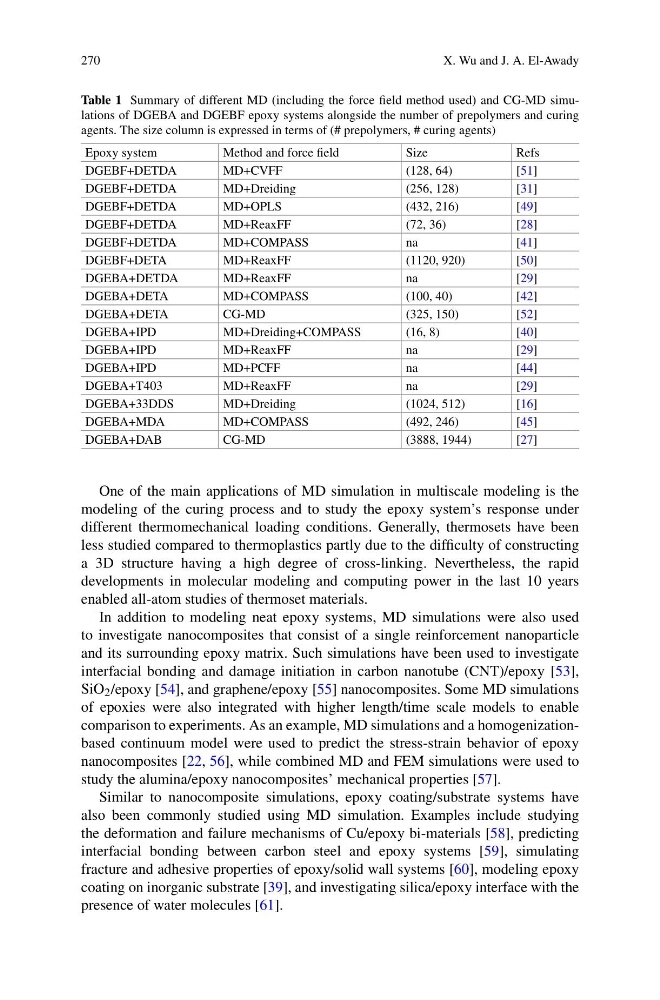
Table 1 Summary of different MD (including the force field method used) and CG-MD simulations of DGEBA and DGEBF epoxy systems alongside the number of prepolymers and curing
agents. The size column is expressed in terms of (# prepolymers, # curing agents)
Epoxy system
Method and force field
Size
Refs
DGEBF+DETDA
MD+CVFF
(128, 64)
[51]
DGEBF+DETDA
MD+Dreiding
(256, 128)
[31]
DGEBF+DETDA
MD+OPLS
(432, 216)
[49]
DGEBF+DETDA
MD+ReaxFF
(72, 36)
[28]
DGEBF+DETDA
MD+COMPASS
na
[41]
DGEBF+DETA
MD+ReaxFF
(1120, 920)
[50]
DGEBA+DETDA
MD+ReaxFF
na
[29]
DGEBA+DETA
MD+COMPASS
(100, 40)
[42]
DGEBA+DETA
CG-MD
(325, 150)
[52]
DGEBA+IPD
MD+Dreiding+COMPASS
(16, 8)
[40]
DGEBA+IPD
MD+ReaxFF
na
[29]
DGEBA+IPD
MD+PCFF
na
[44]
DGEBA+T403
MD+ReaxFF
na
[29]
DGEBA+33DDS
MD+Dreiding
(1024, 512)
[16]
DGEBA+MDA
MD+COMPASS
(492, 246)
[45]
DGEBA+DAB
CG-MD
(3888, 1944)
[27]
One of the main applications of MD simulation in multiscale modeling is the
modeling of the curing process and to study the epoxy system’s response under
different thermomechanical loading conditions. Generally, thermosets have been
less studied compared to thermoplastics partly due to the difficulty of constructing
a 3D structure having a high degree of cross-linking. Nevertheless, the rapid
developments in molecular modeling and computing power in the last 10 years
enabled all-atom studies of thermoset materials.
In addition to modeling neat epoxy systems, MD simulations were also used
to investigate nanocomposites that consist of a single reinforcement nanoparticle
and its surrounding epoxy matrix. Such simulations have been used to investigate
interfacial bonding and damage initiation in carbon nanotube (CNT)/epoxy [53],
SiO 2 /epoxy [54], and graphene/epoxy [55] nanocomposites. Some MD simulations
of epoxies were also integrated with higher length/time scale models to enable
comparison to experiments. As an example, MD simulations and a homogenizationbased continuum model were used to predict the stress-strain behavior of epoxy
nanocomposites [22, 56], while combined MD and FEM simulations were used to
study the alumina/epoxy nanocomposites’ mechanical properties [57].
Similar to nanocomposite simulations, epoxy coating/substrate systems have
also been commonly studied using MD simulation. Examples include studying
the deformation and failure mechanisms of Cu/epoxy bi-materials [58], predicting
interfacial bonding between carbon steel and epoxy systems [59], simulating
fracture and adhesive properties of epoxy/solid wall systems [60], modeling epoxy
coating on inorganic substrate [39], and investigating silica/epoxy interface with the
presence of water molecules [61].
X. Wu and J. A. El-Awady
Table 1 Summary of different MD (including the force field method used) and CG-MD simulations of DGEBA and DGEBF epoxy systems alongside the number of prepolymers and curing
agents. The size column is expressed in terms of (# prepolymers, # curing agents)
Epoxy system
Method and force field
Size
Refs
DGEBF+DETDA
MD+CVFF
(128, 64)
[51]
DGEBF+DETDA
MD+Dreiding
(256, 128)
[31]
DGEBF+DETDA
MD+OPLS
(432, 216)
[49]
DGEBF+DETDA
MD+ReaxFF
(72, 36)
[28]
DGEBF+DETDA
MD+COMPASS
na
[41]
DGEBF+DETA
MD+ReaxFF
(1120, 920)
[50]
DGEBA+DETDA
MD+ReaxFF
na
[29]
DGEBA+DETA
MD+COMPASS
(100, 40)
[42]
DGEBA+DETA
CG-MD
(325, 150)
[52]
DGEBA+IPD
MD+Dreiding+COMPASS
(16, 8)
[40]
DGEBA+IPD
MD+ReaxFF
na
[29]
DGEBA+IPD
MD+PCFF
na
[44]
DGEBA+T403
MD+ReaxFF
na
[29]
DGEBA+33DDS
MD+Dreiding
(1024, 512)
[16]
DGEBA+MDA
MD+COMPASS
(492, 246)
[45]
DGEBA+DAB
CG-MD
(3888, 1944)
[27]
One of the main applications of MD simulation in multiscale modeling is the
modeling of the curing process and to study the epoxy system’s response under
different thermomechanical loading conditions. Generally, thermosets have been
less studied compared to thermoplastics partly due to the difficulty of constructing
a 3D structure having a high degree of cross-linking. Nevertheless, the rapid
developments in molecular modeling and computing power in the last 10 years
enabled all-atom studies of thermoset materials.
In addition to modeling neat epoxy systems, MD simulations were also used
to investigate nanocomposites that consist of a single reinforcement nanoparticle
and its surrounding epoxy matrix. Such simulations have been used to investigate
interfacial bonding and damage initiation in carbon nanotube (CNT)/epoxy [53],
SiO 2 /epoxy [54], and graphene/epoxy [55] nanocomposites. Some MD simulations
of epoxies were also integrated with higher length/time scale models to enable
comparison to experiments. As an example, MD simulations and a homogenizationbased continuum model were used to predict the stress-strain behavior of epoxy
nanocomposites [22, 56], while combined MD and FEM simulations were used to
study the alumina/epoxy nanocomposites’ mechanical properties [57].
Similar to nanocomposite simulations, epoxy coating/substrate systems have
also been commonly studied using MD simulation. Examples include studying
the deformation and failure mechanisms of Cu/epoxy bi-materials [58], predicting
interfacial bonding between carbon steel and epoxy systems [59], simulating
fracture and adhesive properties of epoxy/solid wall systems [60], modeling epoxy
coating on inorganic substrate [39], and investigating silica/epoxy interface with the
presence of water molecules [61].