

254
D. Patel et al.
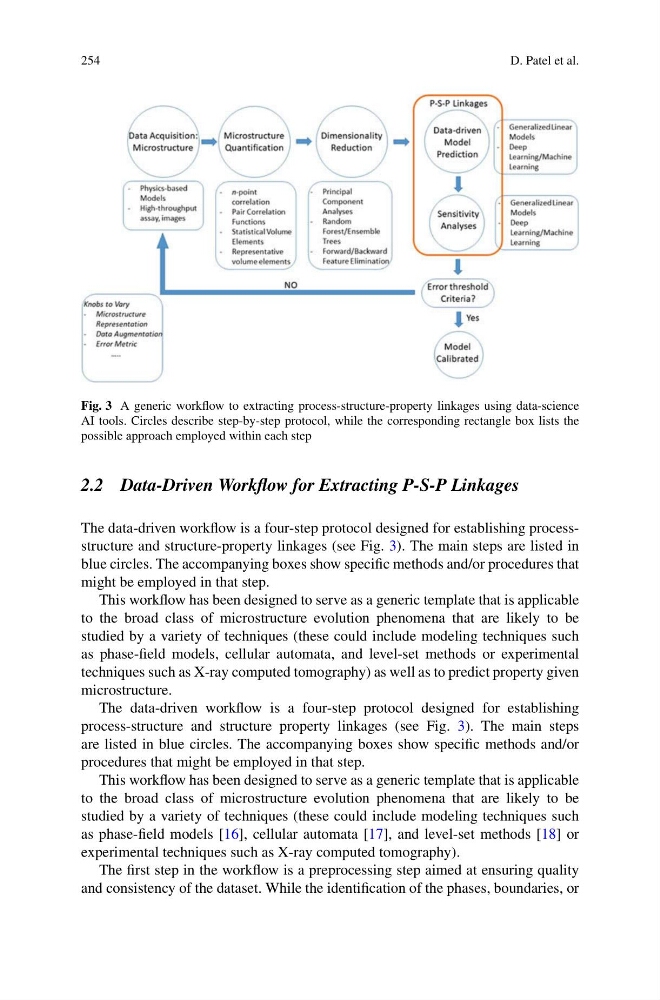
Fig. 3 A generic workflow to extracting process-structure-property linkages using data-science
AI tools. Circles describe step-by-step protocol, while the corresponding rectangle box lists the
possible approach employed within each step
2.2 Data-Driven Workflow for Extracting P-S-P Linkages
The data-driven workflow is a four-step protocol designed for establishing processstructure and structure-property linkages (see Fig. 3). The main steps are listed in
blue circles. The accompanying boxes show specific methods and/or procedures that
might be employed in that step.
This workflow has been designed to serve as a generic template that is applicable
to the broad class of microstructure evolution phenomena that are likely to be
studied by a variety of techniques (these could include modeling techniques such
as phase-field models, cellular automata, and level-set methods or experimental
techniques such as X-ray computed tomography) as well as to predict property given
microstructure.
The data-driven workflow is a four-step protocol designed for establishing
process-structure and structure property linkages (see Fig. 3). The main steps
are listed in blue circles. The accompanying boxes show specific methods and/or
procedures that might be employed in that step.
This workflow has been designed to serve as a generic template that is applicable
to the broad class of microstructure evolution phenomena that are likely to be
studied by a variety of techniques (these could include modeling techniques such
as phase-field models [16], cellular automata [17], and level-set methods [18] or
experimental techniques such as X-ray computed tomography).
The first step in the workflow is a preprocessing step aimed at ensuring quality
and consistency of the dataset. While the identification of the phases, boundaries, or
D. Patel et al.
Fig. 3 A generic workflow to extracting process-structure-property linkages using data-science
AI tools. Circles describe step-by-step protocol, while the corresponding rectangle box lists the
possible approach employed within each step
2.2 Data-Driven Workflow for Extracting P-S-P Linkages
The data-driven workflow is a four-step protocol designed for establishing processstructure and structure-property linkages (see Fig. 3). The main steps are listed in
blue circles. The accompanying boxes show specific methods and/or procedures that
might be employed in that step.
This workflow has been designed to serve as a generic template that is applicable
to the broad class of microstructure evolution phenomena that are likely to be
studied by a variety of techniques (these could include modeling techniques such
as phase-field models, cellular automata, and level-set methods or experimental
techniques such as X-ray computed tomography) as well as to predict property given
microstructure.
The data-driven workflow is a four-step protocol designed for establishing
process-structure and structure property linkages (see Fig. 3). The main steps
are listed in blue circles. The accompanying boxes show specific methods and/or
procedures that might be employed in that step.
This workflow has been designed to serve as a generic template that is applicable
to the broad class of microstructure evolution phenomena that are likely to be
studied by a variety of techniques (these could include modeling techniques such
as phase-field models [16], cellular automata [17], and level-set methods [18] or
experimental techniques such as X-ray computed tomography).
The first step in the workflow is a preprocessing step aimed at ensuring quality
and consistency of the dataset. While the identification of the phases, boundaries, or