

Material Agnostic Data-Driven Framework to Develop Structure-Property Linkages
251
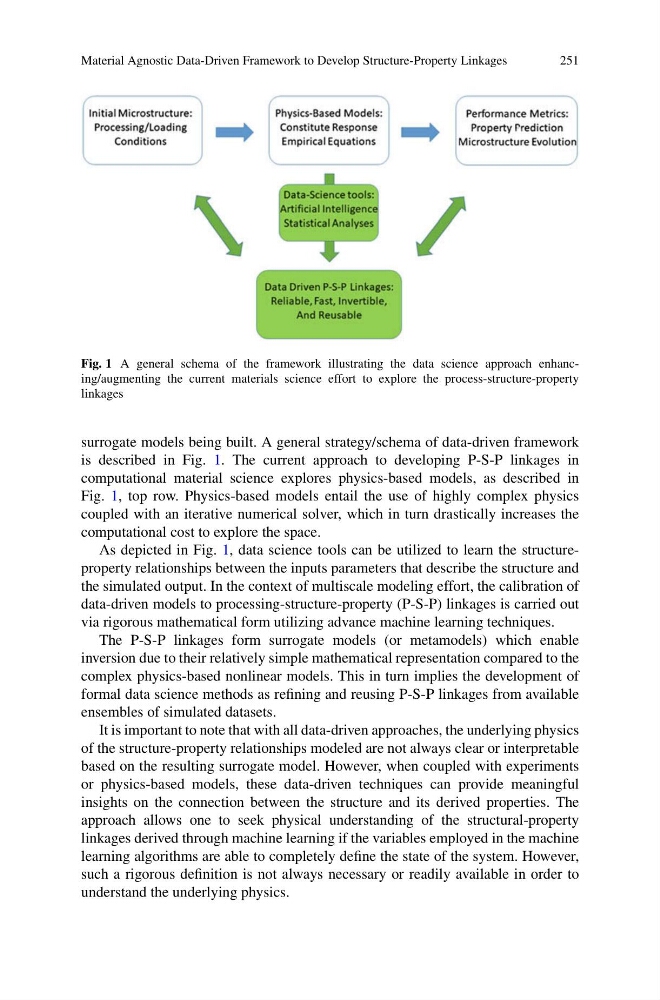
Fig. 1 A general schema of the framework illustrating the data science approach enhancing/augmenting the current materials science effort to explore the process-structure-property
linkages
surrogate models being built. A general strategy/schema of data-driven framework
is described in Fig. 1. The current approach to developing P-S-P linkages in
computational material science explores physics-based models, as described in
Fig. 1, top row. Physics-based models entail the use of highly complex physics
coupled with an iterative numerical solver, which in turn drastically increases the
computational cost to explore the space.
As depicted in Fig. 1, data science tools can be utilized to learn the structureproperty relationships between the inputs parameters that describe the structure and
the simulated output. In the context of multiscale modeling effort, the calibration of
data-driven models to processing-structure-property (P-S-P) linkages is carried out
via rigorous mathematical form utilizing advance machine learning techniques.
The P-S-P linkages form surrogate models (or metamodels) which enable
inversion due to their relatively simple mathematical representation compared to the
complex physics-based nonlinear models. This in turn implies the development of
formal data science methods as refining and reusing P-S-P linkages from available
ensembles of simulated datasets.
It is important to note that with all data-driven approaches, the underlying physics
of the structure-property relationships modeled are not always clear or interpretable
based on the resulting surrogate model. However, when coupled with experiments
or physics-based models, these data-driven techniques can provide meaningful
insights on the connection between the structure and its derived properties. The
approach allows one to seek physical understanding of the structural-property
linkages derived through machine learning if the variables employed in the machine
learning algorithms are able to completely define the state of the system. However,
such a rigorous definition is not always necessary or readily available in order to
understand the underlying physics.
251
Fig. 1 A general schema of the framework illustrating the data science approach enhancing/augmenting the current materials science effort to explore the process-structure-property
linkages
surrogate models being built. A general strategy/schema of data-driven framework
is described in Fig. 1. The current approach to developing P-S-P linkages in
computational material science explores physics-based models, as described in
Fig. 1, top row. Physics-based models entail the use of highly complex physics
coupled with an iterative numerical solver, which in turn drastically increases the
computational cost to explore the space.
As depicted in Fig. 1, data science tools can be utilized to learn the structureproperty relationships between the inputs parameters that describe the structure and
the simulated output. In the context of multiscale modeling effort, the calibration of
data-driven models to processing-structure-property (P-S-P) linkages is carried out
via rigorous mathematical form utilizing advance machine learning techniques.
The P-S-P linkages form surrogate models (or metamodels) which enable
inversion due to their relatively simple mathematical representation compared to the
complex physics-based nonlinear models. This in turn implies the development of
formal data science methods as refining and reusing P-S-P linkages from available
ensembles of simulated datasets.
It is important to note that with all data-driven approaches, the underlying physics
of the structure-property relationships modeled are not always clear or interpretable
based on the resulting surrogate model. However, when coupled with experiments
or physics-based models, these data-driven techniques can provide meaningful
insights on the connection between the structure and its derived properties. The
approach allows one to seek physical understanding of the structural-property
linkages derived through machine learning if the variables employed in the machine
learning algorithms are able to completely define the state of the system. However,
such a rigorous definition is not always necessary or readily available in order to
understand the underlying physics.