

6
M. P. Echlin et al.
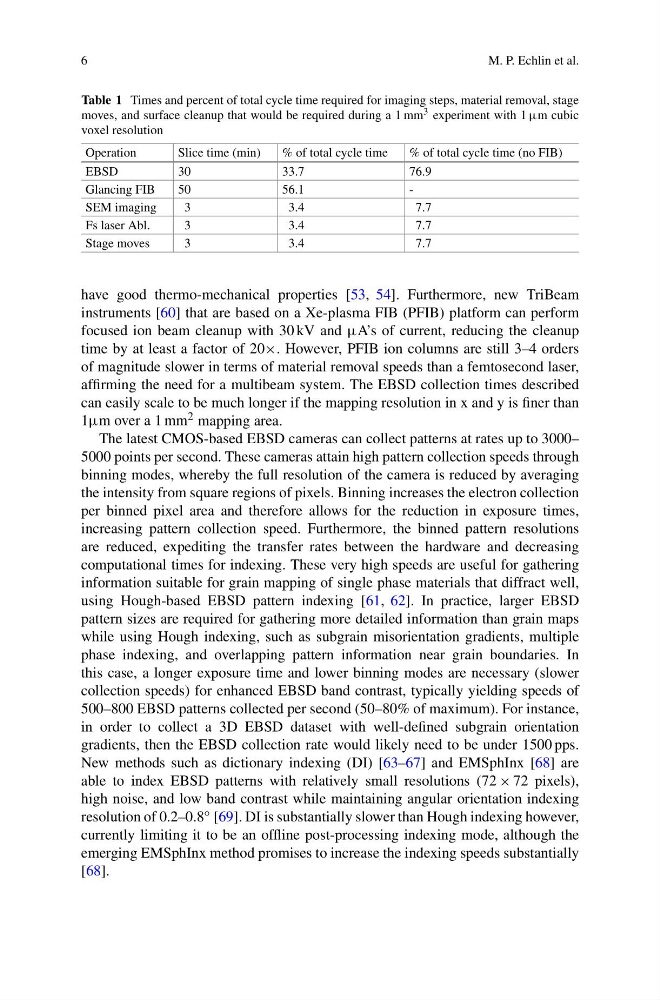
Table 1 Times and percent of total cycle time required for imaging steps, material removal, stage
moves, and surface cleanup that would be required during a 1 mm 3 experiment with 1 μm cubic
voxel resolution
Operation
Slice time (min)
% of total cycle time
% of total cycle time (no FIB)
EBSD
30
33.7
76.9
Glancing FIB
50
56.1
-
SEM imaging
3
3.4
7.7
Fs laser Abl.
3
3.4
7.7
Stage moves
3
3.4
7.7
have good thermo-mechanical properties [53, 54]. Furthermore, new TriBeam
instruments [60] that are based on a Xe-plasma FIB (PFIB) platform can perform
focused ion beam cleanup with 30 kV and μA’s of current, reducing the cleanup
time by at least a factor of 20×. However, PFIB ion columns are still 3–4 orders
of magnitude slower in terms of material removal speeds than a femtosecond laser,
affirming the need for a multibeam system. The EBSD collection times described
can easily scale to be much longer if the mapping resolution in x and y is finer than
1μm over a 1 mm 2 mapping area.
The latest CMOS-based EBSD cameras can collect patterns at rates up to 3000–
5000 points per second. These cameras attain high pattern collection speeds through
binning modes, whereby the full resolution of the camera is reduced by averaging
the intensity from square regions of pixels. Binning increases the electron collection
per binned pixel area and therefore allows for the reduction in exposure times,
increasing pattern collection speed. Furthermore, the binned pattern resolutions
are reduced, expediting the transfer rates between the hardware and decreasing
computational times for indexing. These very high speeds are useful for gathering
information suitable for grain mapping of single phase materials that diffract well,
using Hough-based EBSD pattern indexing [61, 62]. In practice, larger EBSD
pattern sizes are required for gathering more detailed information than grain maps
while using Hough indexing, such as subgrain misorientation gradients, multiple
phase indexing, and overlapping pattern information near grain boundaries. In
this case, a longer exposure time and lower binning modes are necessary (slower
collection speeds) for enhanced EBSD band contrast, typically yielding speeds of
500–800 EBSD patterns collected per second (50–80% of maximum). For instance,
in order to collect a 3D EBSD dataset with well-defined subgrain orientation
gradients, then the EBSD collection rate would likely need to be under 1500 pps.
New methods such as dictionary indexing (DI) [63–67] and EMSphInx [68] are
able to index EBSD patterns with relatively small resolutions (72 × 72 pixels),
high noise, and low band contrast while maintaining angular orientation indexing
resolution of 0.2–0.8 ◦ [69]. DI is substantially slower than Hough indexing however,
currently limiting it to be an offline post-processing indexing mode, although the
emerging EMSphInx method promises to increase the indexing speeds substantially
[68].
M. P. Echlin et al.
Table 1 Times and percent of total cycle time required for imaging steps, material removal, stage
moves, and surface cleanup that would be required during a 1 mm 3 experiment with 1 μm cubic
voxel resolution
Operation
Slice time (min)
% of total cycle time
% of total cycle time (no FIB)
EBSD
30
33.7
76.9
Glancing FIB
50
56.1
-
SEM imaging
3
3.4
7.7
Fs laser Abl.
3
3.4
7.7
Stage moves
3
3.4
7.7
have good thermo-mechanical properties [53, 54]. Furthermore, new TriBeam
instruments [60] that are based on a Xe-plasma FIB (PFIB) platform can perform
focused ion beam cleanup with 30 kV and μA’s of current, reducing the cleanup
time by at least a factor of 20×. However, PFIB ion columns are still 3–4 orders
of magnitude slower in terms of material removal speeds than a femtosecond laser,
affirming the need for a multibeam system. The EBSD collection times described
can easily scale to be much longer if the mapping resolution in x and y is finer than
1μm over a 1 mm 2 mapping area.
The latest CMOS-based EBSD cameras can collect patterns at rates up to 3000–
5000 points per second. These cameras attain high pattern collection speeds through
binning modes, whereby the full resolution of the camera is reduced by averaging
the intensity from square regions of pixels. Binning increases the electron collection
per binned pixel area and therefore allows for the reduction in exposure times,
increasing pattern collection speed. Furthermore, the binned pattern resolutions
are reduced, expediting the transfer rates between the hardware and decreasing
computational times for indexing. These very high speeds are useful for gathering
information suitable for grain mapping of single phase materials that diffract well,
using Hough-based EBSD pattern indexing [61, 62]. In practice, larger EBSD
pattern sizes are required for gathering more detailed information than grain maps
while using Hough indexing, such as subgrain misorientation gradients, multiple
phase indexing, and overlapping pattern information near grain boundaries. In
this case, a longer exposure time and lower binning modes are necessary (slower
collection speeds) for enhanced EBSD band contrast, typically yielding speeds of
500–800 EBSD patterns collected per second (50–80% of maximum). For instance,
in order to collect a 3D EBSD dataset with well-defined subgrain orientation
gradients, then the EBSD collection rate would likely need to be under 1500 pps.
New methods such as dictionary indexing (DI) [63–67] and EMSphInx [68] are
able to index EBSD patterns with relatively small resolutions (72 × 72 pixels),
high noise, and low band contrast while maintaining angular orientation indexing
resolution of 0.2–0.8 ◦ [69]. DI is substantially slower than Hough indexing however,
currently limiting it to be an offline post-processing indexing mode, although the
emerging EMSphInx method promises to increase the indexing speeds substantially
[68].